 Add to Chrome
 Add to Firefox
 Add to Edge
To Add Is Machine, To Delete Is Human: Measuring and Mitigating Deletion Avoidance in LLM Code Editing
Jul 30, 2026
Large language models increasingly write and repair production code, yet evidence is mounting that their test-passing patches leave codebases harder to maintain. We identify one concrete source: deletion avoidance, the systematic tendency to retain code that an intended edit requires removing. Across the five leading models on the official SWE-bench Verified leaderboard, deletion recall against the developer patch reaches at most 71.7% even on tasks all five solve, and models reach the right file for over 92% of required deletions but cut the exact line in under 52% of cases. Instead, 29.0% of passing patches wrap the targeted code in a guard or fallback, a pattern we call Guard-and-Go. Such patches pass because the original tests rarely check removal: when we retrofit 34 Verified tasks with tests that fail if the targeted code remains, four frontier models spanning closed and open weights fall from 63.2% to 41.9%. Because real repairs mix removal with addition, we curate CanItDelete, a benchmark of 200 tasks mined from real commits whose entire required edit is deletion. Even with the addition work gone, the best model still fails one task in five, and smaller open models fall to 18.0%. We then ablate GPT-5.6 Sol under four cumulative prompts; success moves little until we supply the exact lines, which nearly eliminate incomplete deletion yet raise success only to 80.5% because the model then deletes beyond the spans or adds code instead. Finally, through a pilot study we show one potential fix: teaching deletion during post-training reduces deletion avoidance and improves broader code-editing performance, suggesting the behavior is undertrained rather than beyond reach.

Data Quality Antipatterns for Software Analytics
Aug 22, 2024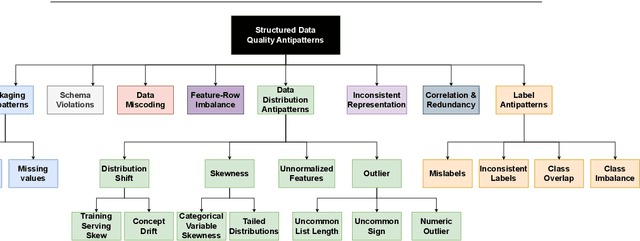


Background: Data quality is vital in software analytics, particularly for machine learning (ML) applications like software defect prediction (SDP). Despite the widespread use of ML in software engineering, the effect of data quality antipatterns on these models remains underexplored. Objective: This study develops a taxonomy of ML-specific data quality antipatterns and assesses their impact on software analytics models' performance and interpretation. Methods: We identified eight types and 14 sub-types of ML-specific data quality antipatterns through a literature review. We conducted experiments to determine the prevalence of these antipatterns in SDP data (RQ1), assess how cleaning order affects model performance (RQ2), evaluate the impact of antipattern removal on performance (RQ3), and examine the consistency of interpretation from models built with different antipatterns (RQ4). Results: In our SDP case study, we identified nine antipatterns. Over 90% of these overlapped at both row and column levels, complicating cleaning prioritization and risking excessive data removal. The order of cleaning significantly impacts ML model performance, with neural networks being more resilient to cleaning order changes than simpler models like logistic regression. Antipatterns such as Tailed Distributions and Class Overlap show a statistically significant correlation with performance metrics when other antipatterns are cleaned. Models built with different antipatterns showed moderate consistency in interpretation results. Conclusion: The cleaning order of different antipatterns impacts ML model performance. Five antipatterns have a statistically significant correlation with model performance when others are cleaned. Additionally, model interpretation is moderately affected by different data quality antipatterns.
Towards a Change Taxonomy for Machine Learning Systems
Mar 21, 2022
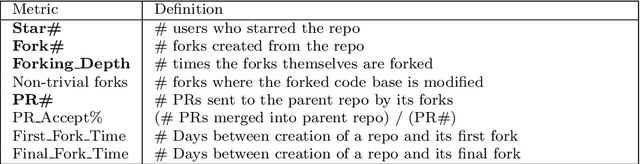
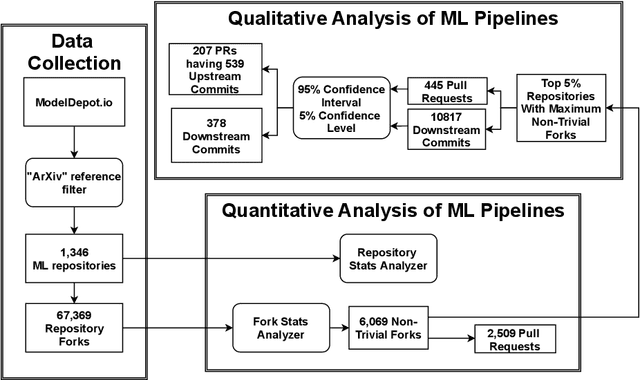
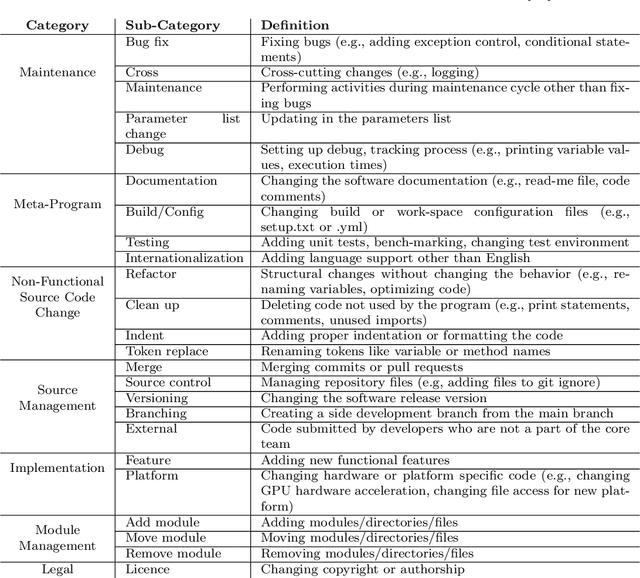
Machine Learning (ML) research publications commonly provide open-source implementations on GitHub, allowing their audience to replicate, validate, or even extend machine learning algorithms, data sets, and metadata. However, thus far little is known about the degree of collaboration activity happening on such ML research repositories, in particular regarding (1) the degree to which such repositories receive contributions from forks, (2) the nature of such contributions (i.e., the types of changes), and (3) the nature of changes that are not contributed back to forks, which might represent missed opportunities. In this paper, we empirically study contributions to 1,346 ML research repositories and their 67,369 forks, both quantitatively and qualitatively (by building on Hindle et al.'s seminal taxonomy of code changes). We found that while ML research repositories are heavily forked, only 9% of the forks made modifications to the forked repository. 42% of the latter sent changes to the parent repositories, half of which (52%) were accepted by the parent repositories. Our qualitative analysis on 539 contributed and 378 local (fork-only) changes, extends Hindle et al.'s taxonomy with one new top-level change category related to ML (Data), and 15 new sub-categories, including nine ML-specific ones (input data, output data, program data, sharing, change evaluation, parameter tuning, performance, pre-processing, model training). While the changes that are not contributed back by the forks mostly concern domain-specific customizations and local experimentation (e.g., parameter tuning), the origin ML repositories do miss out on a non-negligible 15.4% of Documentation changes, 13.6% of Feature changes and 11.4% of Bug fix changes. The findings in this paper will be useful for practitioners, researchers, toolsmiths, and educators.