 Add to Chrome
 Add to Firefox
 Add to Edge
Prof-K: Probabilistic One-Pass Filtering for Efficient Top-k Selection
Aug 12, 2026
Top-k selection is a fundamental computational primitive with applications spanning databases, information retrieval, signal processing, and modern machine learning workloads, including sparse activations and attention pruning. As data sizes grow, existing approaches become inefficient: exact methods incur high memory and compute overhead, while approximate methods often rely on brittle heuristics that degrade under adversarial or heavy-tailed inputs. In this paper, we introduce Prof-K, a fast, scalable, and distribution-agnostic top-k algorithm with probabilistic correctness guarantees. Prof-K performs a single-pass filtering procedure: a small random sample estimates an adaptive threshold, the N input elements are streamed once into a compact buffer, and an exact top-k routine on this buffer recovers the true top-k elements with probability at least 1 - $ε$, where $ε$ > 0 is user specified. We derive high-probability guarantees for correctness and buffer size, together with an approximately optimal sample size that minimizes overhead as a function of N and k. Empirically, Prof-K achieves 1.5x-10x speedups over the highly optimized PyTorch topk and recent RadiK implementations, with the largest gains in the large-scale, small-to-moderate-k regime where prior methods struggle most. Unlike previous approaches, these guarantees hold independently of the input distribution, ensuring robustness to adversarial settings. By relaxing the recall target (e.g., recovering 95% of the true top-k values), Prof-K additionally provides a principled accuracy-speed trade-off. We further demonstrate its impact on training BatchTopK Sparse Autoencoders (SAEs), where top-k selection constitutes a significant portion of the training cost.

Fast LapSum: Exact Differentiable Top-k at Million Scale
Aug 07, 2026The top-$k$ operation is a fundamental building block of modern sparse computation, enabling token routing, expert activation, memory selection, and attention pruning. Yet standard hard top-$k$ blocks gradients, while existing continuous (soft) relaxations remain too costly for large-scale models. We introduce Fast LapSum, an exact-budget soft top-$k$ primitive whose GPU solver runs in linear time after sorting. Unlike prior linear-time methods such as DFTopK, which relax the normalization constraint, Fast LapSum is, to our knowledge, the first method to preserve an exact selection mass of $k$ while remaining fully differentiable end-to-end. Our solver combines a linear-time threshold computation with an analytical vector--Jacobian product, and for extreme scales employs probabilistic bracketing to sort only the uncertain middle band of kernel-noised scores. The resulting overhead is almost negligible: the solver processes $10^6$, $10^7$, and $10^8$ scores in $0.41$, $1.15$, and $5.23$\,ms, respectively. This makes exact soft top-$k$ practical for sparse routing, retrieval, and large-scale optimization. We demonstrate Fast LapSum on two demanding applications operating over millions of coordinates inside the training loop: generating megapixel sparse adversarial examples with an exact soft budget of ${\sim}0.02\%$ of an image's pixels, achieving an order-of-magnitude speedup over state-of-the-art methods, and training a fully differentiable sparse image coder from scratch.
LaPrune: Controllable Differentiable Sparsity at Million Scale
Aug 04, 2026Top-$k$ selection determines which components of a sparse model remain active. Hard selection blocks gradients, while continuous relaxations often couple mask hardness to the selected mass. We introduce LaPrune, a mathematically exact-budget differentiable layer that controls the normalized second moment while preserving the selected mass. A LapSum barrier preserves the selection mass, and a normalized second-moment constraint moves the mask from a dense equal-mass allocation toward hard top-$k$ at each budget. We derive a population prediction of the saturated fraction, a near-binary limiting law, and a tight worst-case guarantee on the near-zero fraction. The normalized hardness parameter is invariant to score scale, while a fixed LapSum temperature is not.
What Pixels Are Enough? SEAMS: Sufficiency Saliency via MSE-Preservation Soft-Masks
Jul 10, 2026Saliency maps are most useful when they identify the image regions that are sufficient to preserve a model's behaviour. We introduce SEAMS, a sufficiency-based saliency method that directly optimises a soft mask using a preservation objective. Given a frozen differentiable model output, such as a class probability, CLS embedding, or token representation, SEAMS searches for a compact mask that preserves the selected output. The approach relies on a simple optimisation framework based on soft masks, a learnable budget, and a three-way image composite generated entirely from the query image. As a result, it requires no auxiliary distractor dataset, architecture-specific attribution mechanism, or differentiable top-k relaxation. Experiments with frozen ViT-S/16 and ConvNeXt models show that the same optimisation pipeline can generate object-level, class-conditioned, and token-level explanations by changing only the preserved target. The resulting masks are compact, interpretable, stable across random initialisations, and competitive on insertion and deletion benchmarks. Our results also indicate that different architectures often rely on different sufficient evidence while achieving similar preservation fidelity, highlighting the architecture-dependent nature of visual explanations.
SoftMoE: Soft Differentiable Routing for Mixture-of-Experts in LLMs
Jun 16, 2026Sparse Mixture-of-Experts (MoE) architectures enable scaling LLM parameters under a fixed inference budget by activating only a small subset of experts via top-$k$ routing. While this preserves causality and suits autoregressive language models, the discrete top-$k$ operator is not differentiable, forcing a fixed number of active experts per input and resulting in inefficient use of computation. We propose SoftMoE, which replaces discrete routing with a truncated soft top-$k$ LapSum relaxation, allowing gradient-based optimization of expert routing. We further parameterize the mean number of active experts per layer and impose a global budget constraint, enabling the model to learn how to allocate expert capacity across layers. SoftMoE remains fully compatible with autoregressive modeling and achieves performance comparable to or better than sparse MoE on language modeling and downstream tasks, while activating significantly fewer experts. Notably, the learned allocation is highly non-uniform, with later layers activating more experts. The source code is publicly available$^\dagger$.
LAPLEX: The FFT of Learnable Laplace Kernels
May 23, 2026Fast linear algebra in deep learning usually comes with a choice: fixed geometry and exact computation, as in the Fourier transform, or adaptive geometry paid for by dense parameters, random features, or low-rank surrogates. To move beyond this trade-off, we introduce LAPLEX, a class of exact, trainable (phased) Laplace-kernel operators. A LAPLEX layer is a typically full-rank dense matrix, implicitly defined by learnable coordinate anchors, with FFT-like scaling. Consequently, it supports trainable matrix--vector operations at vector dimensions up to $10^9$ on modern GPUs. As a neural layer, it yields compact projections and classification heads interpretable as soft, trainable routing models. The same primitive also serves as an efficient Gram operator, enabling high-dimensional covariance models on flattened images of dimension $3 \cdot 10^6$ that preserve visible spatial structure without imposing convolutional bias. These applications reflect a single principle: dense geometry can be learned without storing a dense matrix, which enables data-adaptive global interactions in regimes where ordinary dense layers are out of reach. In this sense, LAPLEX separates expressivity from storage cost: it behaves like a dense trainable matrix, but is represented and applied through a small structured set of parameters.
Conceptualizing Embeddings: Sparse Disentanglement for Vision-Language Models
May 21, 2026Vision-language models learn powerful multimodal embeddings, yet their internal semantics remain opaque. While sparse autoencoders (SAEs) can extract interpretable features, they rely on expanding the representation dimension, which compromises the original geometry and introduces redundancy. We introduce CEDAR (Conceptual Embedding Disentanglement via Adaptive Rotation), a post-hoc method that reveals the compositional structure of pretrained embeddings without increasing dimensionality. By learning an invertible transformation with a top-$k$ sparsity bottleneck, CEDAR concentrates semantic information into axis-aligned disentangled coordinates. In CLIP-like architecture, individual coordinates can be interpreted with textual concepts, while for generative models such as BLIP, they can be decoded into natural language descriptions. Experiments demonstrate that CEDAR achieves a competitive reconstruction-sparsity trade-off while producing explanations that are more interpretable and better aligned with human perception. Our results suggest that the apparent entanglement in vision-language representations can be resolved through a suitable change of basis, eliminating the need for overcomplete expansions.
Stop Marginalizing My Dreams: Model Inversion via Laplace Kernel for Continual Learning
May 12, 2026Data-free continual learning (DFCIL) relies on model inversion to synthesize pseudo-samples and mitigate catastrophic forgetting. However, existing inversion methods are fundamentally limited by a simplifying assumption: they model feature distributions using diagonal covariance, effectively ignoring correlations that define the geometry of learned representations. As a result, synthesized samples often lack fidelity, limiting knowledge retention. In this work, we show that modeling feature dependencies is a key ingredient for effective DFCIL. We introduce REMIX, a structured covariance modeling framework that enables scalable full-covariance modeling without the prohibitive cost of dense matrix inversion and log-determinant computation. By leveraging a Laplace kernel parameterization, REMIX captures structured feature dependencies using memory that scales linearly with the feature dimensionality, while requiring only an additional logarithmic factor in computation. Modeling these correlations produces more coherent synthetic samples and consistently improves performance across standard DFCIL benchmarks. Our results demonstrate that moving beyond diagonal assumptions is essential for effective and scalable data-free continual learning. Our code is available at https://github. com/pkrukowski1/REMIX-Model-Inversion-via-Laplace-Kernel.
EPIC: Explanation of Pretrained Image Classification Networks via Prototype
May 19, 2025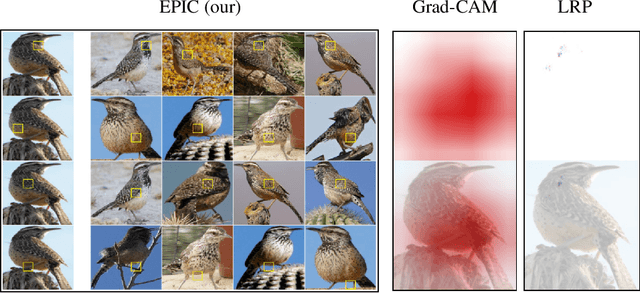
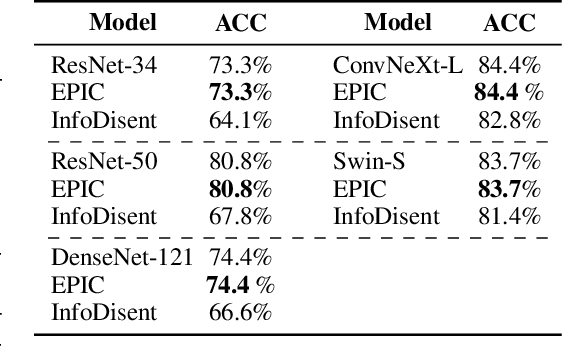
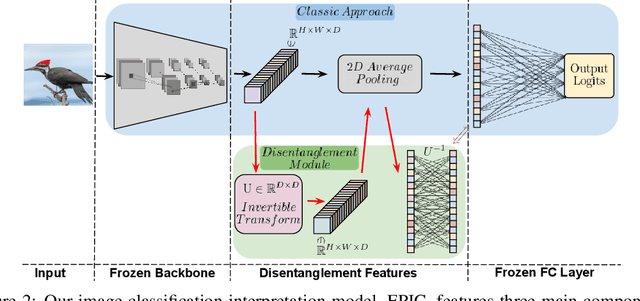
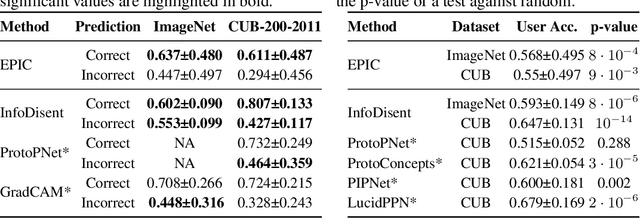
Explainable AI (XAI) methods generally fall into two categories. Post-hoc approaches generate explanations for pre-trained models and are compatible with various neural network architectures. These methods often use feature importance visualizations, such as saliency maps, to indicate which input regions influenced the model's prediction. Unfortunately, they typically offer a coarse understanding of the model's decision-making process. In contrast, ante-hoc (inherently explainable) methods rely on specially designed model architectures trained from scratch. A notable subclass of these methods provides explanations through prototypes, representative patches extracted from the training data. However, prototype-based approaches have limitations: they require dedicated architectures, involve specialized training procedures, and perform well only on specific datasets. In this work, we propose EPIC (Explanation of Pretrained Image Classification), a novel approach that bridges the gap between these two paradigms. Like post-hoc methods, EPIC operates on pre-trained models without architectural modifications. Simultaneously, it delivers intuitive, prototype-based explanations inspired by ante-hoc techniques. To the best of our knowledge, EPIC is the first post-hoc method capable of fully replicating the core explanatory power of inherently interpretable models. We evaluate EPIC on benchmark datasets commonly used in prototype-based explanations, such as CUB-200-2011 and Stanford Cars, alongside large-scale datasets like ImageNet, typically employed by post-hoc methods. EPIC uses prototypes to explain model decisions, providing a flexible and easy-to-understand tool for creating clear, high-quality explanations.
LapSum -- One Method to Differentiate Them All: Ranking, Sorting and Top-k Selection
Mar 08, 2025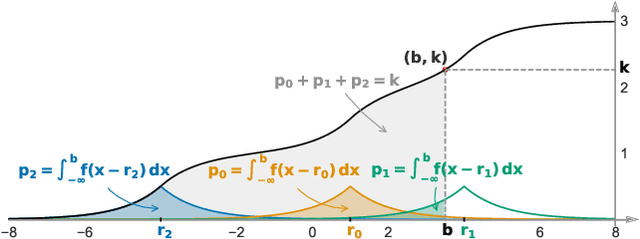
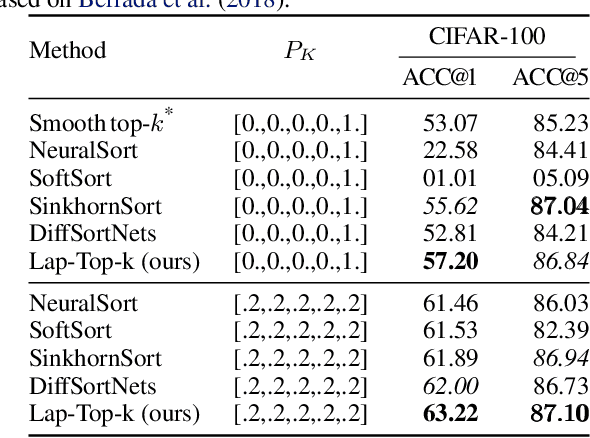
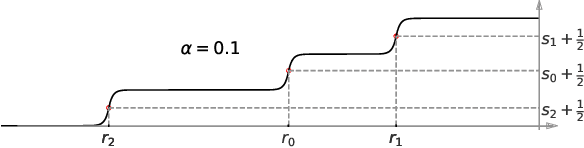
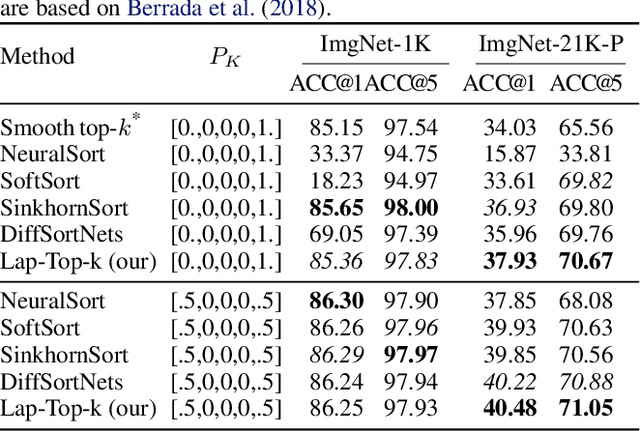
We present a novel technique for constructing differentiable order-type operations, including soft ranking, soft top-k selection, and soft permutations. Our approach leverages an efficient closed-form formula for the inverse of the function LapSum, defined as the sum of Laplace distributions. This formulation ensures low computational and memory complexity in selecting the highest activations, enabling losses and gradients to be computed in $O(n\log{}n)$ time. Through extensive experiments, we demonstrate that our method outperforms state-of-the-art techniques for high-dimensional vectors and large $k$ values. Furthermore, we provide efficient implementations for both CPU and CUDA environments, underscoring the practicality and scalability of our method for large-scale ranking and differentiable ordering problems.