 Add to Chrome
 Add to Firefox
 Add to Edge
Sewer Ml
Papers and Code
Evaluating Time Series Models for Urban Wastewater Management: Predictive Performance, Model Complexity and Resilience
Apr 24, 2025
Climate change increases the frequency of extreme rainfall, placing a significant strain on urban infrastructures, especially Combined Sewer Systems (CSS). Overflows from overburdened CSS release untreated wastewater into surface waters, posing environmental and public health risks. Although traditional physics-based models are effective, they are costly to maintain and difficult to adapt to evolving system dynamics. Machine Learning (ML) approaches offer cost-efficient alternatives with greater adaptability. To systematically assess the potential of ML for modeling urban infrastructure systems, we propose a protocol for evaluating Neural Network architectures for CSS time series forecasting with respect to predictive performance, model complexity, and robustness to perturbations. In addition, we assess model performance on peak events and critical fluctuations, as these are the key regimes for urban wastewater management. To investigate the feasibility of lightweight models suitable for IoT deployment, we compare global models, which have access to all information, with local models, which rely solely on nearby sensor readings. Additionally, to explore the security risks posed by network outages or adversarial attacks on urban infrastructure, we introduce error models that assess the resilience of models. Our results demonstrate that while global models achieve higher predictive performance, local models provide sufficient resilience in decentralized scenarios, ensuring robust modeling of urban infrastructure. Furthermore, models with longer native forecast horizons exhibit greater robustness to data perturbations. These findings contribute to the development of interpretable and reliable ML solutions for sustainable urban wastewater management. The implementation is available in our GitHub repository.

Self-Supervised Anomaly Detection in the Wild: Favor Joint Embeddings Methods
Oct 05, 2024Accurate anomaly detection is critical in vision-based infrastructure inspection, where it helps prevent costly failures and enhances safety. Self-Supervised Learning (SSL) offers a promising approach by learning robust representations from unlabeled data. However, its application in anomaly detection remains underexplored. This paper addresses this gap by providing a comprehensive evaluation of SSL methods for real-world anomaly detection, focusing on sewer infrastructure. Using the Sewer-ML dataset, we evaluate lightweight models such as ViT-Tiny and ResNet-18 across SSL frameworks, including BYOL, Barlow Twins, SimCLR, DINO, and MAE, under varying class imbalance levels. Through 250 experiments, we rigorously assess the performance of these SSL methods to ensure a robust and comprehensive evaluation. Our findings highlight the superiority of joint-embedding methods like SimCLR and Barlow Twins over reconstruction-based approaches such as MAE, which struggle to maintain performance under class imbalance. Furthermore, we find that the SSL model choice is more critical than the backbone architecture. Additionally, we emphasize the need for better label-free assessments of SSL representations, as current methods like RankMe fail to adequately evaluate representation quality, making cross-validation without labels infeasible. Despite the remaining performance gap between SSL and supervised models, these findings highlight the potential of SSL to enhance anomaly detection, paving the way for further research in this underexplored area of SSL applications.
Multi-label Sewer Pipe Defect Recognition with Mask Attention Feature Enhancement and Label Correlation Learning
Aug 01, 2024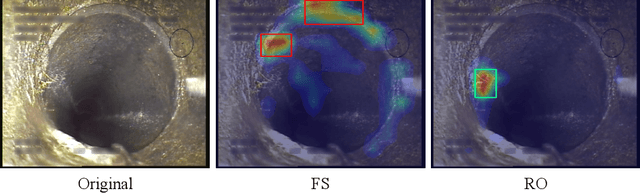
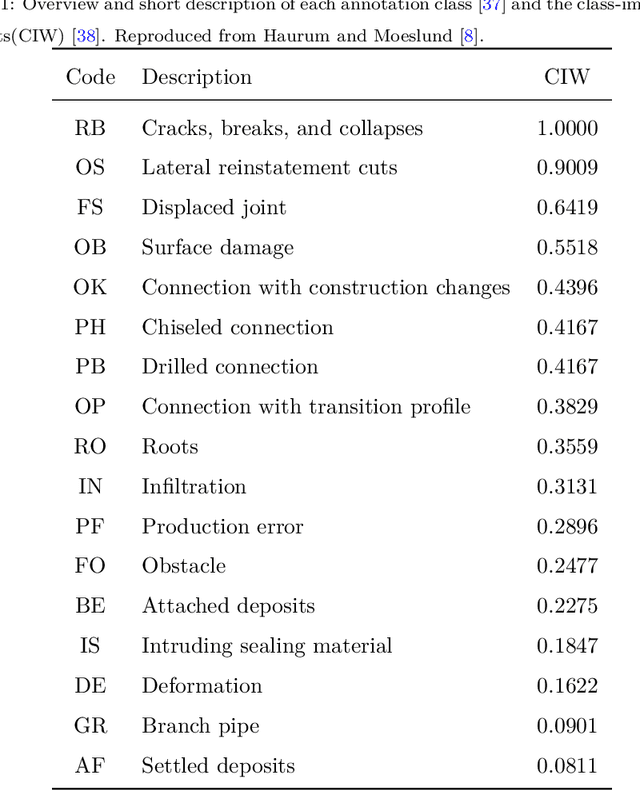
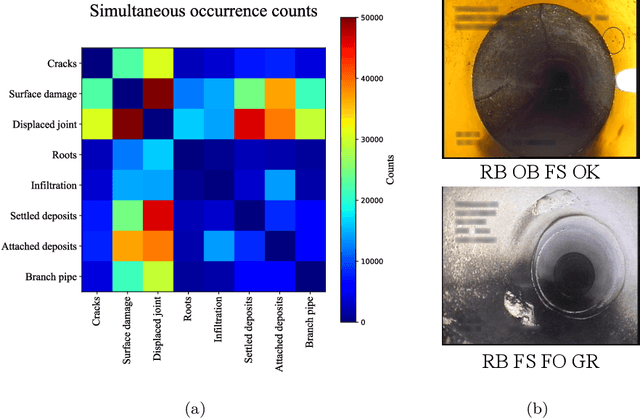

The coexistence of multiple defect categories as well as the substantial class imbalance problem significantly impair the detection of sewer pipeline defects. To solve this problem, a multi-label pipe defect recognition method is proposed based on mask attention guided feature enhancement and label correlation learning. The proposed method can achieve current approximate state-of-the-art classification performance using just 1/16 of the Sewer-ML training dataset and exceeds the current best method by 11.87\% in terms of F2 metric on the full dataset, while also proving the superiority of the model. The major contribution of this study is the development of a more efficient model for identifying and locating multiple defects in sewer pipe images for a more accurate sewer pipeline condition assessment. Moreover, by employing class activation maps, our method can accurately pinpoint multiple defect categories in the image which demonstrates a strong model interpretability. Our code is available at \href{https://github.com/shengyu27/MA-Q2L}{\textcolor{black}{https://github.com/shengyu27/MA-Q2L.}
Sewer Image Super-Resolution with Depth Priors and Its Lightweight Network
Jul 27, 2024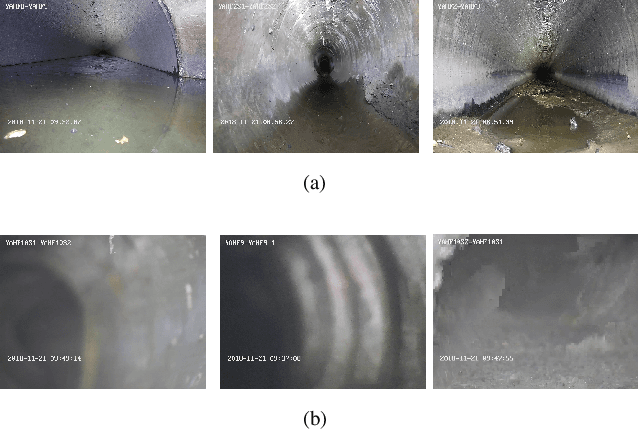
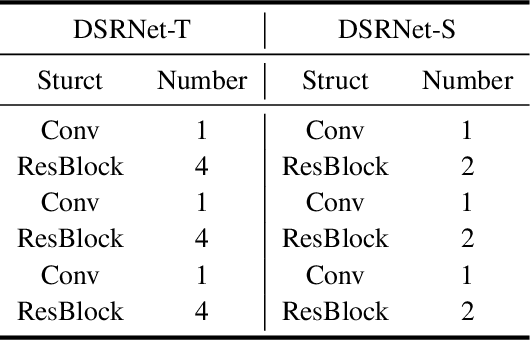
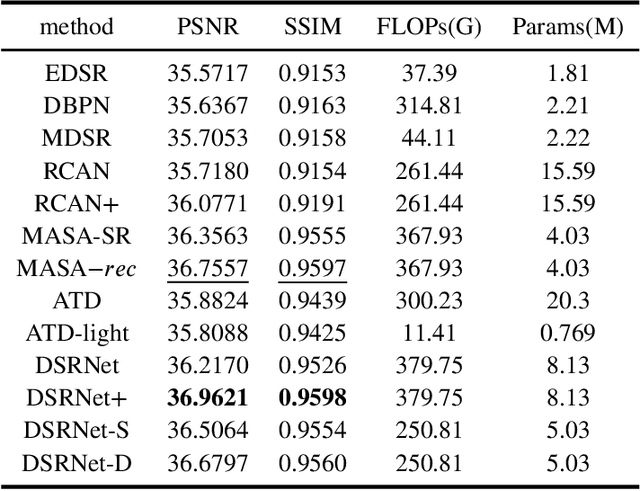
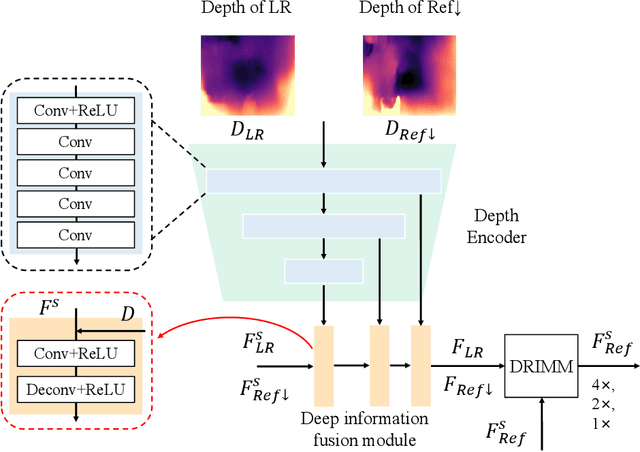
The Quick-view (QV) technique serves as a primary method for detecting defects within sewerage systems. However, the effectiveness of QV is impeded by the limited visual range of its hardware, resulting in suboptimal image quality for distant portions of the sewer network. Image super-resolution is an effective way to improve image quality and has been applied in a variety of scenes. However, research on super-resolution for sewer images remains considerably unexplored. In response, this study leverages the inherent depth relationships present within QV images and introduces a novel Depth-guided, Reference-based Super-Resolution framework denoted as DSRNet. It comprises two core components: a depth extraction module and a depth information matching module (DMM). DSRNet utilizes the adjacent frames of the low-resolution image as reference images and helps them recover texture information based on the correlation. By combining these modules, the integration of depth priors significantly enhances both visual quality and performance benchmarks. Besides, in pursuit of computational efficiency and compactness, our paper introduces a super-resolution knowledge distillation model based on an attention mechanism. This mechanism facilitates the acquisition of feature similarity between a more complex teacher model and a streamlined student model, the latter being a lightweight version of DSRNet. Experimental results demonstrate that DSRNet significantly improves PSNR and SSIM compared with other methods. This study also conducts experiments on sewer defect semantic segmentation, object detection, and classification on the Pipe dataset and Sewer-ML dataset. Experiments show that the method can improve the performance of low-resolution sewer images in these tasks.
Multi-Task Classification of Sewer Pipe Defects and Properties using a Cross-Task Graph Neural Network Decoder
Nov 15, 2021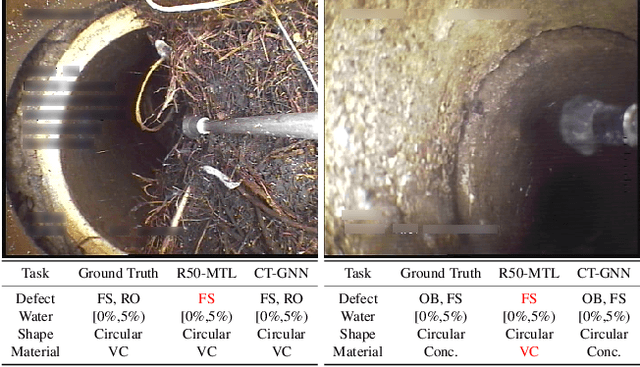
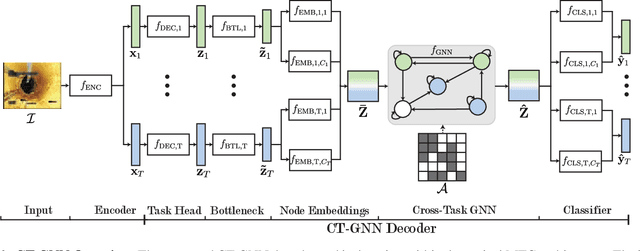
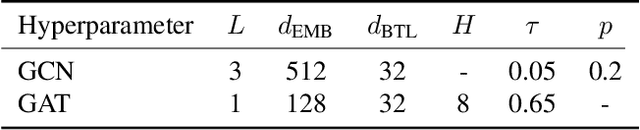
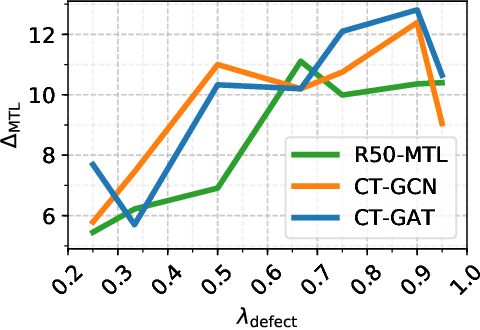
The sewerage infrastructure is one of the most important and expensive infrastructures in modern society. In order to efficiently manage the sewerage infrastructure, automated sewer inspection has to be utilized. However, while sewer defect classification has been investigated for decades, little attention has been given to classifying sewer pipe properties such as water level, pipe material, and pipe shape, which are needed to evaluate the level of sewer pipe deterioration. In this work we classify sewer pipe defects and properties concurrently and present a novel decoder-focused multi-task classification architecture Cross-Task Graph Neural Network (CT-GNN), which refines the disjointed per-task predictions using cross-task information. The CT-GNN architecture extends the traditional disjointed task-heads decoder, by utilizing a cross-task graph and unique class node embeddings. The cross-task graph can either be determined a priori based on the conditional probability between the task classes or determined dynamically using self-attention. CT-GNN can be added to any backbone and trained end-to-end at a small increase in the parameter count. We achieve state-of-the-art performance on all four classification tasks in the Sewer-ML dataset, improving defect classification and water level classification by 5.3 and 8.0 percentage points, respectively. We also outperform the single task methods as well as other multi-task classification approaches while introducing 50 times fewer parameters than previous model-focused approaches. The code and models are available at the project page http://vap.aau.dk/ctgnn
Sewer-ML: A Multi-Label Sewer Defect Classification Dataset and Benchmark
Mar 19, 2021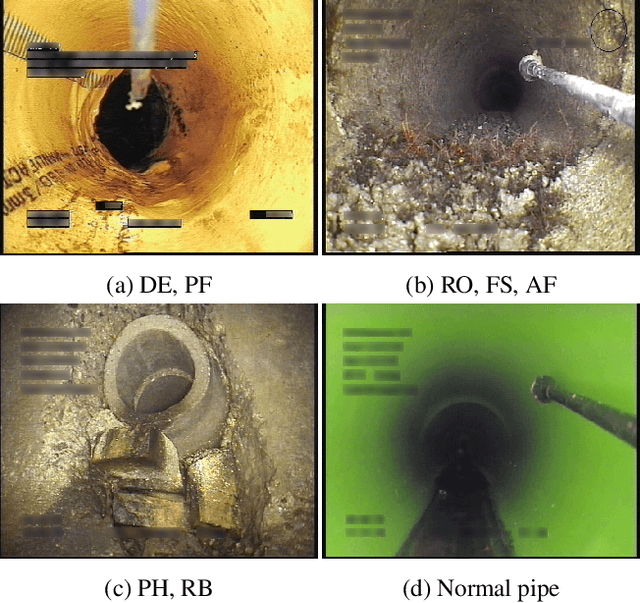
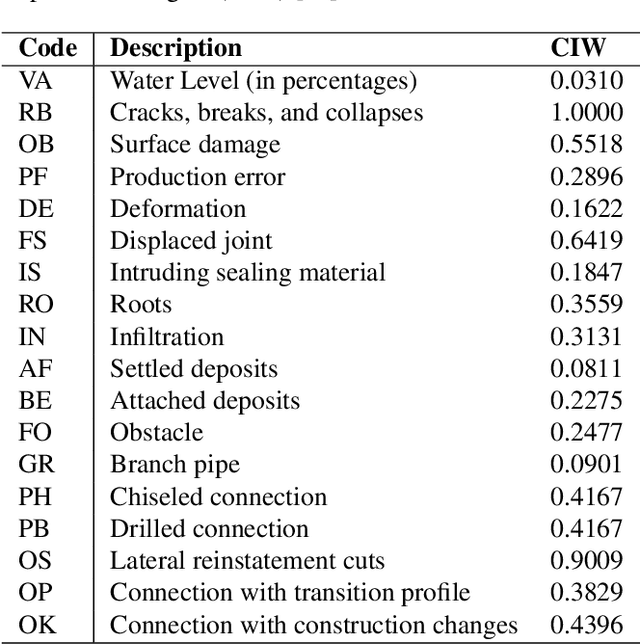
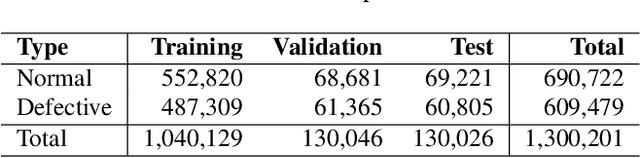
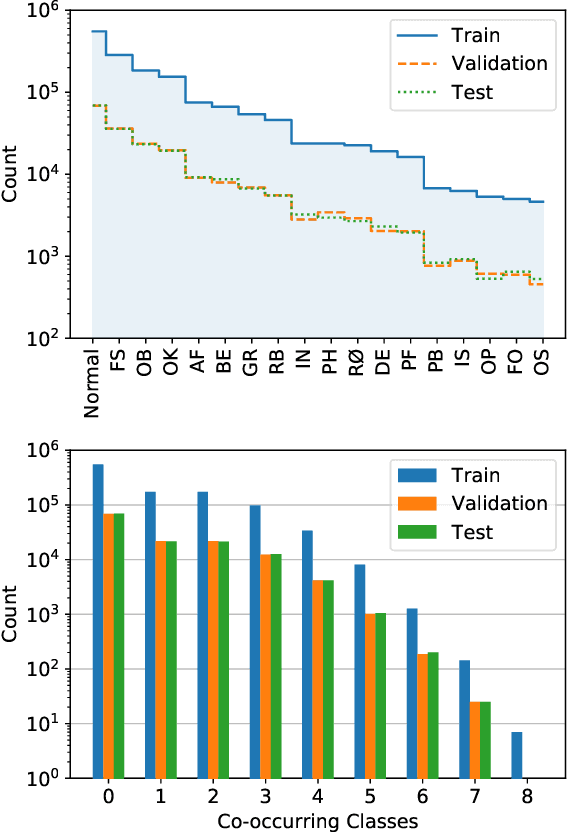
Perhaps surprisingly sewerage infrastructure is one of the most costly infrastructures in modern society. Sewer pipes are manually inspected to determine whether the pipes are defective. However, this process is limited by the number of qualified inspectors and the time it takes to inspect a pipe. Automatization of this process is therefore of high interest. So far, the success of computer vision approaches for sewer defect classification has been limited when compared to the success in other fields mainly due to the lack of public datasets. To this end, in this work we present a large novel and publicly available multi-label classification dataset for image-based sewer defect classification called Sewer-ML. The Sewer-ML dataset consists of 1.3 million images annotated by professional sewer inspectors from three different utility companies across nine years. Together with the dataset, we also present a benchmark algorithm and a novel metric for assessing performance. The benchmark algorithm is a result of evaluating 12 state-of-the-art algorithms, six from the sewer defect classification domain and six from the multi-label classification domain, and combining the best performing algorithms. The novel metric is a class-importance weighted F2 score, $\text{F}2_{\text{CIW}}$, reflecting the economic impact of each class, used together with the normal pipe F1 score, $\text{F}1_{\text{Normal}}$. The benchmark algorithm achieves an $\text{F}2_{\text{CIW}}$ score of 55.11% and $\text{F}1_{\text{Normal}}$ score of 90.94%, leaving ample room for improvement on the Sewer-ML dataset. The code, models, and dataset are available at the project page https://vap.aau.dk/sewer-ml/