 Add to Chrome
 Add to Firefox
 Add to Edge
Mmse Hr
Papers and Code
Phase-shifted remote photoplethysmography for estimating heart rate and blood pressure from facial video
Jan 09, 2024
Human health can be critically affected by cardiovascular diseases, such as hypertension, arrhythmias, and stroke. Heart rate and blood pressure are important biometric information for the monitoring of cardiovascular system and early diagnosis of cardiovascular diseases. Existing methods for estimating the heart rate are based on electrocardiography and photoplethyomography, which require contacting the sensor to the skin surface. Moreover, catheter and cuff-based methods for measuring blood pressure cause inconvenience and have limited applicability. Therefore, in this thesis, we propose a vision-based method for estimating the heart rate and blood pressure. This thesis proposes a 2-stage deep learning framework consisting of a dual remote photoplethysmography network (DRP-Net) and bounded blood pressure network (BBP-Net). In the first stage, DRP-Net infers remote photoplethysmography (rPPG) signals for the acral and facial regions, and these phase-shifted rPPG signals are utilized to estimate the heart rate. In the second stage, BBP-Net integrates temporal features and analyzes phase discrepancy between the acral and facial rPPG signals to estimate SBP and DBP values. To improve the accuracy of estimating the heart rate, we employed a data augmentation method based on a frame interpolation model. Moreover, we designed BBP-Net to infer blood pressure within a predefined range by incorporating a scaled sigmoid function. Our method resulted in estimating the heart rate with the mean absolute error (MAE) of 1.78 BPM, reducing the MAE by 34.31 % compared to the recent method, on the MMSE-HR dataset. The MAE for estimating the systolic blood pressure (SBP) and diastolic blood pressure (DBP) were 10.19 mmHg and 7.09 mmHg. On the V4V dataset, the MAE for the heart rate, SBP, and DBP were 3.83 BPM, 13.64 mmHg, and 9.4 mmHg, respectively.

EVM-CNN: Real-Time Contactless Heart Rate Estimation from Facial Video
Dec 25, 2022With the increase in health consciousness, noninvasive body monitoring has aroused interest among researchers. As one of the most important pieces of physiological information, researchers have remotely estimated the heart rate (HR) from facial videos in recent years. Although progress has been made over the past few years, there are still some limitations, like the processing time increasing with accuracy and the lack of comprehensive and challenging datasets for use and comparison. Recently, it was shown that HR information can be extracted from facial videos by spatial decomposition and temporal filtering. Inspired by this, a new framework is introduced in this paper to remotely estimate the HR under realistic conditions by combining spatial and temporal filtering and a convolutional neural network. Our proposed approach shows better performance compared with the benchmark on the MMSE-HR dataset in terms of both the average HR estimation and short-time HR estimation. High consistency in short-time HR estimation is observed between our method and the ground truth.
Real-Time Monitoring of User Stress, Heart Rate and Heart Rate Variability on Mobile Devices
Oct 04, 2022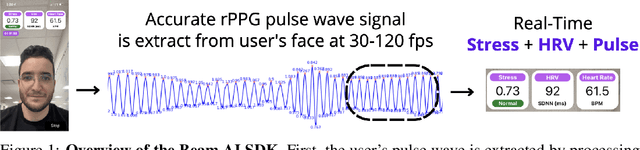
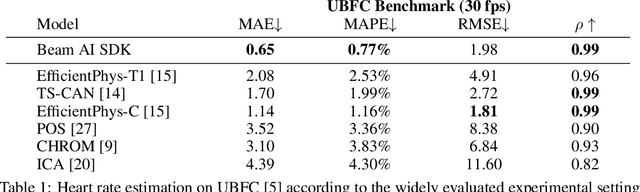
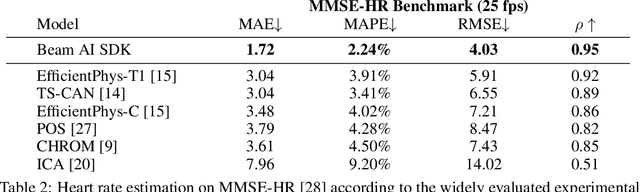
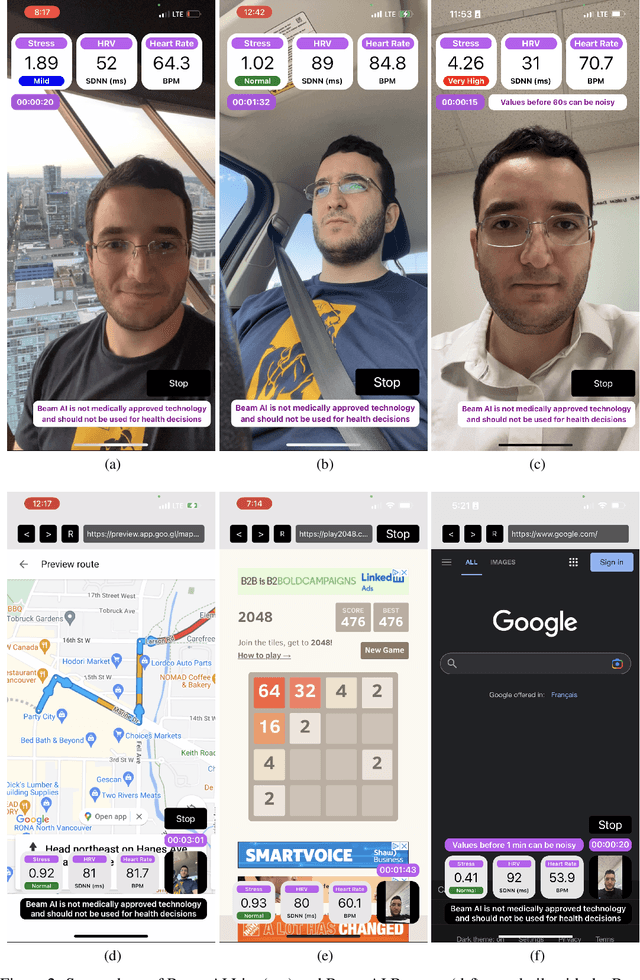
Stress is considered to be the epidemic of the 21st-century. Yet, mobile apps cannot directly evaluate the impact of their content and services on user stress. We introduce the Beam AI SDK to address this issue. Using our SDK, apps can monitor user stress through the selfie camera in real-time. Our technology extracts the user's pulse wave by analyzing subtle color variations across the skin regions of the user's face. The user's pulse wave is then used to determine stress (according to the Baevsky Stress Index), heart rate, and heart rate variability. We evaluate our technology on the UBFC dataset, the MMSE-HR dataset, and Beam AI's internal data. Our technology achieves 99.2%, 97.8% and 98.5% accuracy for heart rate estimation on each benchmark respectively, a nearly twice lower error rate than competing methods. We further demonstrate an average Pearson correlation of 0.801 in determining stress and heart rate variability, thus producing commercially useful readings to derive content decisions in apps. Our SDK is available for use at www.beamhealth.ai.
Overcoming Difficulty in Obtaining Dark-skinned Subjects for Remote-PPG by Synthetic Augmentation
Jun 10, 2021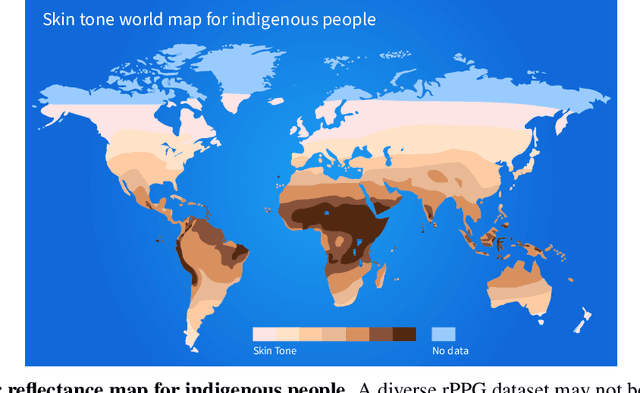
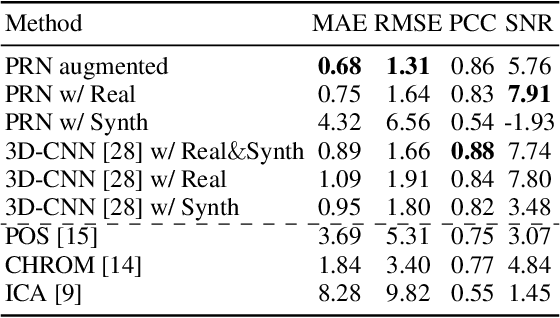
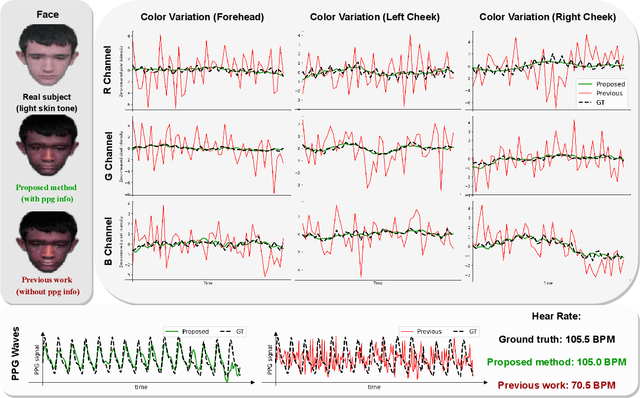
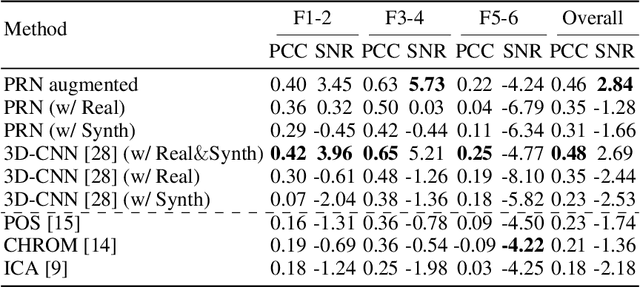
Camera-based remote photoplethysmography (rPPG) provides a non-contact way to measure physiological signals (e.g., heart rate) using facial videos. Recent deep learning architectures have improved the accuracy of such physiological measurement significantly, yet they are restricted by the diversity of the annotated videos. The existing datasets MMSE-HR, AFRL, and UBFC-RPPG contain roughly 10%, 0%, and 5% of dark-skinned subjects respectively. The unbalanced training sets result in a poor generalization capability to unseen subjects and lead to unwanted bias toward different demographic groups. In Western academia, it is regrettably difficult in a university setting to collect data on these dark-skinned subjects. Here we show a first attempt to overcome the lack of dark-skinned subjects by synthetic augmentation. A joint optimization framework is utilized to translate real videos from light-skinned subjects to dark skin tones while retaining their pulsatile signals. In the experiment, our method exhibits around 31% reduction in mean absolute error for the dark-skinned group and 46% improvement on bias mitigation for all the groups, as compared with the previous work trained with just real samples.