 Add to Chrome
 Add to Firefox
 Add to Edge
Frll Morphs
Papers and Code
FD-MAD: Frequency-Domain Residual Analysis for Face Morphing Attack Detection
Jan 28, 2026
Face morphing attacks present a significant threat to face recognition systems used in electronic identity enrolment and border control, particularly in single-image morphing attack detection (S-MAD) scenarios where no trusted reference is available. In spite of the vast amount of research on this problem, morph detection systems struggle in cross-dataset scenarios. To address this problem, we introduce a region-aware frequency-based morph detection strategy that drastically improves over strong baseline methods in challenging cross-dataset and cross-morph settings using a lightweight approach. Having observed the separability of bona fide and morph samples in the frequency domain of different facial parts, our approach 1) introduces the concept of residual frequency domain, where the frequency of the signal is decoupled from the natural spectral decay to easily discriminate between morph and bona fide data; 2) additionally, we reason in a global and local manner by combining the evidence from different facial regions in a Markov Random Field, which infers a globally consistent decision. The proposed method, trained exclusively on the synthetic morphing attack detection development dataset (SMDD), is evaluated in challenging cross-dataset and cross-morph settings on FRLL-Morph and MAD22 sets. Our approach achieves an average equal error rate (EER) of 1.85\% on FRLL-Morph and ranks second on MAD22 with an average EER of 6.12\%, while also obtaining a good bona fide presentation classification error rate (BPCER) at a low attack presentation classification error rate (APCER) using only spectral features. These findings indicate that Fourier-domain residual modeling with structured regional fusion offers a competitive alternative to deep S-MAD architectures.

dc-GAN: Dual-Conditioned GAN for Face Demorphing From a Single Morph
Nov 20, 2024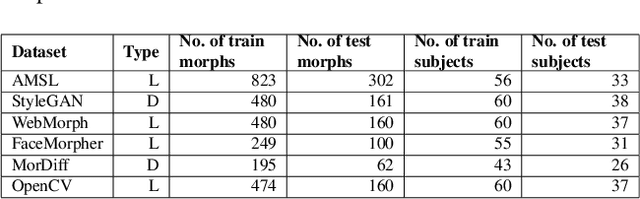

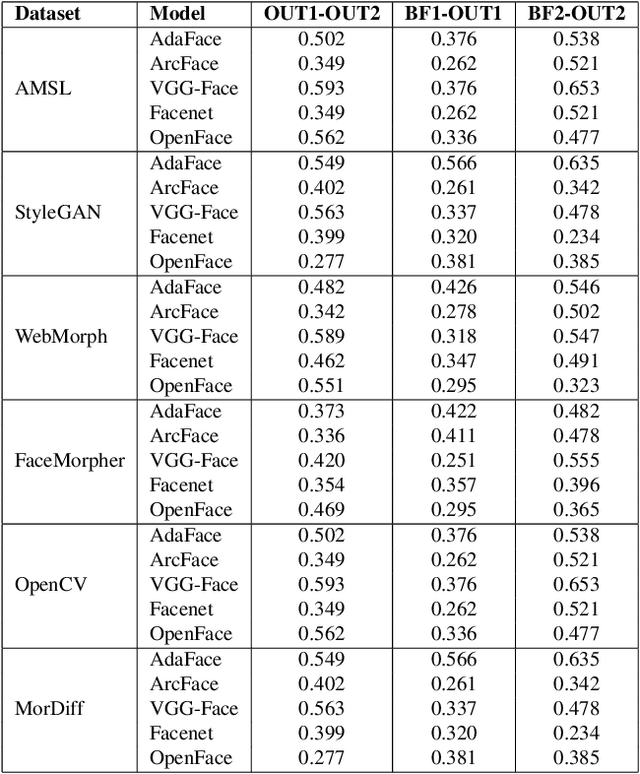
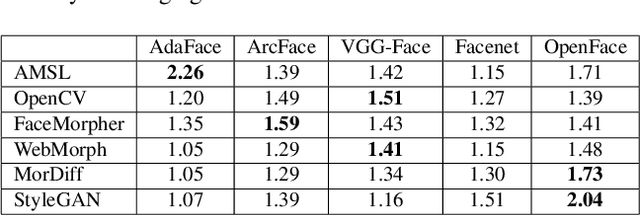
A facial morph is an image created by combining two face images pertaining to two distinct identities. Face demorphing inverts the process and tries to recover the original images constituting a facial morph. While morph attack detection (MAD) techniques can be used to flag morph images, they do not divulge any visual information about the faces used to create them. Demorphing helps address this problem. Existing demorphing techniques are either very restrictive (assume identities during testing) or produce feeble outputs (both outputs look very similar). In this paper, we overcome these issues by proposing dc-GAN, a novel GAN-based demorphing method conditioned on the morph images. Our method overcomes morph-replication and produces high quality reconstructions of the bonafide images used to create the morphs. Moreover, our method is highly generalizable across demorphing paradigms (differential/reference-free). We conduct experiments on AMSL, FRLL-Morphs and MorDiff datasets to showcase the efficacy of our method.
Impact of Synthetic Images on Morphing Attack Detection Using a Siamese Network
Mar 20, 2024This paper evaluated the impact of synthetic images on Morphing Attack Detection (MAD) using a Siamese network with a semi-hard-loss function. Intra and cross-dataset evaluations were performed to measure synthetic image generalisation capabilities using a cross-dataset for evaluation. Three different pre-trained networks were used as feature extractors from traditional MobileNetV2, MobileNetV3 and EfficientNetB0. Our results show that MAD trained on EfficientNetB0 from FERET, FRGCv2, and FRLL can reach a lower error rate in comparison with SOTA. Conversely, worse performances were reached when the system was trained only with synthetic images. A mixed approach (synthetic + digital) database may help to improve MAD and reduce the error rate. This fact shows that we still need to keep going with our efforts to include synthetic images in the training process.
Face Morphing Attack Detection with Denoising Diffusion Probabilistic Models
Jun 27, 2023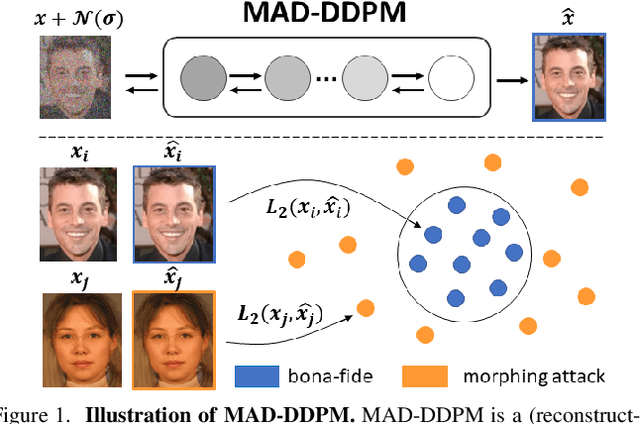
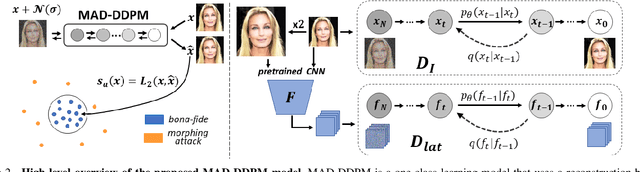
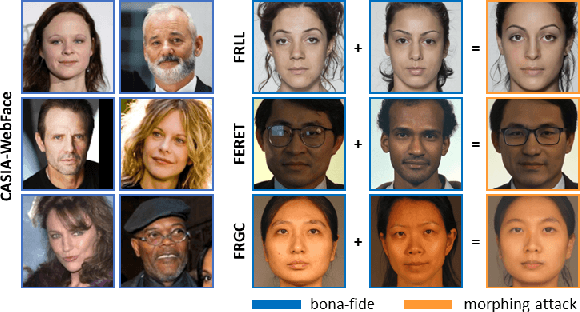
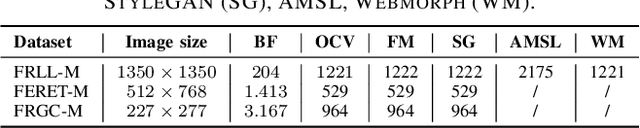
Morphed face images have recently become a growing concern for existing face verification systems, as they are relatively easy to generate and can be used to impersonate someone's identity for various malicious purposes. Efficient Morphing Attack Detection (MAD) that generalizes well across different morphing techniques is, therefore, of paramount importance. Existing MAD techniques predominantly rely on discriminative models that learn from examples of bona fide and morphed images and, as a result, often exhibit sub-optimal generalization performance when confronted with unknown types of morphing attacks. To address this problem, we propose a novel, diffusion-based MAD method in this paper that learns only from the characteristics of bona fide images. Various forms of morphing attacks are then detected by our model as out-of-distribution samples. We perform rigorous experiments over four different datasets (CASIA-WebFace, FRLL-Morphs, FERET-Morphs and FRGC-Morphs) and compare the proposed solution to both discriminatively-trained and once-class MAD models. The experimental results show that our MAD model achieves highly competitive results on all considered datasets.
* Published at IWBF 2023
Face Feature Visualisation of Single Morphing Attack Detection
Apr 25, 2023This paper proposes an explainable visualisation of different face feature extraction algorithms that enable the detection of bona fide and morphing images for single morphing attack detection. The feature extraction is based on raw image, shape, texture, frequency and compression. This visualisation may help to develop a Graphical User Interface for border policies and specifically for border guard personnel that have to investigate details of suspect images. A Random forest classifier was trained in a leave-one-out protocol on three landmarks-based face morphing methods and a StyleGAN-based morphing method for which morphed images are available in the FRLL database. For morphing attack detection, the Discrete Cosine-Transformation-based method obtained the best results for synthetic images and BSIF for landmark-based image features.
SDeMorph: Towards Better Facial De-morphing from Single Morph
Aug 22, 2023Face Recognition Systems (FRS) are vulnerable to morph attacks. A face morph is created by combining multiple identities with the intention to fool FRS and making it match the morph with multiple identities. Current Morph Attack Detection (MAD) can detect the morph but are unable to recover the identities used to create the morph with satisfactory outcomes. Existing work in de-morphing is mostly reference-based, i.e. they require the availability of one identity to recover the other. Sudipta et al. \cite{ref9} proposed a reference-free de-morphing technique but the visual realism of outputs produced were feeble. In this work, we propose SDeMorph (Stably Diffused De-morpher), a novel de-morphing method that is reference-free and recovers the identities of bona fides. Our method produces feature-rich outputs that are of significantly high quality in terms of definition and facial fidelity. Our method utilizes Denoising Diffusion Probabilistic Models (DDPM) by destroying the input morphed signal and then reconstructing it back using a branched-UNet. Experiments on ASML, FRLL-FaceMorph, FRLL-MorDIFF, and SMDD datasets support the effectiveness of the proposed method.
Face Morphing Attack Detection Using Privacy-Aware Training Data
Jul 02, 2022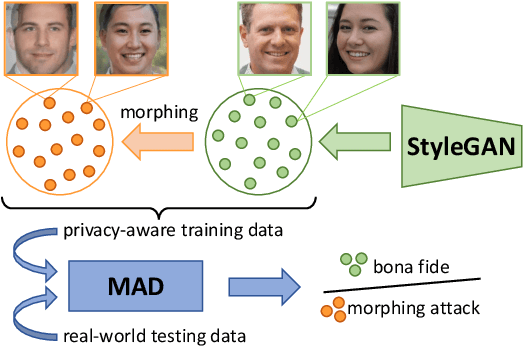

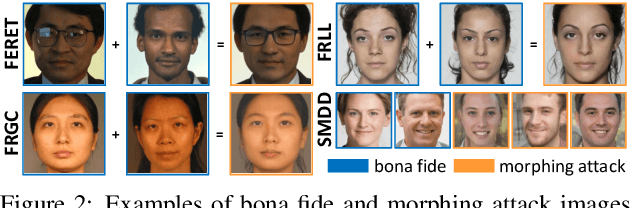
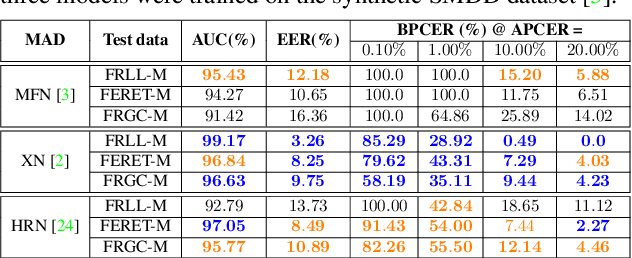
Images of morphed faces pose a serious threat to face recognition--based security systems, as they can be used to illegally verify the identity of multiple people with a single morphed image. Modern detection algorithms learn to identify such morphing attacks using authentic images of real individuals. This approach raises various privacy concerns and limits the amount of publicly available training data. In this paper, we explore the efficacy of detection algorithms that are trained only on faces of non--existing people and their respective morphs. To this end, two dedicated algorithms are trained with synthetic data and then evaluated on three real-world datasets, i.e.: FRLL-Morphs, FERET-Morphs and FRGC-Morphs. Our results show that synthetic facial images can be successfully employed for the training process of the detection algorithms and generalize well to real-world scenarios.
OrthoMAD: Morphing Attack Detection Through Orthogonal Identity Disentanglement
Aug 23, 2022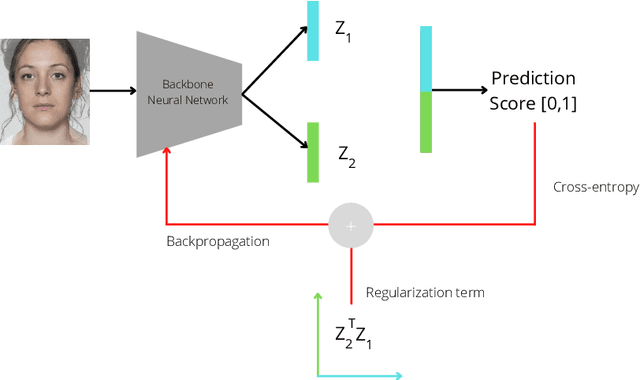
Morphing attacks are one of the many threats that are constantly affecting deep face recognition systems. It consists of selecting two faces from different individuals and fusing them into a final image that contains the identity information of both. In this work, we propose a novel regularisation term that takes into account the existent identity information in both and promotes the creation of two orthogonal latent vectors. We evaluate our proposed method (OrthoMAD) in five different types of morphing in the FRLL dataset and evaluate the performance of our model when trained on five distinct datasets. With a small ResNet-18 as the backbone, we achieve state-of-the-art results in the majority of the experiments, and competitive results in the others. The code of this paper will be publicly available.
Adversarially Perturbed Wavelet-based Morphed Face Generation
Nov 03, 2021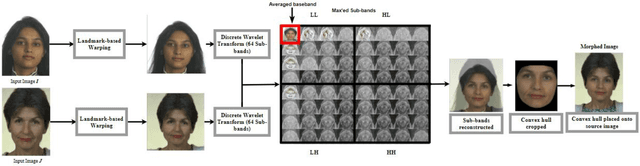
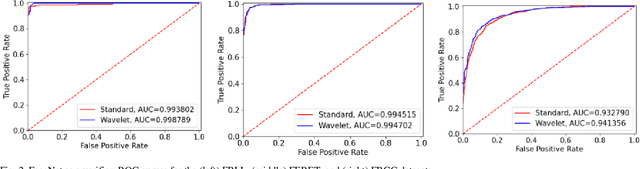
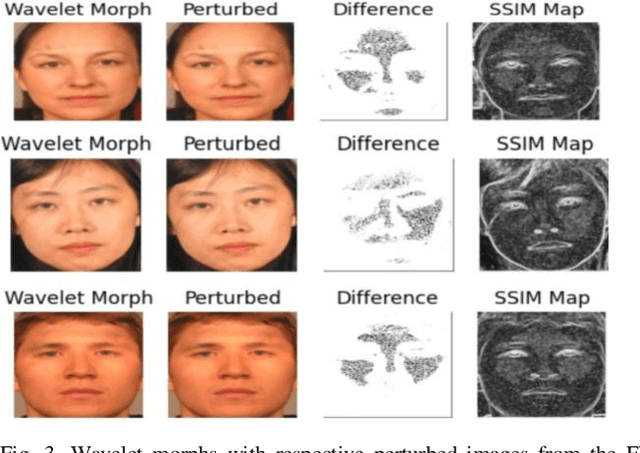
Morphing is the process of combining two or more subjects in an image in order to create a new identity which contains features of both individuals. Morphed images can fool Facial Recognition Systems (FRS) into falsely accepting multiple people, leading to failures in national security. As morphed image synthesis becomes easier, it is vital to expand the research community's available data to help combat this dilemma. In this paper, we explore combination of two methods for morphed image generation, those of geometric transformation (warping and blending to create morphed images) and photometric perturbation. We leverage both methods to generate high-quality adversarially perturbed morphs from the FERET, FRGC, and FRLL datasets. The final images retain high similarity to both input subjects while resulting in minimal artifacts in the visual domain. Images are synthesized by fusing the wavelet sub-bands from the two look-alike subjects, and then adversarially perturbed to create highly convincing imagery to deceive both humans and deep morph detectors.