 Add to Chrome
 Add to Firefox
 Add to Edge
SRL-MAD: Structured Residual Latents for One-Class Morphing Attack Detection
Mar 16, 2026
Face morphing attacks represent a significant threat to biometric systems as they allow multiple identities to be combined into a single face. While supervised morphing attack detection (MAD) methods have shown promising performance, their reliance on attack-labeled data limits generalization to unseen morphing attacks. This has motivated increasing interest in one-class MAD, where models are trained exclusively on bona fide samples and are expected to detect unseen attacks as deviations from the normal facial structure. In this context, we introduce SRL-MAD, a one-class single-image MAD that uses structured residual Fourier representations for open-set morphing attack detection. Starting from a residual frequency map that suppresses image-specific spectral trends, we preserve the two-dimensional organization of the Fourier domain through a ring-based representation and replace azimuthal averaging with a learnable ring-wise spectral projection. To further encode domain knowledge about where morphing artifacts arise, we impose a frequency-informed inductive bias by organizing spectral evidence into low, mid, and high-frequency bands and learning cross-band interactions. These structured spectral features are mapped into a latent space designed for direct scoring, avoiding the reliance on reconstruction errors. Extensive evaluation on FERET-Morph, FRLL-Morph, and MorDIFF demonstrates that SRL-MAD consistently outperforms recent one-class and supervised MAD models. Overall, our results show that learning frequency-aware projections provides a more discriminative alternative to azimuthal spectral summarization for one-class morphing attack detection.

The Good, the Better, and the Best: Improving the Discriminability of Face Embeddings through Attribute-aware Learning
Mar 16, 2026Despite recent advances in face recognition, robust performance remains challenging under large variations in age, pose, and occlusion. A common strategy to address these issues is to guide representation learning with auxiliary supervision from facial attributes, encouraging the visual encoder to focus on identity-relevant regions. However, existing approaches typically rely on heterogeneous and fixed sets of attributes, implicitly assuming equal relevance across attributes. This assumption is suboptimal, as different attributes exhibit varying discriminative power for identity recognition, and some may even introduce harmful biases. In this paper, we propose an attribute-aware face recognition architecture that supervises the learning of facial embeddings using identity class labels, identity-relevant facial attributes, and non-identity-related attributes. Facial attributes are organized into interpretable groups, making it possible to decompose and analyze their individual contributions in a human-understandable manner. Experiments on standard face verification benchmarks demonstrate that joint learning of identity and facial attributes improves the discriminability of face embeddings with two major conclusions: (i) using identity-relevant subsets of facial attributes consistently outperforms supervision with a broader attribute set, and (ii) explicitly forcing embeddings to unlearn non-identity-related attributes yields further performance gains compared to leaving such attributes unsupervised. Additionally, our method serves as a diagnostic tool for assessing the trustworthiness of face recognition encoders by allowing for the measurement of accuracy gains with suppression of non-identity-relevant attributes, with such gains suggesting shortcut learning from redundant attributes associated with each identity.
FD-MAD: Frequency-Domain Residual Analysis for Face Morphing Attack Detection
Jan 28, 2026Face morphing attacks present a significant threat to face recognition systems used in electronic identity enrolment and border control, particularly in single-image morphing attack detection (S-MAD) scenarios where no trusted reference is available. In spite of the vast amount of research on this problem, morph detection systems struggle in cross-dataset scenarios. To address this problem, we introduce a region-aware frequency-based morph detection strategy that drastically improves over strong baseline methods in challenging cross-dataset and cross-morph settings using a lightweight approach. Having observed the separability of bona fide and morph samples in the frequency domain of different facial parts, our approach 1) introduces the concept of residual frequency domain, where the frequency of the signal is decoupled from the natural spectral decay to easily discriminate between morph and bona fide data; 2) additionally, we reason in a global and local manner by combining the evidence from different facial regions in a Markov Random Field, which infers a globally consistent decision. The proposed method, trained exclusively on the synthetic morphing attack detection development dataset (SMDD), is evaluated in challenging cross-dataset and cross-morph settings on FRLL-Morph and MAD22 sets. Our approach achieves an average equal error rate (EER) of 1.85\% on FRLL-Morph and ranks second on MAD22 with an average EER of 6.12\%, while also obtaining a good bona fide presentation classification error rate (BPCER) at a low attack presentation classification error rate (APCER) using only spectral features. These findings indicate that Fourier-domain residual modeling with structured regional fusion offers a competitive alternative to deep S-MAD architectures.
SortWaste: A Densely Annotated Dataset for Object Detection in Industrial Waste Sorting
Jan 07, 2026The increasing production of waste, driven by population growth, has created challenges in managing and recycling materials effectively. Manual waste sorting is a common practice; however, it remains inefficient for handling large-scale waste streams and presents health risks for workers. On the other hand, existing automated sorting approaches still struggle with the high variability, clutter, and visual complexity of real-world waste streams. The lack of real-world datasets for waste sorting is a major reason automated systems for this problem are underdeveloped. Accordingly, we introduce SortWaste, a densely annotated object detection dataset collected from a Material Recovery Facility. Additionally, we contribute to standardizing waste detection in sorting lines by proposing ClutterScore, an objective metric that gauges the scene's hardness level using a set of proxies that affect visual complexity (e.g., object count, class and size entropy, and spatial overlap). In addition to these contributions, we provide an extensive benchmark of state-of-the-art object detection models, detailing their results with respect to the hardness level assessed by the proposed metric. Despite achieving promising results (mAP of 59.7% in the plastic-only detection task), performance significantly decreases in highly cluttered scenes. This highlights the need for novel and more challenging datasets on the topic.
CBVLM: Training-free Explainable Concept-based Large Vision Language Models for Medical Image Classification
Jan 21, 2025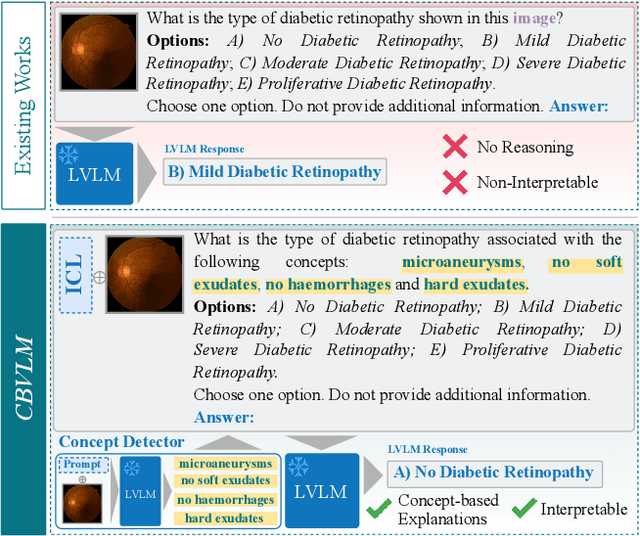
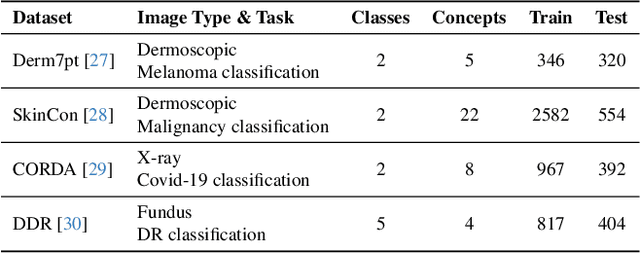
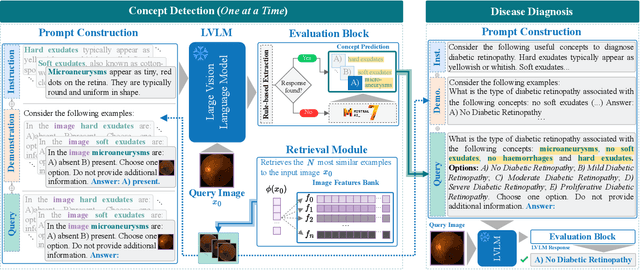
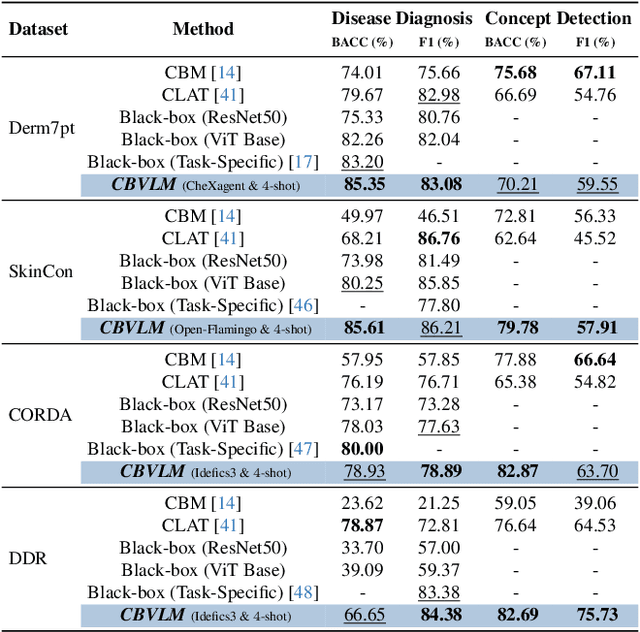
The main challenges limiting the adoption of deep learning-based solutions in medical workflows are the availability of annotated data and the lack of interpretability of such systems. Concept Bottleneck Models (CBMs) tackle the latter by constraining the final disease prediction on a set of predefined and human-interpretable concepts. However, the increased interpretability achieved through these concept-based explanations implies a higher annotation burden. Moreover, if a new concept needs to be added, the whole system needs to be retrained. Inspired by the remarkable performance shown by Large Vision-Language Models (LVLMs) in few-shot settings, we propose a simple, yet effective, methodology, CBVLM, which tackles both of the aforementioned challenges. First, for each concept, we prompt the LVLM to answer if the concept is present in the input image. Then, we ask the LVLM to classify the image based on the previous concept predictions. Moreover, in both stages, we incorporate a retrieval module responsible for selecting the best examples for in-context learning. By grounding the final diagnosis on the predicted concepts, we ensure explainability, and by leveraging the few-shot capabilities of LVLMs, we drastically lower the annotation cost. We validate our approach with extensive experiments across four medical datasets and twelve LVLMs (both generic and medical) and show that CBVLM consistently outperforms CBMs and task-specific supervised methods without requiring any training and using just a few annotated examples. More information on our project page: https://cristianopatricio.github.io/CBVLM/.
A Two-Step Concept-Based Approach for Enhanced Interpretability and Trust in Skin Lesion Diagnosis
Nov 08, 2024The main challenges hindering the adoption of deep learning-based systems in clinical settings are the scarcity of annotated data and the lack of interpretability and trust in these systems. Concept Bottleneck Models (CBMs) offer inherent interpretability by constraining the final disease prediction on a set of human-understandable concepts. However, this inherent interpretability comes at the cost of greater annotation burden. Additionally, adding new concepts requires retraining the entire system. In this work, we introduce a novel two-step methodology that addresses both of these challenges. By simulating the two stages of a CBM, we utilize a pretrained Vision Language Model (VLM) to automatically predict clinical concepts, and a Large Language Model (LLM) to generate disease diagnoses based on the predicted concepts. We validate our approach on three skin lesion datasets, demonstrating that it outperforms traditional CBMs and state-of-the-art explainable methods, all without requiring any training and utilizing only a few annotated examples. The code is available at https://github.com/CristianoPatricio/2-step-concept-based-skin-diagnosis.
Multi-Feature Aggregation in Diffusion Models for Enhanced Face Super-Resolution
Aug 27, 2024
Super-resolution algorithms often struggle with images from surveillance environments due to adverse conditions such as unknown degradation, variations in pose, irregular illumination, and occlusions. However, acquiring multiple images, even of low quality, is possible with surveillance cameras. In this work, we develop an algorithm based on diffusion models that utilize a low-resolution image combined with features extracted from multiple low-quality images to generate a super-resolved image while minimizing distortions in the individual's identity. Unlike other algorithms, our approach recovers facial features without explicitly providing attribute information or without the need to calculate a gradient of a function during the reconstruction process. To the best of our knowledge, this is the first time multi-features combined with low-resolution images are used as conditioners to generate more reliable super-resolution images using stochastic differential equations. The FFHQ dataset was employed for training, resulting in state-of-the-art performance in facial recognition and verification metrics when evaluated on the CelebA and Quis-Campi datasets. Our code is publicly available at https://github.com/marcelowds/fasr
Unsupervised Contrastive Analysis for Salient Pattern Detection using Conditional Diffusion Models
Jun 04, 2024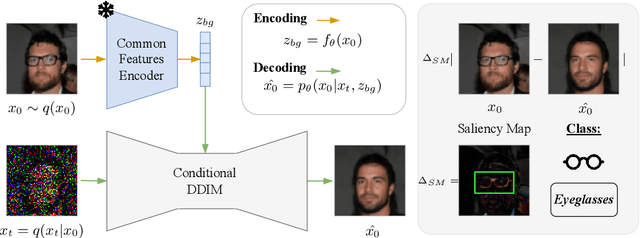

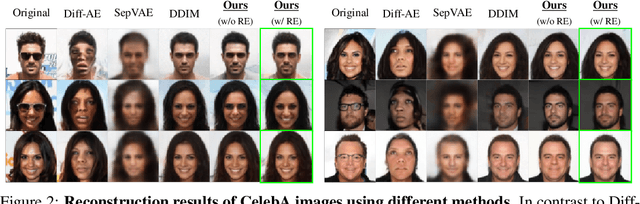
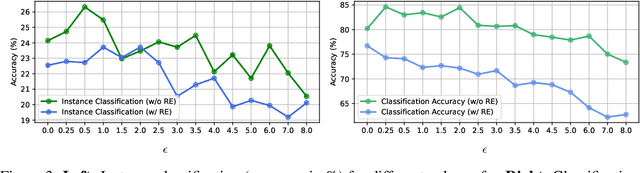
Contrastive Analysis (CA) regards the problem of identifying patterns in images that allow distinguishing between a background (BG) dataset (i.e. healthy subjects) and a target (TG) dataset (i.e. unhealthy subjects). Recent works on this topic rely on variational autoencoders (VAE) or contrastive learning strategies to learn the patterns that separate TG samples from BG samples in a supervised manner. However, the dependency on target (unhealthy) samples can be challenging in medical scenarios due to their limited availability. Also, the blurred reconstructions of VAEs lack utility and interpretability. In this work, we redefine the CA task by employing a self-supervised contrastive encoder to learn a latent representation encoding only common patterns from input images, using samples exclusively from the BG dataset during training, and approximating the distribution of the target patterns by leveraging data augmentation techniques. Subsequently, we exploit state-of-the-art generative methods, i.e. diffusion models, conditioned on the learned latent representation to produce a realistic (healthy) version of the input image encoding solely the common patterns. Thorough validation on a facial image dataset and experiments across three brain MRI datasets demonstrate that conditioning the generative process of state-of-the-art generative methods with the latent representation from our self-supervised contrastive encoder yields improvements in the generated image quality and in the accuracy of image classification. The code is available at https://github.com/CristianoPatricio/unsupervised-contrastive-cond-diff.
Towards Concept-based Interpretability of Skin Lesion Diagnosis using Vision-Language Models
Nov 24, 2023Concept-based models naturally lend themselves to the development of inherently interpretable skin lesion diagnosis, as medical experts make decisions based on a set of visual patterns of the lesion. Nevertheless, the development of these models depends on the existence of concept-annotated datasets, whose availability is scarce due to the specialized knowledge and expertise required in the annotation process. In this work, we show that vision-language models can be used to alleviate the dependence on a large number of concept-annotated samples. In particular, we propose an embedding learning strategy to adapt CLIP to the downstream task of skin lesion classification using concept-based descriptions as textual embeddings. Our experiments reveal that vision-language models not only attain better accuracy when using concepts as textual embeddings, but also require a smaller number of concept-annotated samples to attain comparable performance to approaches specifically devised for automatic concept generation.
Coherent Concept-based Explanations in Medical Image and Its Application to Skin Lesion Diagnosis
Apr 17, 2023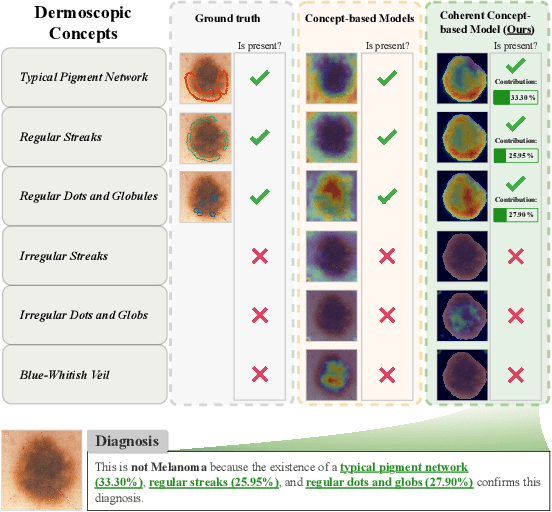
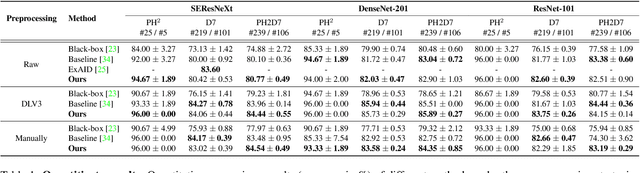
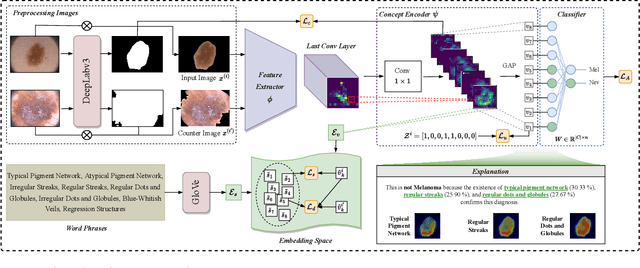
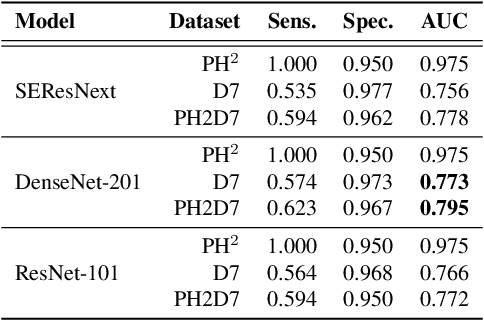
Early detection of melanoma is crucial for preventing severe complications and increasing the chances of successful treatment. Existing deep learning approaches for melanoma skin lesion diagnosis are deemed black-box models, as they omit the rationale behind the model prediction, compromising the trustworthiness and acceptability of these diagnostic methods. Attempts to provide concept-based explanations are based on post-hoc approaches, which depend on an additional model to derive interpretations. In this paper, we propose an inherently interpretable framework to improve the interpretability of concept-based models by incorporating a hard attention mechanism and a coherence loss term to assure the visual coherence of concept activations by the concept encoder, without requiring the supervision of additional annotations. The proposed framework explains its decision in terms of human-interpretable concepts and their respective contribution to the final prediction, as well as a visual interpretation of the locations where the concept is present in the image. Experiments on skin image datasets demonstrate that our method outperforms existing black-box and concept-based models for skin lesion classification.