 Add to Chrome
 Add to Firefox
 Add to Edge
Deep Boltzmann Machines
Papers and Code
Boltzmann-GPT: Bridging Energy-Based World Models and Language Generation
Jan 23, 2026
Large Language Models (LLMs) generate fluent text, yet whether they truly understand the world or merely produce plausible language about it remains contested. We propose an architectural principle, the mouth is not the brain, that explicitly separates world models from language models. Our architecture comprises three components: a Deep Boltzmann Machine (DBM) that captures domain structure as an energy-based world model, an adapter that projects latent belief states into embedding space, and a frozen GPT-2 that provides linguistic competence without domain knowledge. We instantiate this framework in the consumer review domain using Amazon smartphone reviews. Experiments demonstrate that (1) conditioning through the world model yields significantly higher sentiment correlation, lower perplexity, and greater semantic similarity compared to prompt-based generation alone; (2) the DBM's energy function distinguishes coherent from incoherent market configurations, assigning higher energy to implausible brand-price combinations; and (3) interventions on specific attributes propagate causally to generated text with intervened outputs exhibiting distributions statistically consistent with naturally occurring samples sharing the target configuration. These findings suggest that even small-scale language models can achieve consistent, controllable generation when connected to an appropriate world model, providing empirical support for separating linguistic competence from world understanding.

Probabilistic Computers for Neural Quantum States
Dec 31, 2025Neural quantum states efficiently represent many-body wavefunctions with neural networks, but the cost of Monte Carlo sampling limits their scaling to large system sizes. Here we address this challenge by combining sparse Boltzmann machine architectures with probabilistic computing hardware. We implement a probabilistic computer on field programmable gate arrays (FPGAs) and use it as a fast sampler for energy-based neural quantum states. For the two-dimensional transverse-field Ising model at criticality, we obtain accurate ground-state energies for lattices up to 80 $\times$ 80 (6400 spins) using a custom multi-FPGA cluster. Furthermore, we introduce a dual-sampling algorithm to train deep Boltzmann machines, replacing intractable marginalization with conditional sampling over auxiliary layers. This enables the training of sparse deep models and improves parameter efficiency relative to shallow networks. Using this algorithm, we train deep Boltzmann machines for a system with 35 $\times$ 35 (1225 spins). Together, these results demonstrate that probabilistic hardware can overcome the sampling bottleneck in variational simulation of quantum many-body systems, opening a path to larger system sizes and deeper variational architectures.
DO-EM: Density Operator Expectation Maximization
Jul 30, 2025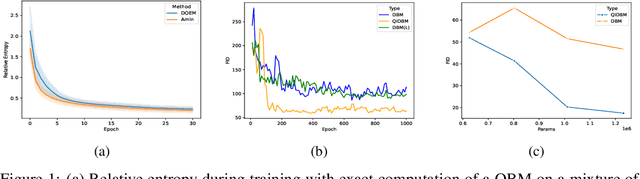
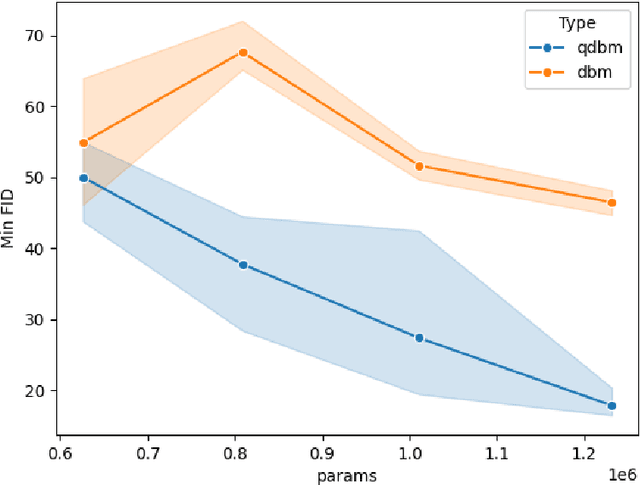
Density operators, quantum generalizations of probability distributions, are gaining prominence in machine learning due to their foundational role in quantum computing. Generative modeling based on density operator models (\textbf{DOMs}) is an emerging field, but existing training algorithms -- such as those for the Quantum Boltzmann Machine -- do not scale to real-world data, such as the MNIST dataset. The Expectation-Maximization algorithm has played a fundamental role in enabling scalable training of probabilistic latent variable models on real-world datasets. \textit{In this paper, we develop an Expectation-Maximization framework to learn latent variable models defined through \textbf{DOMs} on classical hardware, with resources comparable to those used for probabilistic models, while scaling to real-world data.} However, designing such an algorithm is nontrivial due to the absence of a well-defined quantum analogue to conditional probability, which complicates the Expectation step. To overcome this, we reformulate the Expectation step as a quantum information projection (QIP) problem and show that the Petz Recovery Map provides a solution under sufficient conditions. Using this formulation, we introduce the Density Operator Expectation Maximization (DO-EM) algorithm -- an iterative Minorant-Maximization procedure that optimizes a quantum evidence lower bound. We show that the \textbf{DO-EM} algorithm ensures non-decreasing log-likelihood across iterations for a broad class of models. Finally, we present Quantum Interleaved Deep Boltzmann Machines (\textbf{QiDBMs}), a \textbf{DOM} that can be trained with the same resources as a DBM. When trained with \textbf{DO-EM} under Contrastive Divergence, a \textbf{QiDBM} outperforms larger classical DBMs in image generation on the MNIST dataset, achieving a 40--60\% reduction in the Fr\'echet Inception Distance.
Enhancing Gradient-based Discrete Sampling via Parallel Tempering
Feb 26, 2025While gradient-based discrete samplers are effective in sampling from complex distributions, they are susceptible to getting trapped in local minima, particularly in high-dimensional, multimodal discrete distributions, owing to the discontinuities inherent in these landscapes. To circumvent this issue, we combine parallel tempering, also known as replica exchange, with the discrete Langevin proposal and develop the Parallel Tempering enhanced Discrete Langevin Proposal (PTDLP), which are simulated at a series of temperatures. Significant energy differences prompt sample swaps, which are governed by a Metropolis criterion specifically designed for discrete sampling to ensure detailed balance is maintained. Additionally, we introduce an automatic scheme to determine the optimal temperature schedule and the number of chains, ensuring adaptability across diverse tasks with minimal tuning. Theoretically, we establish that our algorithm converges non-asymptotically to the target energy and exhibits faster mixing compared to a single chain. Empirical results further emphasize the superiority of our method in sampling from complex, multimodal discrete distributions, including synthetic problems, restricted Boltzmann machines, and deep energy-based models.
Exploring the Energy Landscape of RBMs: Reciprocal Space Insights into Bosons, Hierarchical Learning and Symmetry Breaking
Mar 27, 2025Deep generative models have become ubiquitous due to their ability to learn and sample from complex distributions. Despite the proliferation of various frameworks, the relationships among these models remain largely unexplored, a gap that hinders the development of a unified theory of AI learning. We address two central challenges: clarifying the connections between different deep generative models and deepening our understanding of their learning mechanisms. We focus on Restricted Boltzmann Machines (RBMs), known for their universal approximation capabilities for discrete distributions. By introducing a reciprocal space formulation, we reveal a connection between RBMs, diffusion processes, and coupled Bosons. We show that at initialization, the RBM operates at a saddle point, where the local curvature is determined by the singular values, whose distribution follows the Marcenko-Pastur law and exhibits rotational symmetry. During training, this rotational symmetry is broken due to hierarchical learning, where different degrees of freedom progressively capture features at multiple levels of abstraction. This leads to a symmetry breaking in the energy landscape, reminiscent of Landau theory. This symmetry breaking in the energy landscape is characterized by the singular values and the weight matrix eigenvector matrix. We derive the corresponding free energy in a mean-field approximation. We show that in the limit of infinite size RBM, the reciprocal variables are Gaussian distributed. Our findings indicate that in this regime, there will be some modes for which the diffusion process will not converge to the Boltzmann distribution. To illustrate our results, we trained replicas of RBMs with different hidden layer sizes using the MNIST dataset. Our findings bridge the gap between disparate generative frameworks and also shed light on the processes underpinning learning in generative models.
Benchmarking Classical, Deep, and Generative Models for Human Activity Recognition
Jan 14, 2025Human Activity Recognition (HAR) has gained significant importance with the growing use of sensor-equipped devices and large datasets. This paper evaluates the performance of three categories of models : classical machine learning, deep learning architectures, and Restricted Boltzmann Machines (RBMs) using five key benchmark datasets of HAR (UCI-HAR, OPPORTUNITY, PAMAP2, WISDM, and Berkeley MHAD). We assess various models, including Decision Trees, Random Forests, Convolutional Neural Networks (CNN), and Deep Belief Networks (DBNs), using metrics such as accuracy, precision, recall, and F1-score for a comprehensive comparison. The results show that CNN models offer superior performance across all datasets, especially on the Berkeley MHAD. Classical models like Random Forest do well on smaller datasets but face challenges with larger, more complex data. RBM-based models also show notable potential, particularly for feature learning. This paper offers a detailed comparison to help researchers choose the most suitable model for HAR tasks.
Unfolding Tensors to Identify the Graph in Discrete Latent Bipartite Graphical Models
Jan 18, 2025We use a tensor unfolding technique to prove a new identifiability result for discrete bipartite graphical models, which have a bipartite graph between an observed and a latent layer. This model family includes popular models such as Noisy-Or Bayesian networks for medical diagnosis and Restricted Boltzmann Machines in machine learning. These models are also building blocks for deep generative models. Our result on identifying the graph structure enjoys the following nice properties. First, our identifiability proof is constructive, in which we innovatively unfold the population tensor under the model into matrices and inspect the rank properties of the resulting matrices to uncover the graph. This proof itself gives a population-level structure learning algorithm that outputs both the number of latent variables and the bipartite graph. Second, we allow various forms of nonlinear dependence among the variables, unlike many continuous latent variable graphical models that rely on linearity to show identifiability. Third, our identifiability condition is interpretable, only requiring each latent variable to connect to at least two "pure" observed variables in the bipartite graph. The new result not only brings novel advances in algebraic statistics, but also has useful implications for these models' trustworthy applications in scientific disciplines and interpretable machine learning.
Using Quantum Solved Deep Boltzmann Machines to Increase the Data Efficiency of RL Agents
Aug 30, 2024

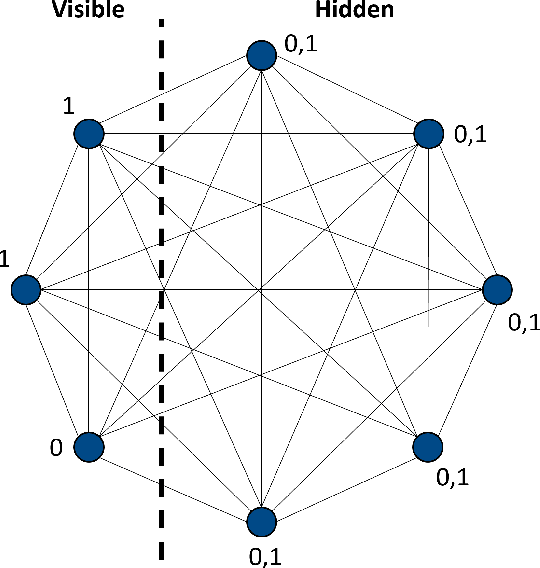

Deep Learning algorithms, such as those used in Reinforcement Learning, often require large quantities of data to train effectively. In most cases, the availability of data is not a significant issue. However, for some contexts, such as in autonomous cyber defence, we require data efficient methods. Recently, Quantum Machine Learning and Boltzmann Machines have been proposed as solutions to this challenge. In this work we build upon the pre-existing work to extend the use of Deep Boltzmann Machines to the cutting edge algorithm Proximal Policy Optimisation in a Reinforcement Learning cyber defence environment. We show that this approach, when solved using a D-WAVE quantum annealer, can lead to a two-fold increase in data efficiency. We therefore expect it to be used by the machine learning and quantum communities who are hoping to capitalise on data-efficient Reinforcement Learning methods.
Zephyr quantum-assisted hierarchical Calo4pQVAE for particle-calorimeter interactions
Dec 06, 2024With the approach of the High Luminosity Large Hadron Collider (HL-LHC) era set to begin particle collisions by the end of this decade, it is evident that the computational demands of traditional collision simulation methods are becoming increasingly unsustainable. Existing approaches, which rely heavily on first-principles Monte Carlo simulations for modeling event showers in calorimeters, are projected to require millions of CPU-years annually -- far exceeding current computational capacities. This bottleneck presents an exciting opportunity for advancements in computational physics by integrating deep generative models with quantum simulations. We propose a quantum-assisted hierarchical deep generative surrogate founded on a variational autoencoder (VAE) in combination with an energy conditioned restricted Boltzmann machine (RBM) embedded in the model's latent space as a prior. By mapping the topology of D-Wave's Zephyr quantum annealer (QA) into the nodes and couplings of a 4-partite RBM, we leverage quantum simulation to accelerate our shower generation times significantly. To evaluate our framework, we use Dataset 2 of the CaloChallenge 2022. Through the integration of classical computation and quantum simulation, this hybrid framework paves way for utilizing large-scale quantum simulations as priors in deep generative models.
A Survey on Deep Neural Networks in Collaborative Filtering Recommendation Systems
Dec 02, 2024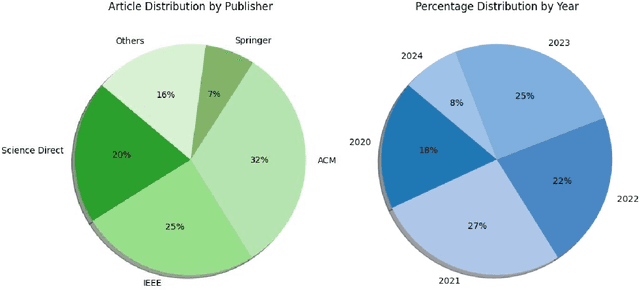

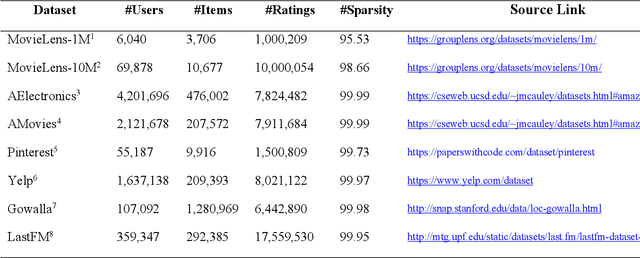

This survey provides an examination of the use of Deep Neural Networks (DNN) in Collaborative Filtering (CF) recommendation systems. As the digital world increasingly relies on data-driven approaches, traditional CF techniques face limitations in scalability and flexibility. DNNs can address these challenges by effectively modeling complex, non-linear relationships within the data. We begin by exploring the fundamental principles of both collaborative filtering and deep neural networks, laying the groundwork for understanding their integration. Subsequently, we review key advancements in the field, categorizing various deep learning models that enhance CF systems, including Multilayer Perceptrons (MLP), Convolutional Neural Networks (CNN), Recurrent Neural Networks (RNN), Graph Neural Networks (GNN), autoencoders, Generative Adversarial Networks (GAN), and Restricted Boltzmann Machines (RBM). The paper also discusses evaluation protocols, various publicly available auxiliary information, and data features. Furthermore, the survey concludes with a discussion of the challenges and future research opportunities in enhancing collaborative filtering systems with deep learning.