 Add to Chrome
 Add to Firefox
 Add to Edge
Probabilistic Computers for Neural Quantum States
Dec 31, 2025
Neural quantum states efficiently represent many-body wavefunctions with neural networks, but the cost of Monte Carlo sampling limits their scaling to large system sizes. Here we address this challenge by combining sparse Boltzmann machine architectures with probabilistic computing hardware. We implement a probabilistic computer on field programmable gate arrays (FPGAs) and use it as a fast sampler for energy-based neural quantum states. For the two-dimensional transverse-field Ising model at criticality, we obtain accurate ground-state energies for lattices up to 80 $\times$ 80 (6400 spins) using a custom multi-FPGA cluster. Furthermore, we introduce a dual-sampling algorithm to train deep Boltzmann machines, replacing intractable marginalization with conditional sampling over auxiliary layers. This enables the training of sparse deep models and improves parameter efficiency relative to shallow networks. Using this algorithm, we train deep Boltzmann machines for a system with 35 $\times$ 35 (1225 spins). Together, these results demonstrate that probabilistic hardware can overcome the sampling bottleneck in variational simulation of quantum many-body systems, opening a path to larger system sizes and deeper variational architectures.

Benchmarking energy consumption and latency for neuromorphic computing in condensed matter and particle physics
Sep 21, 2022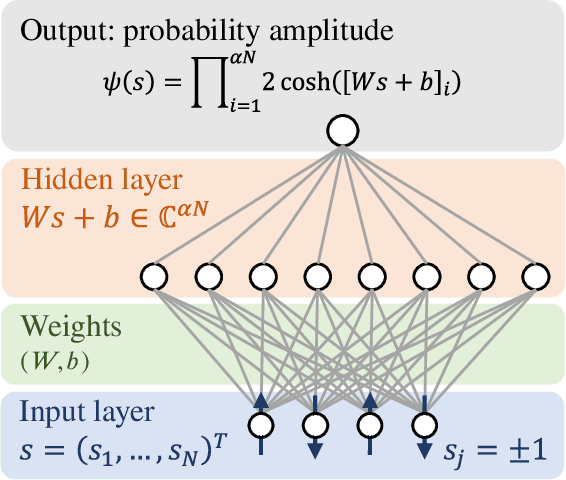
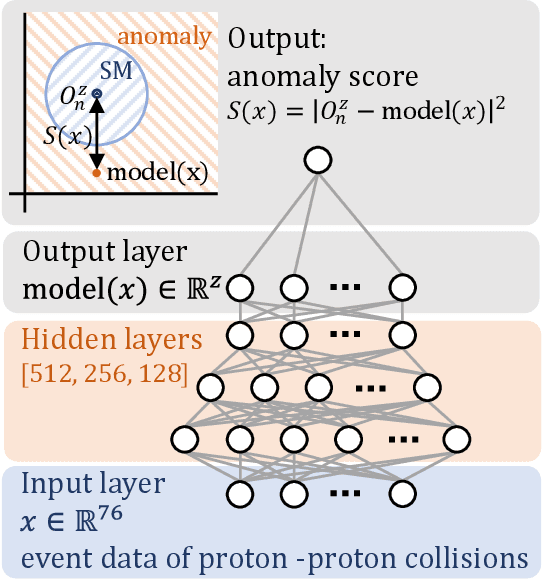
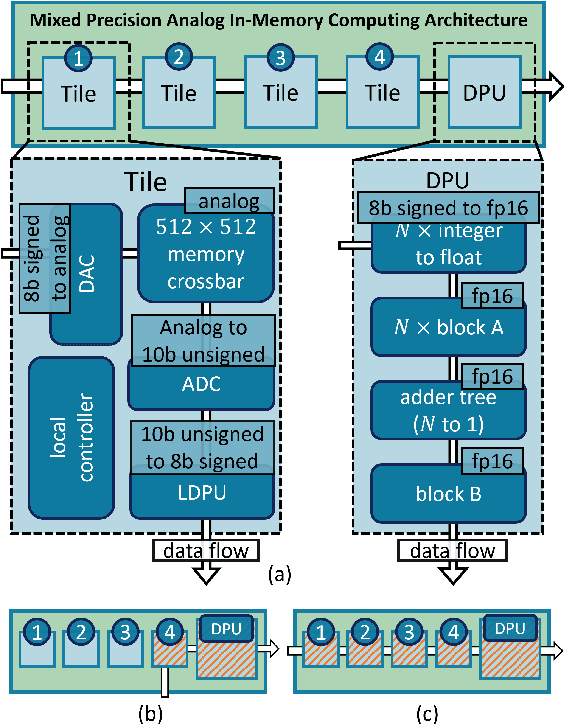
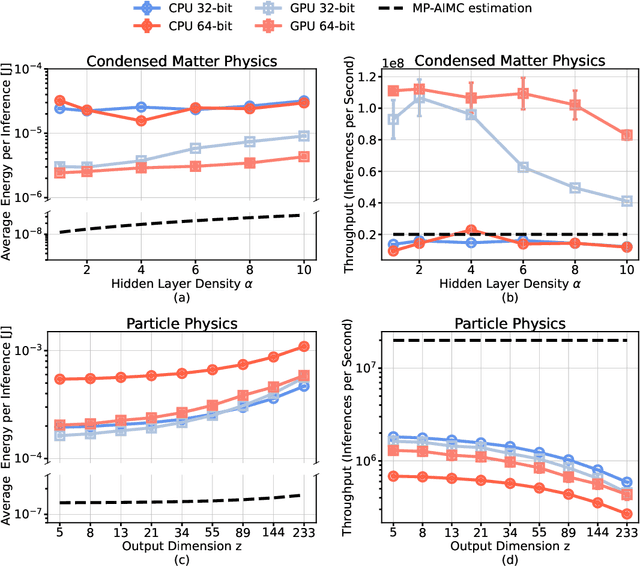
The massive use of artificial neural networks (ANNs), increasingly popular in many areas of scientific computing, rapidly increases the energy consumption of modern high-performance computing systems. An appealing and possibly more sustainable alternative is provided by novel neuromorphic paradigms, which directly implement ANNs in hardware. However, little is known about the actual benefits of running ANNs on neuromorphic hardware for use cases in scientific computing. Here we present a methodology for measuring the energy cost and compute time for inference tasks with ANNs on conventional hardware. In addition, we have designed an architecture for these tasks and estimate the same metrics based on a state-of-the-art analog in-memory computing (AIMC) platform, one of the key paradigms in neuromorphic computing. Both methodologies are compared for a use case in quantum many-body physics in two dimensional condensed matter systems and for anomaly detection at 40 MHz rates at the Large Hadron Collider in particle physics. We find that AIMC can achieve up to one order of magnitude shorter computation times than conventional hardware, at an energy cost that is up to three orders of magnitude smaller. This suggests great potential for faster and more sustainable scientific computing with neuromorphic hardware.