 Add to Chrome
 Add to Firefox
 Add to Edge
Keep the Core: Adversarial Priors for Significance-Preserving Brain MRI Segmentation
Paper and Code
Dec 17, 2025
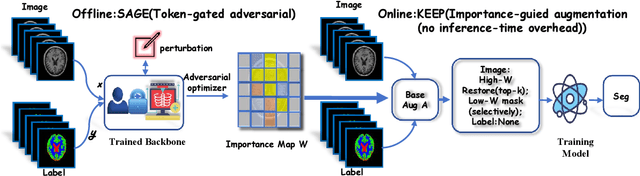
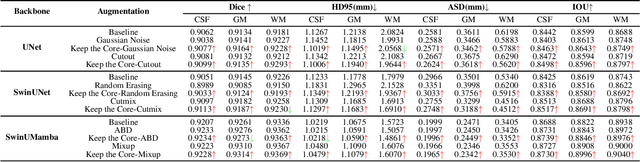
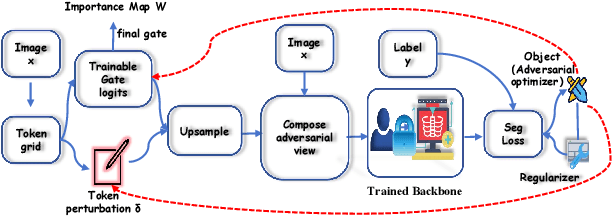
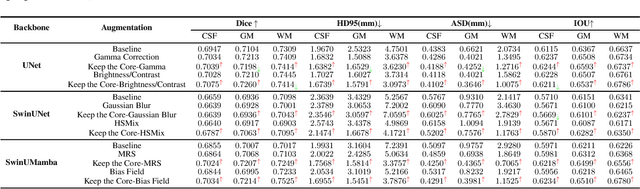
Medical image segmentation is constrained by sparse pathological annotations. Existing augmentation strategies, from conventional transforms to random masking for self-supervision, are feature-agnostic: they often corrupt critical diagnostic semantics or fail to prioritize essential features. We introduce "Keep the Core," a novel data-centric paradigm that uses adversarial priors to guide both augmentation and masking in a significance-preserving manner. Our approach uses SAGE (Sparse Adversarial Gated Estimator), an offline module identifying minimal tokens whose micro-perturbation flips segmentation boundaries. SAGE forges the Token Importance Map $W$ by solving an adversarial optimization problem to maximally degrade performance, while an $\ell_1$ sparsity penalty encourages a compact set of sensitive tokens. The online KEEP (Key-region Enhancement \& Preservation) module uses $W$ for a two-pronged augmentation strategy: (1) Semantic-Preserving Augmentation: High-importance tokens are augmented, but their original pixel values are strictly restored. (2) Guided-Masking Augmentation: Low-importance tokens are selectively masked for an $\text{MAE}$-style reconstruction, forcing the model to learn robust representations from preserved critical features. "Keep the Core" is backbone-agnostic with no inference overhead. Extensive experiments show SAGE's structured priors and KEEP's region-selective mechanism are highly complementary, achieving state-of-the-art segmentation robustness and generalization on 2D medical datasets.
