 Add to Chrome
 Add to Firefox
 Add to Edge
Pilot-Free Optimal Control over Wireless Networks: A Control-Aided Channel Prediction Approach
Feb 25, 2026
A recurring theme in optimal controller design for wireless networked control systems (WNCS) is the reliance on real-time channel state information (CSI). However, acquiring accurate CSI a priori is notoriously challenging due to the time-varying nature of wireless channels. In this work, we propose a pilot-free framework for optimal control over wireless channels in which control commands are generated from plant states together with control-aided channel prediction. For linear plants operating over an orthogonal frequency-division multiplexing (OFDM) architecture, channel prediction is performed via a Kalman filter (KF), and the optimal control policy is derived from the Bellman principle. To alleviate the curse of dimensionality in computing the optimal control policy, we approximate the solution using a coupled algebraic Riccati equation (CARE), which can be computed efficiently via a stochastic approximation (SA) algorithm. Rigorous performance guarantees are established by proving the stability of both the channel predictor and the closed-loop system under the resulting control policy, providing sufficient conditions for the existence and uniqueness of a stabilizing approximate CARE solution, and establishing convergence of the SA-based control algorithm. The framework is further extended to nonlinear plants under general wireless architectures by combining a KalmanNet-based predictor with a Markov-modulated deep deterministic policy gradient (MM-DDPG) controller. Numerical results show that the proposed pilot-free approach outperforms benchmark schemes in both control performance and channel prediction accuracy for linear and nonlinear scenarios.

Multipath Component Power Delay Profile Based Joint Range and Doppler Estimation for AFDM-ISAC Systems
Mar 13, 2025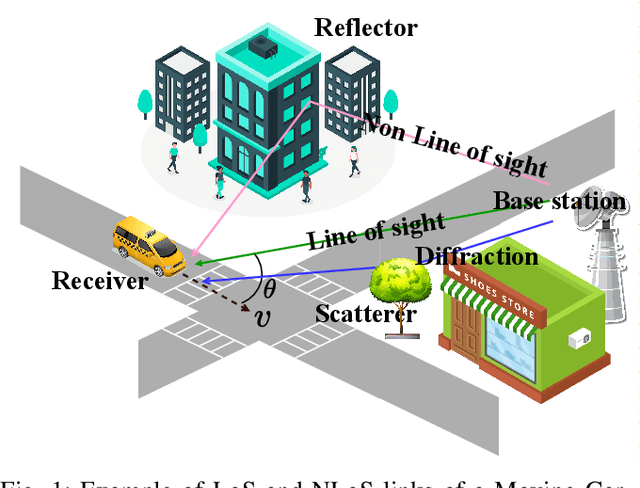
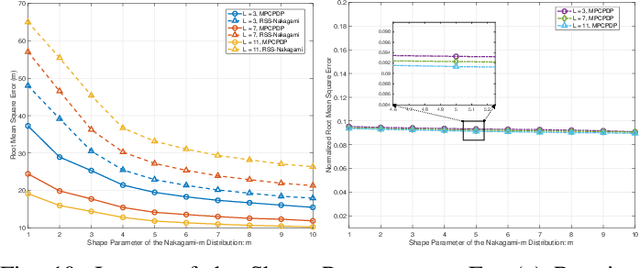
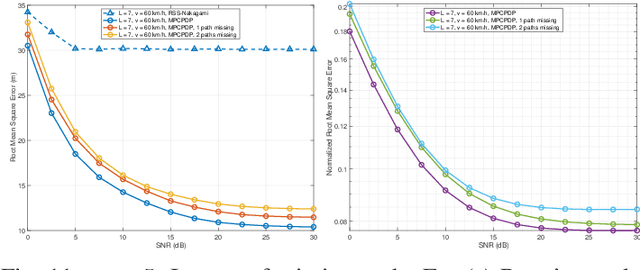
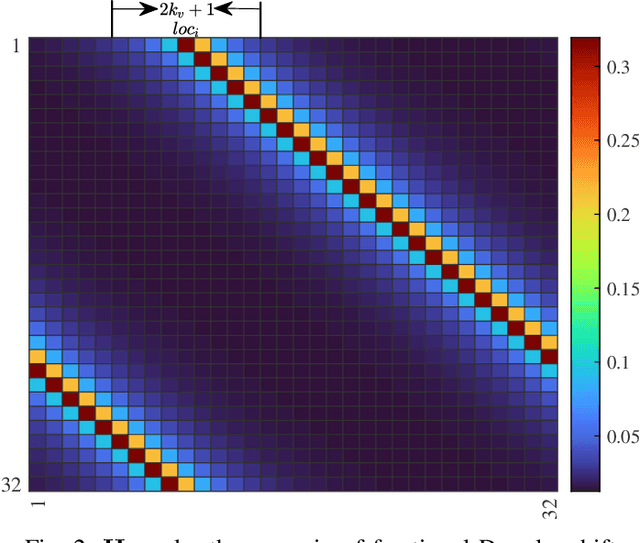
Integrated Sensing and Communication (ISAC) systems combine sensing and communication functionalities within a unified framework, enhancing spectral efficiency and reducing costs by utilizing shared hardware components. This paper investigates multipath component power delay profile (MPCPDP)-based joint range and Doppler estimation for Affine Frequency Division Multiplexing (AFDM)-ISAC systems. The path resolvability of the equivalent channel in the AFDM system allows the recognition of Line-of-Sight (LoS) and Non-Line-of-Sight (NLoS) paths within a single pilot symbol in fast time-varying channels. We develop a joint estimation model that leverages multipath Doppler shifts and delays information under the AFDM waveform. Utilizing the MPCPDP, we propose a novel ranging method that exploits the range-dependent magnitude of the MPCPDP across its delay spread by constructing a Nakagami-m statistical fading model for MPC channel fading and correlating the distribution parameters with propagation distance in AFDM systems. This method eliminates the need for additional time synchronization or extra hardware. We also transform the nonlinear Doppler estimation problem into a bilinear estimation problem using a First-order Taylor expansion. Moreover, we introduce the Expectation Maximization algorithm to estimate the hyperparameters and leverage the Expectation Consistent algorithm to cope with high-dimensional integration challenges. Extensive numerical simulations demonstrate the effectiveness of our MPCPDP-based joint range and Doppler estimation in ISAC systems.