 Add to Chrome
 Add to Firefox
 Add to Edge
Single-Base-Station Indoor Localization via Super-Resolved Relative Power Delay Profiles
Jun 25, 2026
Indoor multipath is shaped by surrounding reflectors, scatterers, and blockages, so a relative power-delay profile (PDP) can serve as a location fingerprint without an identifiable LoS path, angle information, or absolute time-of-arrival ranging. However, a communication receiver observes finitely many noisy pilot-frequency samples rather than an ideal PDP. This paper models the resulting Dirichlet blur, delay folding, and off-grid mismatch, and reconstructs a posterior-power profile using expectation-maximization sparse Bayesian learning. In spatially consistent QuaDRiGa simulations, twofold SBL raises 20-dB Top-1 accuracy from 75.79\% (native PDP) and 87.24\% (threefold zero-padding) to 93.27\%, with 0.392~m mean error.

Gaussian-Process Dynamics of Diagonal Expectation Propagation under Variance-Profile Gaussian Measurements
Jun 03, 2026State-evolution analyses of approximate-message-passing and expectation-propagation-type algorithms rely on an effective-channel principle: after a suitable Onsager, orthogonal, or extrinsic correction, the nonlinear module receives a fresh scalar Gaussian observation. This paper studies this principle for diagonal expectation propagation under variance-profile Gaussian sensing matrices. The model preserves Gaussian conditioning, but removes the isotropy that supports the usual scalar decoupling arguments. We prove a finite-time large-system description in which the linear EP module remains Gaussian at the coordinate level, but is generally not a fresh scalar channel. Instead, the residuals form a coordinate-dependent Gaussian process whose covariance is shaped by the variance profile and by the finite linear history of the algorithm. The standard diagonal EP cavity cancels the instantaneous response of the incoming message, but may leave a component predictable from past residuals. We characterize this process through a conditioned matrix-Dyson-equation deterministic equivalent and a Schur-complement representation of the linear module. A Gaussian-regression decomposition then separates the predictable memory from the orthogonal innovation and yields an oracle state-evolution-level correction. Thus, under variance-profile measurements, the limiting object for diagonal EP is a Gaussian-process dynamics with profile-dependent memory rather than the conventional fresh-noise scalar state evolution.
Performance Benchmarks for Line Spectral Estimation: Ordered Ziv-Zakai Characterization and Plug-In Amplitude Error Analysis
Apr 27, 2026Line spectral estimation (LSE) involves estimating both spectral frequencies and their associated complex amplitudes. Existing Fisher-information-based benchmarks are local and therefore do not capture either the threshold behavior of frequency estimation or the propagation of frequency errors to subsequent amplitude reconstruction. This paper develops explicit performance benchmarks for LSE from two complementary perspectives: ordered frequency estimation and plug-in amplitude reconstruction. On the frequency side, we develop a computable Ziv-Zakai bound (ZZB)-type benchmark under an ordered prior by combining a generalized-likelihood-ratio-test (GLRT)-based surrogate for the unavailable pairwise kernel with an ordered-prior correction. The resulting benchmark recovers the ordered a priori bound at low signal-to-noise ratio (SNR) and the marginalized frequency-side Cramer-Rao bound (CRB) at high SNR. On the amplitude side, we derive a local transfer characterization for the sequential plug-in estimator and obtain a computable benchmark for the induced amplitude error. The resulting framework explicitly characterizes threshold behavior on the frequency side and error propagation on the amplitude side. Numerical results support the proposed benchmarks across different SNR regimes, snapshot numbers, and model orders.
Expectations in Expectation Propagation
Dec 08, 2025Expectation Propagation (EP) is a widely used message-passing algorithm that decomposes a global inference problem into multiple local ones. It approximates marginal distributions (beliefs) using intermediate functions (messages). While beliefs must be proper probability distributions that integrate to one, messages may have infinite integral values. In Gaussian-projected EP, such messages take a Gaussian form and appear as if they have "negative" variances. Although allowed within the EP framework, these negative-variance messages can impede algorithmic progress. In this paper, we investigate EP in linear models and analyze the relationship between the corresponding beliefs. Based on the analysis, we propose both non-persistent and persistent approaches that prevent the algorithm from being blocked by messages with infinite integral values. Furthermore, by examining the relationship between the EP messages in linear models, we develop an additional approach that avoids the occurrence of messages with infinite integral values.
Multipath Component Power Delay Profile Based Joint Range and Doppler Estimation for AFDM-ISAC Systems
Mar 13, 2025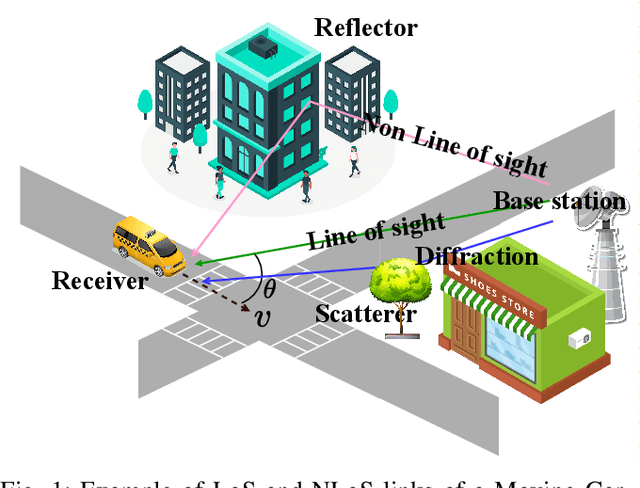
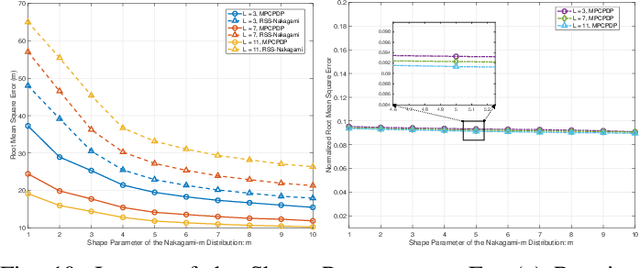
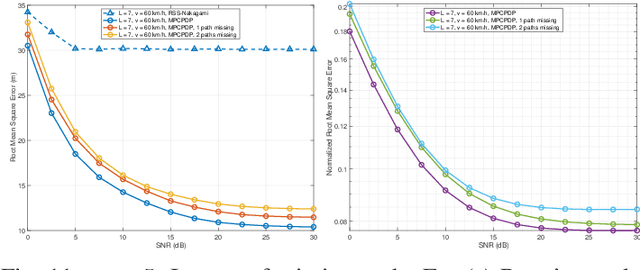
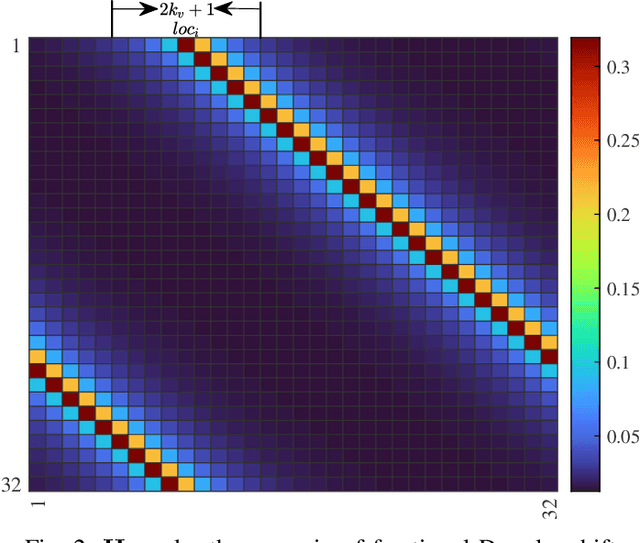
Integrated Sensing and Communication (ISAC) systems combine sensing and communication functionalities within a unified framework, enhancing spectral efficiency and reducing costs by utilizing shared hardware components. This paper investigates multipath component power delay profile (MPCPDP)-based joint range and Doppler estimation for Affine Frequency Division Multiplexing (AFDM)-ISAC systems. The path resolvability of the equivalent channel in the AFDM system allows the recognition of Line-of-Sight (LoS) and Non-Line-of-Sight (NLoS) paths within a single pilot symbol in fast time-varying channels. We develop a joint estimation model that leverages multipath Doppler shifts and delays information under the AFDM waveform. Utilizing the MPCPDP, we propose a novel ranging method that exploits the range-dependent magnitude of the MPCPDP across its delay spread by constructing a Nakagami-m statistical fading model for MPC channel fading and correlating the distribution parameters with propagation distance in AFDM systems. This method eliminates the need for additional time synchronization or extra hardware. We also transform the nonlinear Doppler estimation problem into a bilinear estimation problem using a First-order Taylor expansion. Moreover, we introduce the Expectation Maximization algorithm to estimate the hyperparameters and leverage the Expectation Consistent algorithm to cope with high-dimensional integration challenges. Extensive numerical simulations demonstrate the effectiveness of our MPCPDP-based joint range and Doppler estimation in ISAC systems.