 Add to Chrome
 Add to Firefox
 Add to Edge
Attention Sink Forges Native MoE in Attention Layers: Sink-Aware Training to Address Head Collapse
Feb 01, 2026
Large Language Models (LLMs) often assign disproportionate attention to the first token, a phenomenon known as the attention sink. Several recent approaches aim to address this issue, including Sink Attention in GPT-OSS and Gated Attention in Qwen3-Next. However, a comprehensive analysis of the relationship among these attention mechanisms is lacking. In this work, we provide both theoretical and empirical evidence demonstrating that the sink in Vanilla Attention and Sink Attention naturally construct a Mixture-of-Experts (MoE) mechanism within attention layers. This insight explains the head collapse phenomenon observed in prior work, where only a fixed subset of attention heads contributes to generation. To mitigate head collapse, we propose a sink-aware training algorithm with an auxiliary load balancing loss designed for attention layers. Extensive experiments show that our method achieves effective head load balancing and improves model performance across Vanilla Attention, Sink Attention, and Gated Attention. We hope this study offers a new perspective on attention mechanisms and encourages further exploration of the inherent MoE structure within attention layers.

PHYBench: Holistic Evaluation of Physical Perception and Reasoning in Large Language Models
Apr 22, 2025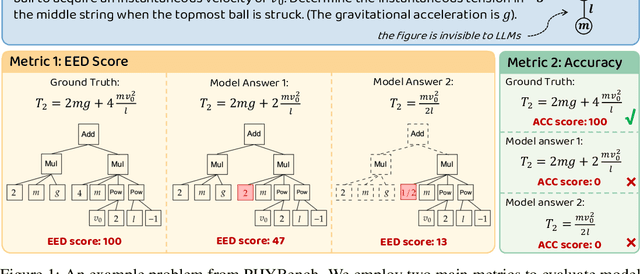

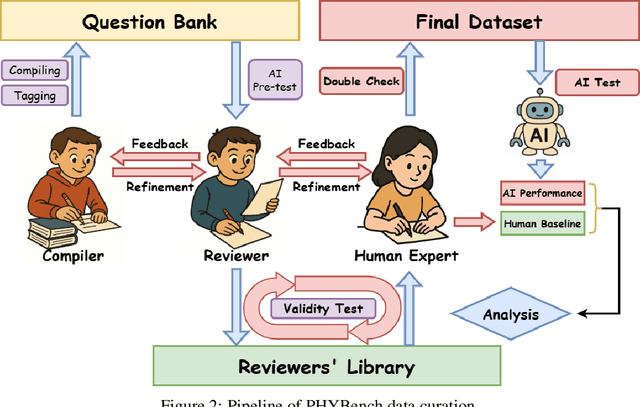
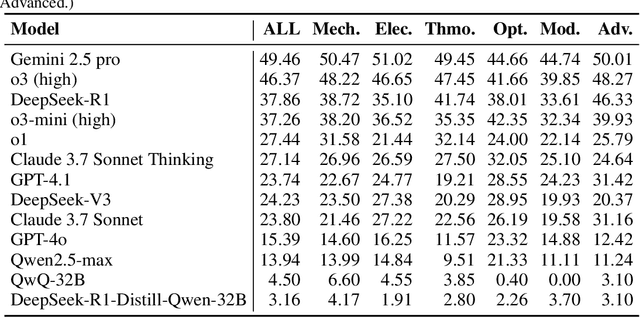
We introduce PHYBench, a novel, high-quality benchmark designed for evaluating reasoning capabilities of large language models (LLMs) in physical contexts. PHYBench consists of 500 meticulously curated physics problems based on real-world physical scenarios, designed to assess the ability of models to understand and reason about realistic physical processes. Covering mechanics, electromagnetism, thermodynamics, optics, modern physics, and advanced physics, the benchmark spans difficulty levels from high school exercises to undergraduate problems and Physics Olympiad challenges. Additionally, we propose the Expression Edit Distance (EED) Score, a novel evaluation metric based on the edit distance between mathematical expressions, which effectively captures differences in model reasoning processes and results beyond traditional binary scoring methods. We evaluate various LLMs on PHYBench and compare their performance with human experts. Our results reveal that even state-of-the-art reasoning models significantly lag behind human experts, highlighting their limitations and the need for improvement in complex physical reasoning scenarios. Our benchmark results and dataset are publicly available at https://phybench-official.github.io/phybench-demo/.