 Add to Chrome
 Add to Firefox
 Add to Edge
VISTA-DZ: Visual Semantic Trajectory Adaptation for Personalized Dilemma Zone Prediction
Jun 28, 2026
Driver decision making in the dilemma zone at signalized intersections is safety critical, as vehicles approaching a yellow signal must decide whether to stop or proceed within limited time and distance margins. Accurate prediction of both stop-go decisions and decision timing is important for adaptive signal control, advanced driver assistance systems, and human-centered intelligent transportation applications. However, dilemma zone behavior is strongly driver dependent. Similar approach trajectories may lead to different decisions across drivers because of differences in risk preference, braking habit, and decision threshold. Existing personalized models often rely on handcrafted scalar descriptors, which provide useful but limited summaries of individual behavior. This paper proposes VISTA-DZ, a semantic-profile-conditioned framework for personalized stop-go and decision-time prediction. Historical trajectories are converted into visual representations, interpreted by a vision-language model to generate behavioral profiles, and encoded as semantic embeddings to condition a dual-output prediction network. The final model combines a bidirectional GRU encoder, driver-conditioned multi-head cross-attention, and Feature-wise Linear Modulation for temporal evidence selection and feature adaptation. Experiments on the SDZ dataset and a newly collected FDZ dataset show that VISTA-DZ outperforms trajectory-only and handcrafted personalization baselines, achieving 93.26% in-domain simulation accuracy and 90.22% mean accuracy across 20 held-out simulation drivers. Cross-domain results further show feasible zero-shot simulation-to-real transfer and better real-world generalization when simulation data are combined with limited field data.

PDB: Not All Drivers Are the Same -- A Personalized Dataset for Understanding Driving Behavior
Mar 09, 2025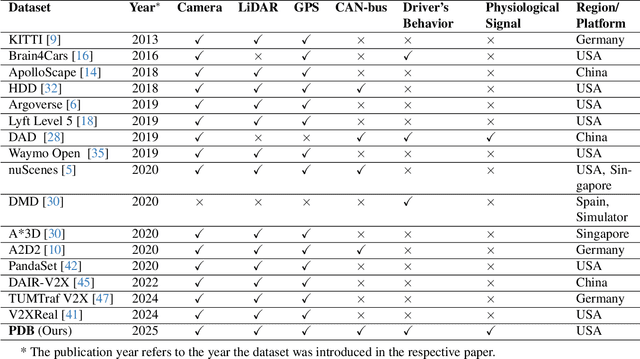
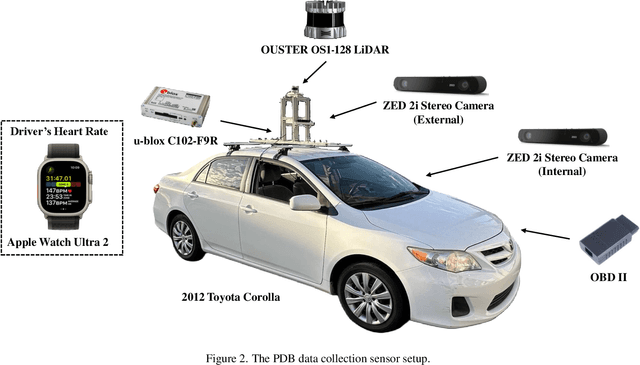
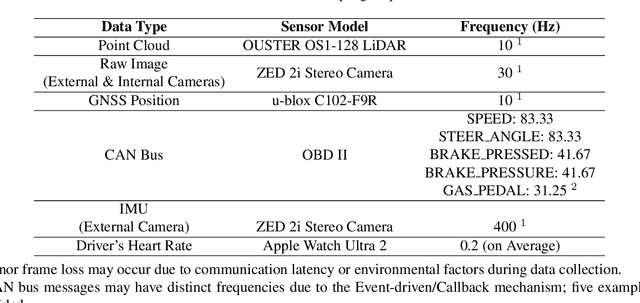
Driving behavior is inherently personal, influenced by individual habits, decision-making styles, and physiological states. However, most existing datasets treat all drivers as homogeneous, overlooking driver-specific variability. To address this gap, we introduce the Personalized Driving Behavior (PDB) dataset, a multi-modal dataset designed to capture personalization in driving behavior under naturalistic driving conditions. Unlike conventional datasets, PDB minimizes external influences by maintaining consistent routes, vehicles, and lighting conditions across sessions. It includes sources from 128-line LiDAR, front-facing camera video, GNSS, 9-axis IMU, CAN bus data (throttle, brake, steering angle), and driver-specific signals such as facial video and heart rate. The dataset features 12 participants, approximately 270,000 LiDAR frames, 1.6 million images, and 6.6 TB of raw sensor data. The processed trajectory dataset consists of 1,669 segments, each spanning 10 seconds with a 0.2-second interval. By explicitly capturing drivers' behavior, PDB serves as a unique resource for human factor analysis, driver identification, and personalized mobility applications, contributing to the development of human-centric intelligent transportation systems.
Investigating Personalized Driving Behaviors in Dilemma Zones: Analysis and Prediction of Stop-or-Go Decisions
May 06, 2024Dilemma zones at signalized intersections present a commonly occurring but unsolved challenge for both drivers and traffic operators. Onsets of the yellow lights prompt varied responses from different drivers: some may brake abruptly, compromising the ride comfort, while others may accelerate, increasing the risk of red-light violations and potential safety hazards. Such diversity in drivers' stop-or-go decisions may result from not only surrounding traffic conditions, but also personalized driving behaviors. To this end, identifying personalized driving behaviors and integrating them into advanced driver assistance systems (ADAS) to mitigate the dilemma zone problem presents an intriguing scientific question. In this study, we employ a game engine-based (i.e., CARLA-enabled) driving simulator to collect high-resolution vehicle trajectories, incoming traffic signal phase and timing information, and stop-or-go decisions from four subject drivers in various scenarios. This approach allows us to analyze personalized driving behaviors in dilemma zones and develop a Personalized Transformer Encoder to predict individual drivers' stop-or-go decisions. The results show that the Personalized Transformer Encoder improves the accuracy of predicting driver decision-making in the dilemma zone by 3.7% to 12.6% compared to the Generic Transformer Encoder, and by 16.8% to 21.6% over the binary logistic regression model.