 Add to Chrome
 Add to Firefox
 Add to Edge
Inter-Reflective Gaussian Splatting for Robust and Efficient Inverse Rendering
Jul 24, 2026
Faithful inverse rendering requires visibility and indirect radiance to explain secondary illumination and inter-reflection, yet rasterization-oriented Gaussian representations do not naturally support the secondary-ray queries needed to recover them. We present IRGS++ (Inter-Reflective Gaussian Splatting), a unified robust and efficient Gaussian inverse rendering framework. During transport-aware optimization, IRGS++ employs differentiable 2D Gaussian ray tracing on surface-oriented Gaussian primitives to query visibility and indirect radiance on the fly and evaluate the full rendering equation for inter-reflective transport. This physical core makes Gaussian inverse rendering physically grounded beyond rasterized appearance modeling. To make this backbone useful beyond low-gloss dielectric scenes, the framework incorporates metallic-aware material modeling and robust reflective initialization for glossy, specular, and metallic materials. To make it practical, multiple importance sampling and denoising stabilize finite-sample rendering, while mesh-based secondary-attribute queries reduce the cost of relighting under novel illumination. Quantitative evaluations on low-gloss and glossy benchmarks show improved decomposition and relighting quality together with favorable quality--speed trade-offs under the reported configurations, while real-world studies illustrate plausible relighting under novel illumination.

Reflective Gaussian Splatting
Dec 26, 2024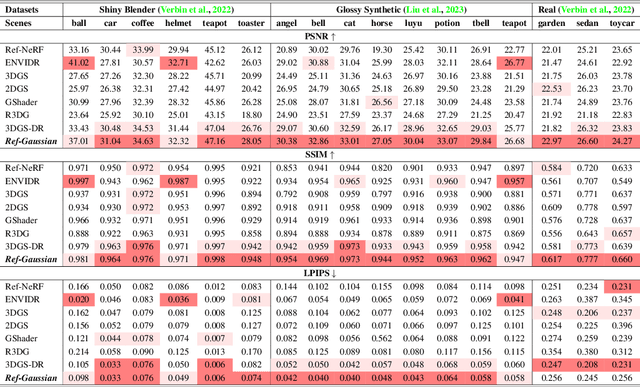
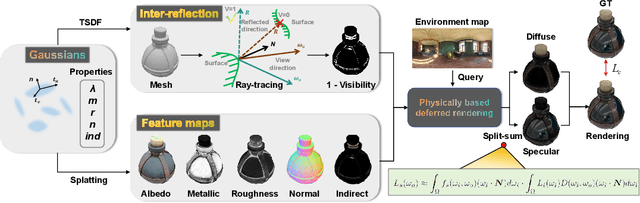
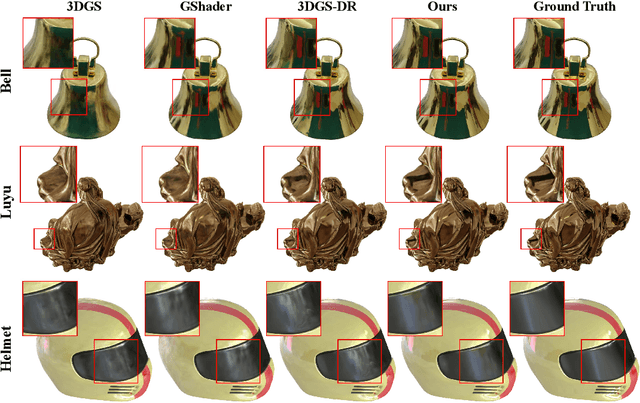

Novel view synthesis has experienced significant advancements owing to increasingly capable NeRF- and 3DGS-based methods. However, reflective object reconstruction remains challenging, lacking a proper solution to achieve real-time, high-quality rendering while accommodating inter-reflection. To fill this gap, we introduce a Reflective Gaussian splatting (\textbf{Ref-Gaussian}) framework characterized with two components: (I) {\em Physically based deferred rendering} that empowers the rendering equation with pixel-level material properties via formulating split-sum approximation; (II) {\em Gaussian-grounded inter-reflection} that realizes the desired inter-reflection function within a Gaussian splatting paradigm for the first time. To enhance geometry modeling, we further introduce material-aware normal propagation and an initial per-Gaussian shading stage, along with 2D Gaussian primitives. Extensive experiments on standard datasets demonstrate that Ref-Gaussian surpasses existing approaches in terms of quantitative metrics, visual quality, and compute efficiency. Further, we show that our method serves as a unified solution for both reflective and non-reflective scenes, going beyond the previous alternatives focusing on only reflective scenes. Also, we illustrate that Ref-Gaussian supports more applications such as relighting and editing.
IRGS: Inter-Reflective Gaussian Splatting with 2D Gaussian Ray Tracing
Dec 20, 2024In inverse rendering, accurately modeling visibility and indirect radiance for incident light is essential for capturing secondary effects. Due to the absence of a powerful Gaussian ray tracer, previous 3DGS-based methods have either adopted a simplified rendering equation or used learnable parameters to approximate incident light, resulting in inaccurate material and lighting estimations. To this end, we introduce inter-reflective Gaussian splatting (IRGS) for inverse rendering. To capture inter-reflection, we apply the full rendering equation without simplification and compute incident radiance on the fly using the proposed differentiable 2D Gaussian ray tracing. Additionally, we present an efficient optimization scheme to handle the computational demands of Monte Carlo sampling for rendering equation evaluation. Furthermore, we introduce a novel strategy for querying the indirect radiance of incident light when relighting the optimized scenes. Extensive experiments on multiple standard benchmarks validate the effectiveness of IRGS, demonstrating its capability to accurately model complex inter-reflection effects.
Evaluating Modern Approaches in 3D Scene Reconstruction: NeRF vs Gaussian-Based Methods
Aug 08, 2024Exploring the capabilities of Neural Radiance Fields (NeRF) and Gaussian-based methods in the context of 3D scene reconstruction, this study contrasts these modern approaches with traditional Simultaneous Localization and Mapping (SLAM) systems. Utilizing datasets such as Replica and ScanNet, we assess performance based on tracking accuracy, mapping fidelity, and view synthesis. Findings reveal that NeRF excels in view synthesis, offering unique capabilities in generating new perspectives from existing data, albeit at slower processing speeds. Conversely, Gaussian-based methods provide rapid processing and significant expressiveness but lack comprehensive scene completion. Enhanced by global optimization and loop closure techniques, newer methods like NICE-SLAM and SplaTAM not only surpass older frameworks such as ORB-SLAM2 in terms of robustness but also demonstrate superior performance in dynamic and complex environments. This comparative analysis bridges theoretical research with practical implications, shedding light on future developments in robust 3D scene reconstruction across various real-world applications.