 Add to Chrome
 Add to Firefox
 Add to Edge
Enabling High Error Tolerance in Satellite Video Transmissions by Generative Semantic Communication
Apr 28, 2026
Low Earth orbit (LEO) satellite relays will significantly extend the coverage of mobile networks, enabling users in remote areas to transmit data of real-time events. Nevertheless, the limited power of user devices and the long distance to satellites lead to low signal-to-noise ratio (SNR), which results in high error rates and frequent retransmissions, severely hindering the transmissions of high-dimensional data such as videos. In this paper, we propose a novel method to achieve high error tolerance in satellite-relay video transmissions using generative semantic communications (GSC). For the transmitter, we design and optimize a semantic encoder integrating a pre-trained video encoder with a low-density parity-check (LDPC) encoder, efficiently achieving generalizability and enabling forward error correction. For the receiver, we fine-tune a generative video model using an efficient in-context adaptation algorithm, enabling it to reconstruct videos from error-corrupted semantic information. Simulation results show that our method achieves 2.5 dB higher video peak SNR than conventional semantic communications at an error rate of 45%, and remains robust when the error rate exceeds 80%.

All-domain Moveline Evolution Network for Click-Through Rate Prediction
Nov 18, 2024E-commerce app users exhibit behaviors that are inherently logically consistent. A series of multi-scenario user behaviors interconnect to form the scene-level all-domain user moveline, which ultimately reveals the user's true intention. Traditional CTR prediction methods typically focus on the item-level interaction between the target item and the historically interacted items. However, the scene-level interaction between the target item and the user moveline remains underexplored. There are two challenges when modeling the interaction with preceding all-domain user moveline: (i) Heterogeneity between items and scenes: Unlike traditional user behavior sequences that utilize items as carriers, the user moveline utilizes scenes as carriers. The heterogeneity between items and scenes complicates the process of aligning interactions within a unified representation space. (ii) Temporal misalignment of linked scene-level and item-level behaviors: In the preceding user moveline with a fixed sampling length, certain critical scene-level behaviors are closely linked to subsequent item-level behaviors. However, it is impossible to establish a complete temporal alignment that clearly identifies which specific scene-level behaviors correspond to which item-level behaviors. To address these challenges and pioneer modeling user intent from the perspective of the all-domain moveline, we propose All-domain Moveline Evolution Network (AMEN). AMEN not only transfers interactions between items and scenes to homogeneous representation spaces, but also introduces a Temporal Sequential Pairwise (TSP) mechanism to understand the nuanced associations between scene-level and item-level behaviors, ensuring that the all-domain user moveline differentially influences CTR predictions for user's favored and unfavored items. Online A/B testing demonstrates that our method achieves a +11.6% increase in CTCVR.
Collaborative Contrastive Network for Click-Through Rate Prediction
Nov 18, 2024
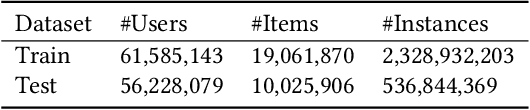
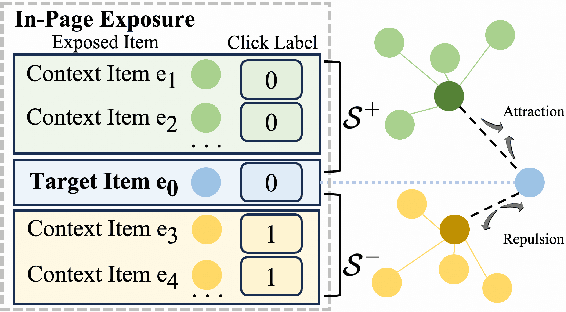
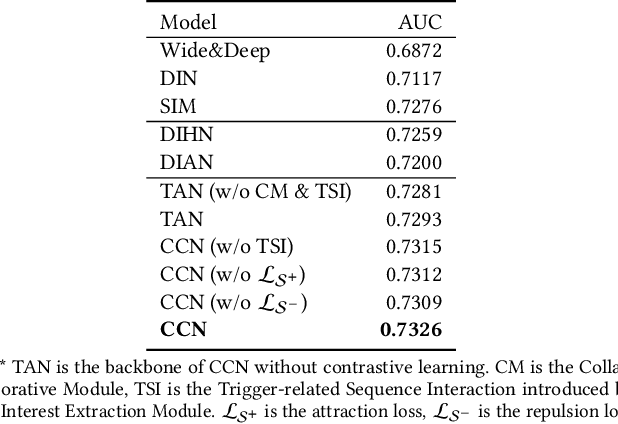
E-commerce platforms provide entrances for customers to enter mini-apps to meet their specific shopping needs. At the entrance of a mini-app, a trigger item recommended based on customers' historical preferences, is displayed to attract customers to enter the mini-app. Existing Click-Through Rate (CTR) prediction approaches have two significant weaknesses: (i) A portion of customer entries is driven by their interest in the mini-app itself rather than the trigger item. In such cases, approaches highly hinging on the trigger item tend to recommend similar items, thus misunderstanding the customers' real intention; (ii) Approaches that consider customers' intention toward mini-apps, require the regular existence of mini-apps for customers to cultivate routine shopping habits, making such approaches less robust for mini-apps that are available for only short periods (1 or 3 days) in Explosive Promotional Scenarios (EPS), such as the Black Friday and China's Double 11 Shopping Carnival. To address the above-mentioned issues, we introduce a more general and robust CTR prediction approach, dubbed Collaborative Contrastive Network (CCN). Given a user, CCN learns to identify two item clusters that can represent the user's interests and disinterests, via leveraging the collaborative relationship of co-click/co-non-click or the non-collaborative relationship of mono-click as the supervision signal for contrastive learning. This paradigm does not need to explicitly estimate user's binary entry intention and avoids amplifying the impact of the trigger item. Online A/B testing on large-scale real-world data demonstrates that CCN sets a new state-of-the-art performance on Taobao, boosting CTR by 12.3% and order volume by 12.7%.