 Add to Chrome
 Add to Firefox
 Add to Edge
From Chains to Trees: Parent-Conditioned Drafting for Semi-Autoregressive Speculative Decoding
Aug 03, 2026
Speculative decoding accelerates LLM inference only when drafted continuations survive target-model verification. Semi-autoregressive drafters such as DSpark predict an entire token block with one backbone forward and refine it with a lightweight Markov head. However, DSpark decodes this block as a single chain, so an early mismatch invalidates the remaining suffix and limits the benefit of large draft blocks. We show that the conditional structure already learned by DSpark can support multiple parent-consistent continuations without retraining or additional backbone passes. We introduce Parent-Conditioned Drafting Tree (PCTree), which uses the pretrained Markov head to score alternative children separately for each concrete parent and allocates a fixed verification budget to the most probable paths. This converts DSpark's linear draft into a tree while preserving its one-pass parallel backbone. Across Qwen3-{4B,8B,14B} and nine benchmarks, at $B{=}7$, measured speedup gains over autoregressive (AR) decoding, relative to matched DSpark, range from $3.1\%$ to $29.5\%$. On Qwen3-4B GSM8K at $B{=}16$, PCTree increases mean acceptance length from $9.41$ to $11.16$ and three-run mean AR speedup from $6.14{\times}$ to $6.60{\times}$. These show that parent-conditioned branching can turn conditional capacity already present in a semi-autoregressive drafter into end-to-end inference gains through an inference-only change.

Exploring Kinetic Curves Features for the Classification of Benign and Malignant Breast Lesions in DCE-MRI
Apr 22, 2024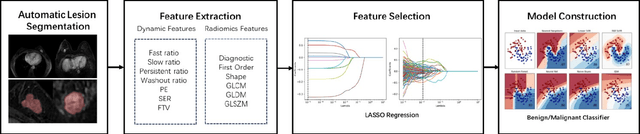

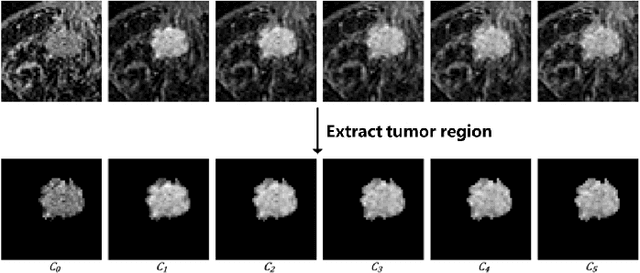
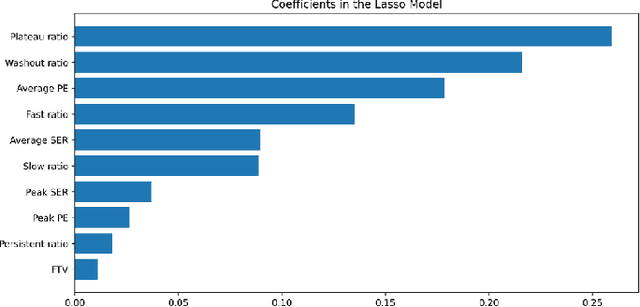
Breast cancer is the most common malignant tumor among women and the second cause of cancer-related death. Early diagnosis in clinical practice is crucial for timely treatment and prognosis. Dynamic contrast-enhanced magnetic resonance imaging (DCE-MRI) has revealed great usability in the preoperative diagnosis and assessing therapy effects thanks to its capability to reflect the morphology and dynamic characteristics of breast lesions. However, most existing computer-assisted diagnosis algorithms only consider conventional radiomic features when classifying benign and malignant lesions in DCE-MRI. In this study, we propose to fully leverage the dynamic characteristics from the kinetic curves as well as the radiomic features to boost the classification accuracy of benign and malignant breast lesions. The proposed method is a fully automated solution by directly analyzing the 3D features from the DCE-MRI. The proposed method is evaluated on an in-house dataset including 200 DCE-MRI scans with 298 breast tumors (172 benign and 126 malignant tumors), achieving favorable classification accuracy with an area under curve (AUC) of 0.94. By simultaneously considering the dynamic and radiomic features, it is beneficial to effectively distinguish between benign and malignant breast lesions.