 Add to Chrome
 Add to Firefox
 Add to Edge
Better, Faster, Stronger: Programmatic Skill Learning Best Reduces Agent Cost
Aug 11, 2026
Recently, the practice of augmenting LLM agent capability with skills has gained prevalence. We explore the cost effective adaptation of agents to novel domains by means of learning skills. Existing works focus on performance gain over cost effectiveness. As a result, little is known about what skill learning strategies save cost. We argue that among all the different skill learning methods, those that view skills as programs can achieve the best cost reduction. By executing sequences of actions deterministically, a program-augmented agent can reliably and cheaply achieve goals that would otherwise require trial and error and risk degenerate behavior over long horizons. An agent can learn at inference time by incrementally discovering these programs and equipping them for future tasks. We hypothesize that past trajectories contain enough signal to guide skill learning, even without replay or validation, provided the agent can learn to analyze them. To test our claims, we propose SpeedRunner, a coding agent that analyzes trajectories and refactors skills for better performance on future tasks. Across three different embodied environments, we show that SpeedRunner consistently achieves the frontier in learning and cost reduction while remaining robust against distribution shifts and environmental randomness.

Robust Data Preprocessing for Machine-Learning-Based Disk Failure Prediction in Cloud Production Environments
Dec 20, 2019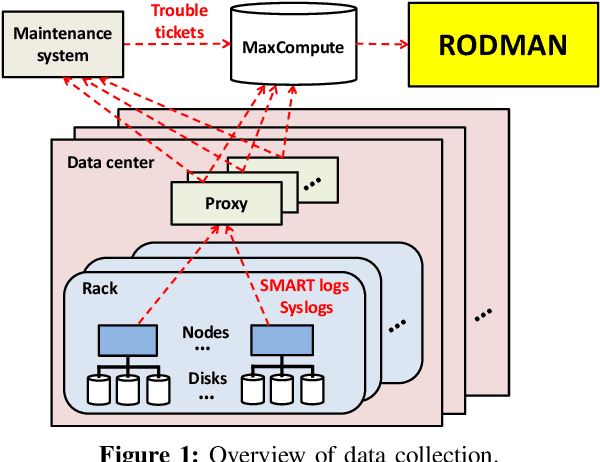
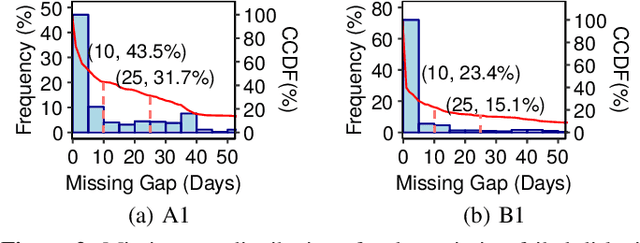
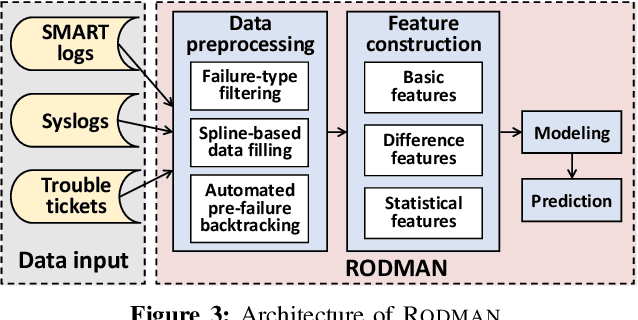
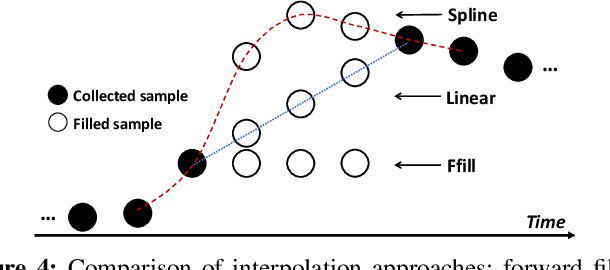
To provide proactive fault tolerance for modern cloud data centers, extensive studies have proposed machine learning (ML) approaches to predict imminent disk failures for early remedy and evaluated their approaches directly on public datasets (e.g., Backblaze SMART logs). However, in real-world production environments, the data quality is imperfect (e.g., inaccurate labeling, missing data samples, and complex failure types), thereby degrading the prediction accuracy. We present RODMAN, a robust data preprocessing pipeline that refines data samples before feeding them into ML models. We start with a large-scale trace-driven study of over three million disks from Alibaba Cloud's data centers, and motivate the practical challenges in ML-based disk failure prediction. We then design RODMAN with three data preprocessing echniques, namely failure-type filtering, spline-based data filling, and automated pre-failure backtracking, that are applicable for general ML models. Evaluation on both the Alibaba and Backblaze datasets shows that RODMAN improves the prediction accuracy compared to without data preprocessing under various settings.