 Add to Chrome
 Add to Firefox
 Add to Edge
EigeNet: Geometry-Informed Multi-Modal Learning for Few-shot Novel View RIR Prediction
May 27, 2026
Predicting spatially varying Room Impulse Response (RIR) from sparse observations is a critical but highly challenging inverse problem for immersive spatial audio rendering. In this work, we present EIGENET, a geometry-informed multi-modal framework for few-shot novel view RIR prediction. At its core is a Cross-view Alternate-attention Transformer that iteratively refines local intra-view acoustic structures and global cross-view spatial relationships. We empirically demonstrate that this architecture is capable of making full use of the multi-view multi-modal context while performing spatial-temporal reasoning for RIR prediction. Inspired by acoustic ray tracing, we design a geometry-informed modulation block to formulate the connection between geometric features and RIR power spectrum. In the mean time, an auxiliary loss is introduced to transform the single-target waveform prediction into a multi-task learning framework. Through ablation studies, we demonstrate that this design yields consistent performance gains regardless of the underlying backbone, thereby confirming its foundational utility and architecture-agnostic generalizability for RIR prediction task. Evaluated on both simulated and real-world benchmarks, EIGENET achieves both state-of-the-art performance in few-shot novel view RIR prediction and sim-to-real generalization. Codes and checkpoints are available on https://github.com/FEAfeatherTHER/EigeNet.

Building Audio-Visual Digital Twins with Smartphones
Dec 11, 2025Digital twins today are almost entirely visual, overlooking acoustics-a core component of spatial realism and interaction. We introduce AV-Twin, the first practical system that constructs editable audio-visual digital twins using only commodity smartphones. AV-Twin combines mobile RIR capture and a visual-assisted acoustic field model to efficiently reconstruct room acoustics. It further recovers per-surface material properties through differentiable acoustic rendering, enabling users to modify materials, geometry, and layout while automatically updating both audio and visuals. Together, these capabilities establish a practical path toward fully modifiable audio-visual digital twins for real-world environments.
Resounding Acoustic Fields with Reciprocity
Oct 23, 2025Achieving immersive auditory experiences in virtual environments requires flexible sound modeling that supports dynamic source positions. In this paper, we introduce a task called resounding, which aims to estimate room impulse responses at arbitrary emitter location from a sparse set of measured emitter positions, analogous to the relighting problem in vision. We leverage the reciprocity property and introduce Versa, a physics-inspired approach to facilitating acoustic field learning. Our method creates physically valid samples with dense virtual emitter positions by exchanging emitter and listener poses. We also identify challenges in deploying reciprocity due to emitter/listener gain patterns and propose a self-supervised learning approach to address them. Results show that Versa substantially improve the performance of acoustic field learning on both simulated and real-world datasets across different metrics. Perceptual user studies show that Versa can greatly improve the immersive spatial sound experience. Code, dataset and demo videos are available on the project website: https://waves.seas.upenn.edu/projects/versa.
Acoustic Volume Rendering for Neural Impulse Response Fields
Nov 09, 2024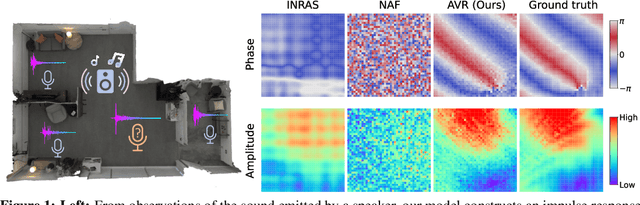
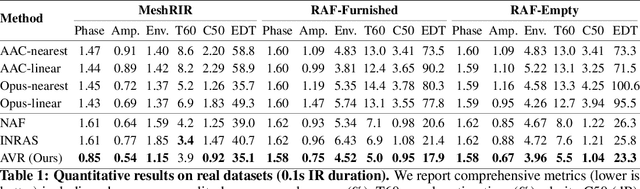
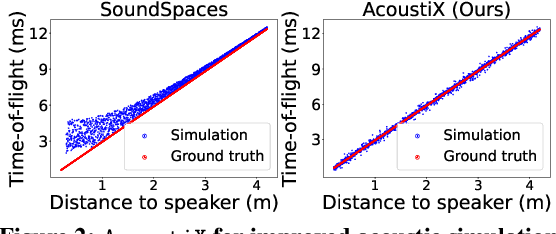
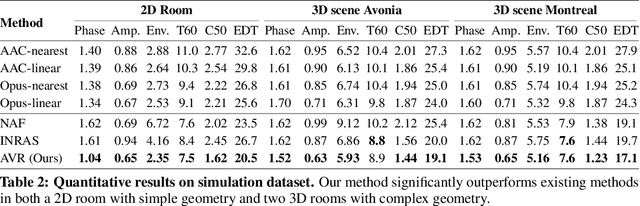
Realistic audio synthesis that captures accurate acoustic phenomena is essential for creating immersive experiences in virtual and augmented reality. Synthesizing the sound received at any position relies on the estimation of impulse response (IR), which characterizes how sound propagates in one scene along different paths before arriving at the listener's position. In this paper, we present Acoustic Volume Rendering (AVR), a novel approach that adapts volume rendering techniques to model acoustic impulse responses. While volume rendering has been successful in modeling radiance fields for images and neural scene representations, IRs present unique challenges as time-series signals. To address these challenges, we introduce frequency-domain volume rendering and use spherical integration to fit the IR measurements. Our method constructs an impulse response field that inherently encodes wave propagation principles and achieves state-of-the-art performance in synthesizing impulse responses for novel poses. Experiments show that AVR surpasses current leading methods by a substantial margin. Additionally, we develop an acoustic simulation platform, AcoustiX, which provides more accurate and realistic IR simulations than existing simulators. Code for AVR and AcoustiX are available at https://zitonglan.github.io/avr.