 Add to Chrome
 Add to Firefox
 Add to Edge
A Reconstruction System for Industrial Pipeline Inner Walls Using Panoramic Image Stitching with Endoscopic Imaging
Feb 28, 2026
Visual analysis and reconstruction of pipeline inner walls remain challenging in industrial inspection scenarios. This paper presents a dedicated reconstruction system for pipeline inner walls via industrial endoscopes, which is built on panoramic image stitching technology. Equipped with a custom graphical user interface (GUI), the system extracts key frames from endoscope video footage, and integrates polar coordinate transformation with image stitching techniques to unwrap annular video frames of pipeline inner walls into planar panoramic images. Experimental results demonstrate that the proposed method enables efficient processing of industrial endoscope videos, and the generated panoramic stitched images preserve all detailed features of pipeline inner walls in their entirety. This provides intuitive and accurate visual support for defect detection and condition assessment of pipeline inner walls. In comparison with the traditional frame-by-frame video review method, the proposed approach significantly elevates the efficiency of pipeline inner wall reconstruction and exhibits considerable engineering application value.

ViP$^2$-CLIP: Visual-Perception Prompting with Unified Alignment for Zero-Shot Anomaly Detection
May 23, 2025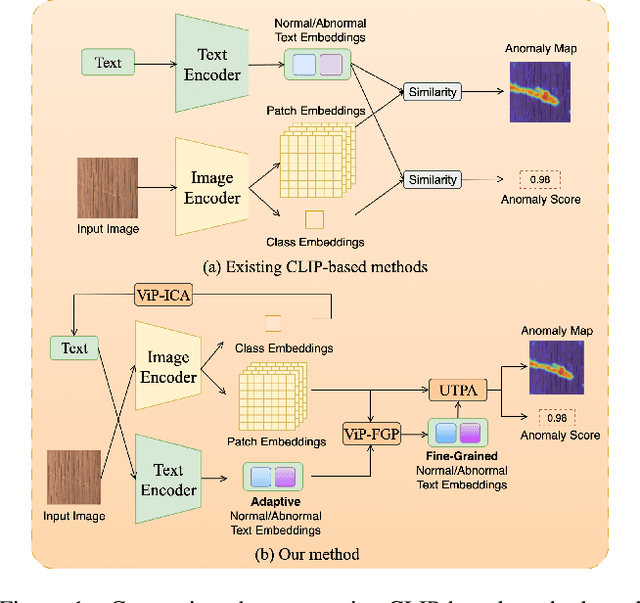
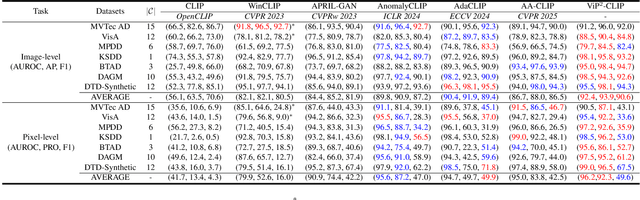
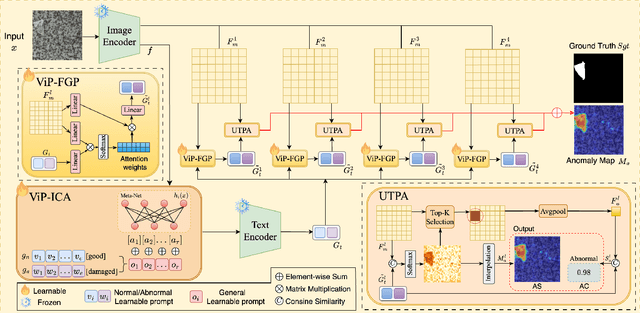
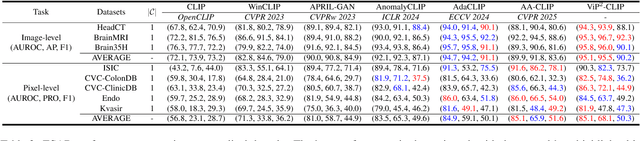
Zero-shot anomaly detection (ZSAD) aims to detect anomalies without any target domain training samples, relying solely on external auxiliary data. Existing CLIP-based methods attempt to activate the model's ZSAD potential via handcrafted or static learnable prompts. The former incur high engineering costs and limited semantic coverage, whereas the latter apply identical descriptions across diverse anomaly types, thus fail to adapt to complex variations. Furthermore, since CLIP is originally pretrained on large-scale classification tasks, its anomaly segmentation quality is highly sensitive to the exact wording of class names, severely constraining prompting strategies that depend on class labels. To address these challenges, we introduce ViP$^{2}$-CLIP. The key insight of ViP$^{2}$-CLIP is a Visual-Perception Prompting (ViP-Prompt) mechanism, which fuses global and multi-scale local visual context to adaptively generate fine-grained textual prompts, eliminating manual templates and class-name priors. This design enables our model to focus on precise abnormal regions, making it particularly valuable when category labels are ambiguous or privacy-constrained. Extensive experiments on 15 industrial and medical benchmarks demonstrate that ViP$^{2}$-CLIP achieves state-of-the-art performance and robust cross-domain generalization.