 Add to Chrome
 Add to Firefox
 Add to Edge
ARES: Scalable and Practical Gradient Inversion Attack in Federated Learning through Activation Recovery
Mar 18, 2026
Federated Learning (FL) enables collaborative model training by sharing model updates instead of raw data, aiming to protect user privacy. However, recent studies reveal that these shared updates can inadvertently leak sensitive training data through gradient inversion attacks (GIAs). Among them, active GIAs are particularly powerful, enabling high-fidelity reconstruction of individual samples even under large batch sizes. Nevertheless, existing approaches often require architectural modifications, which limit their practical applicability. In this work, we bridge this gap by introducing the Activation REcovery via Sparse inversion (ARES) attack, an active GIA designed to reconstruct training samples from large training batches without requiring architectural modifications. Specifically, we formulate the recovery problem as a noisy sparse recovery task and solve it using the generalized Least Absolute Shrinkage and Selection Operator (Lasso). To extend the attack to multi-sample recovery, ARES incorporates the imprint method to disentangle activations, enabling scalable per-sample reconstruction. We further establish the expected recovery rate and derive an upper bound on the reconstruction error, providing theoretical guarantees for the ARES attack. Extensive experiments on CNNs and MLPs demonstrate that ARES achieves high-fidelity reconstruction across diverse datasets, significantly outperforming prior GIAs under large batch sizes and realistic FL settings. Our results highlight that intermediate activations pose a serious and underestimated privacy risk in FL, underscoring the urgent need for stronger defenses.

Beyond Denial-of-Service: The Puppeteer's Attack for Fine-Grained Control in Ranking-Based Federated Learning
Jan 21, 2026Federated Rank Learning (FRL) is a promising Federated Learning (FL) paradigm designed to be resilient against model poisoning attacks due to its discrete, ranking-based update mechanism. Unlike traditional FL methods that rely on model updates, FRL leverages discrete rankings as a communication parameter between clients and the server. This approach significantly reduces communication costs and limits an adversary's ability to scale or optimize malicious updates in the continuous space, thereby enhancing its robustness. This makes FRL particularly appealing for applications where system security and data privacy are crucial, such as web-based auction and bidding platforms. While FRL substantially reduces the attack surface, we demonstrate that it remains vulnerable to a new class of local model poisoning attack, i.e., fine-grained control attacks. We introduce the Edge Control Attack (ECA), the first fine-grained control attack tailored to ranking-based FL frameworks. Unlike conventional denial-of-service (DoS) attacks that cause conspicuous disruptions, ECA enables an adversary to precisely degrade a competitor's accuracy to any target level while maintaining a normal-looking convergence trajectory, thereby avoiding detection. ECA operates in two stages: (i) identifying and manipulating Ascending and Descending Edges to align the global model with the target model, and (ii) widening the selection boundary gap to stabilize the global model at the target accuracy. Extensive experiments across seven benchmark datasets and nine Byzantine-robust aggregation rules (AGRs) show that ECA achieves fine-grained accuracy control with an average error of only 0.224%, outperforming the baseline by up to 17x. Our findings highlight the need for stronger defenses against advanced poisoning attacks. Our code is available at: https://github.com/Chenzh0205/ECA
Not All Edges are Equally Robust: Evaluating the Robustness of Ranking-Based Federated Learning
Mar 12, 2025Federated Ranking Learning (FRL) is a state-of-the-art FL framework that stands out for its communication efficiency and resilience to poisoning attacks. It diverges from the traditional FL framework in two ways: 1) it leverages discrete rankings instead of gradient updates, significantly reducing communication costs and limiting the potential space for malicious updates, and 2) it uses majority voting on the server side to establish the global ranking, ensuring that individual updates have minimal influence since each client contributes only a single vote. These features enhance the system's scalability and position FRL as a promising paradigm for FL training. However, our analysis reveals that FRL is not inherently robust, as certain edges are particularly vulnerable to poisoning attacks. Through a theoretical investigation, we prove the existence of these vulnerable edges and establish a lower bound and an upper bound for identifying them in each layer. Based on this finding, we introduce a novel local model poisoning attack against FRL, namely the Vulnerable Edge Manipulation (VEM) attack. The VEM attack focuses on identifying and perturbing the most vulnerable edges in each layer and leveraging an optimization-based approach to maximize the attack's impact. Through extensive experiments on benchmark datasets, we demonstrate that our attack achieves an overall 53.23% attack impact and is 3.7x more impactful than existing methods. Our findings highlight significant vulnerabilities in ranking-based FL systems and underline the urgency for the development of new robust FL frameworks.
AGRAMPLIFIER: Defending Federated Learning Against Poisoning Attacks Through Local Update Amplification
Nov 23, 2023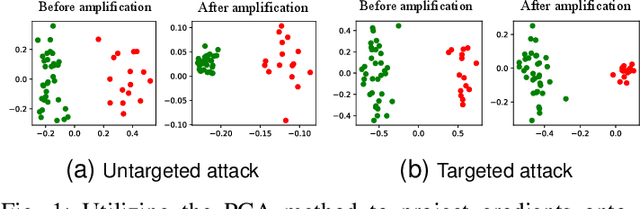
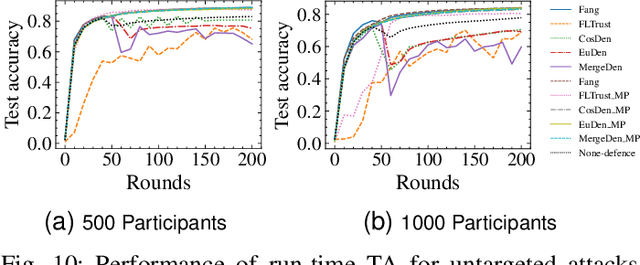


The collaborative nature of federated learning (FL) poses a major threat in the form of manipulation of local training data and local updates, known as the Byzantine poisoning attack. To address this issue, many Byzantine-robust aggregation rules (AGRs) have been proposed to filter out or moderate suspicious local updates uploaded by Byzantine participants. This paper introduces a novel approach called AGRAMPLIFIER, aiming to simultaneously improve the robustness, fidelity, and efficiency of the existing AGRs. The core idea of AGRAMPLIFIER is to amplify the "morality" of local updates by identifying the most repressive features of each gradient update, which provides a clearer distinction between malicious and benign updates, consequently improving the detection effect. To achieve this objective, two approaches, namely AGRMP and AGRXAI, are proposed. AGRMP organizes local updates into patches and extracts the largest value from each patch, while AGRXAI leverages explainable AI methods to extract the gradient of the most activated features. By equipping AGRAMPLIFIER with the existing Byzantine-robust mechanisms, we successfully enhance the model's robustness, maintaining its fidelity and improving overall efficiency. AGRAMPLIFIER is universally compatible with the existing Byzantine-robust mechanisms. The paper demonstrates its effectiveness by integrating it with all mainstream AGR mechanisms. Extensive evaluations conducted on seven datasets from diverse domains against seven representative poisoning attacks consistently show enhancements in robustness, fidelity, and efficiency, with average gains of 40.08%, 39.18%, and 10.68%, respectively.
Yield Evaluation of Citrus Fruits based on the YoloV5 compressed by Knowledge Distillation
Nov 16, 2022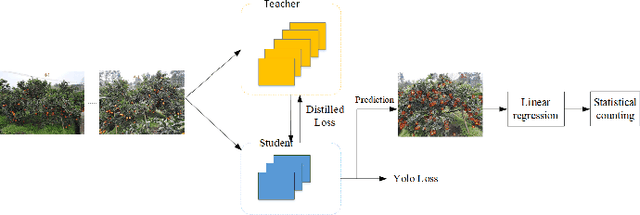

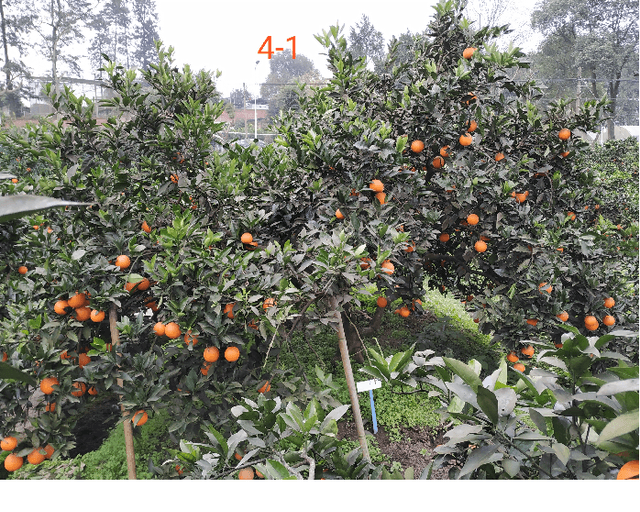
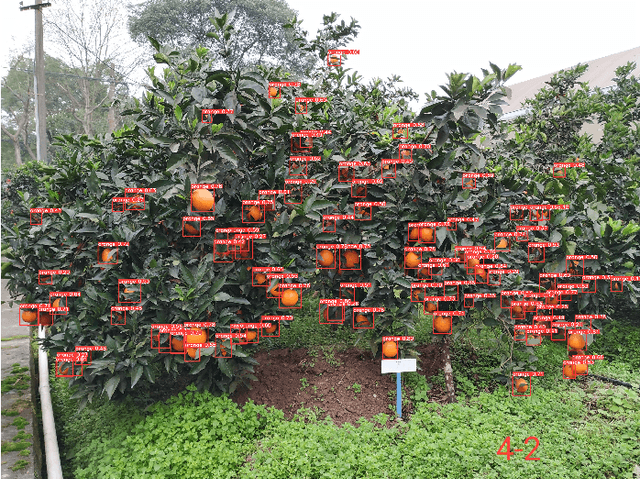
In the field of planting fruit trees, pre-harvest estimation of fruit yield is important for fruit storage and price evaluation. However, considering the cost, the yield of each tree cannot be assessed by directly picking the immature fruit. Therefore, the problem is a very difficult task. In this paper, a fruit counting and yield assessment method based on computer vision is proposed for citrus fruit trees as an example. Firstly, images of single fruit trees from different angles are acquired and the number of fruits is detected using a deep Convolutional Neural Network model YOLOv5, and the model is compressed using a knowledge distillation method. Then, a linear regression method is used to model yield-related features and evaluate yield. Experiments show that the proposed method can accurately count fruits and approximate the yield.