 Add to Chrome
 Add to Firefox
 Add to Edge
LiveMem: Maintaining Memory State Continuity in Long-Running LLM Inference
Aug 03, 2026
Long-running assistants and agents consume interaction streams that eventually outgrow the context. Existing context retention, summarization, and retrieval preserve access to selected history, but do not provide a persistent state over the full lifecycle when working context changes. We formulate this missing inference capability as \emph{state continuity under context turnover}: carrying computation forward through a fixed-capacity memory state whose lifetime is independent of the active context. We introduce an intrinsic memory method, \textbf{LiveMem}, which augments a pretrained full-attention LLM with a memory state that preserves the historical information over the whole lifecycle while the main attention path retains a bounded KV window. Context turnover and memory state maintaining, memory-oriented post-training, and state-aware serving jointly make this memory state load bearing after its originating tokens are released. Our experiments show that LiveMem achieves leading overall performance among evaluated systems and other intrinsic memory methods. Experiments on LongMemEval show that LiveMem is able to answer the question based on the memory state, even when the supporting evidence has been removed from the current context, and evidence-distance analysis shows that useful information persists beyond the active window. LiveMem thus establishes state continuity as a distinct and complementary abstraction for continual LLM inference.

Semantics-Enhanced Retrieval-Augmented Time Series Forecasting
Jun 12, 2026Time series forecasting models often benefit from historical patterns. Inspired by Retrieval-Augmented Generation (RAG), recent research explored retrieving relevant historical time series segments to enhance forecasting. However, relying solely on time series similarity is often insufficient for retrieval under non-stationarity. To address this, we propose a multimodal approach: a \textbf{S}emantics-\textbf{E}nhanced \textbf{R}etrieval-\textbf{A}ugmented Time Series \textbf{F}orecasting framework, SERAF. Unlike mainstream approaches that depend only on time series similarity, SERAF conducts dual retrieval over the time series and their self-generated textual descriptions. It retrieves two complementary sets of historical patterns and corresponding futures, which are selectively and jointly used to guide future predictions. Experiments across seven real-world datasets demonstrate the effectiveness of SERAF in bridging numerical and semantic views of time series compared with state-of-the-art baselines.
Stationarity-Aware Retrieval-Augmented Time Series Forecasting
Jun 02, 2026Time series forecasting relies on historical patterns, but real-world series often exhibit non-stationarity and regime shifts that challenge fully parametric forecasters. Inspired by Retrieval-Augmented Generation (RAG), recent work augments forecasters by retrieving relevant historical segments and using them as external evidence at inference time. However, due to the intrinsic non-stationarity of real-world time series, a highly similar past segment does not necessarily imply a similar future, rendering similarity-only retrieval brittle and prone to redundancy. We propose Stationarity-Aware Retrieval-Augmented Time Series Forecasting (SARAF), a framework that adaptively balances relevance and diversity in retrieval. SARAF first forms a candidate pool via temporal similarity with time-aligned enhancement, then applies a diversity-aware selection strategy to cover heterogeneous historical regimes, with the diversification strength automatically modulated by dataset-level stationarity. Moreover, SARAF uses stationarity-aware aggregation to fuse the retrieved futures. Extensive experiments on eight real-world datasets show that SARAF achieves competitive forecasting performance and improves average accuracy and robustness over strong baselines, with particularly clear benefits under challenging non-stationary settings. Code: https://github.com/ShiqiaoZhou/SARAF.
iTARGET: Interpretable Tailored Age Regression for Grouped Epigenetic Traits
Jan 04, 2025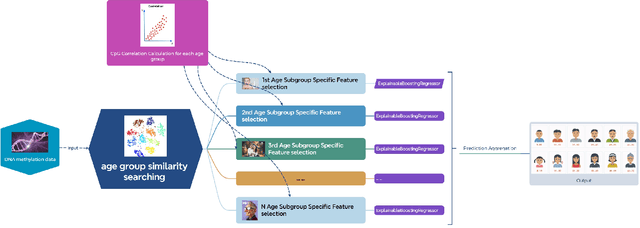
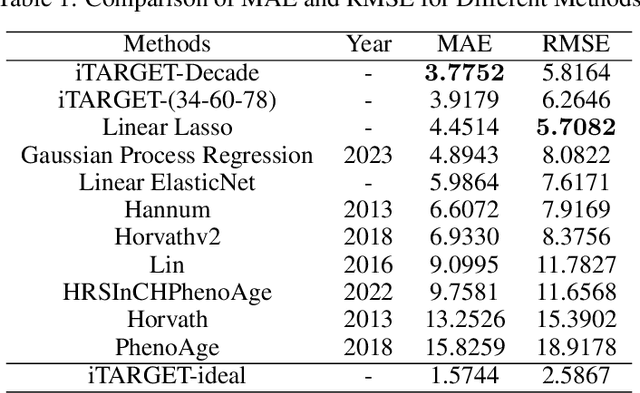
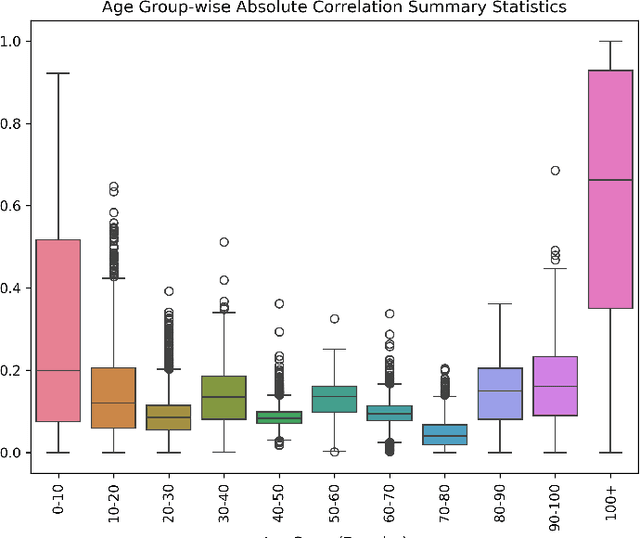
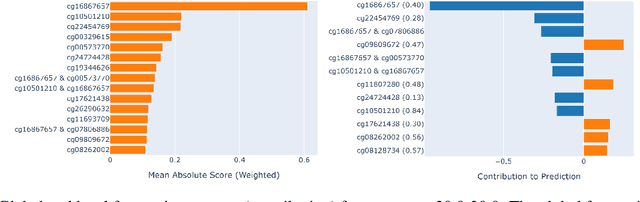
Accurately predicting chronological age from DNA methylation patterns is crucial for advancing biological age estimation. However, this task is made challenging by Epigenetic Correlation Drift (ECD) and Heterogeneity Among CpGs (HAC), which reflect the dynamic relationship between methylation and age across different life stages. To address these issues, we propose a novel two-phase algorithm. The first phase employs similarity searching to cluster methylation profiles by age group, while the second phase uses Explainable Boosting Machines (EBM) for precise, group-specific prediction. Our method not only improves prediction accuracy but also reveals key age-related CpG sites, detects age-specific changes in aging rates, and identifies pairwise interactions between CpG sites. Experimental results show that our approach outperforms traditional epigenetic clocks and machine learning models, offering a more accurate and interpretable solution for biological age estimation with significant implications for aging research.