 Add to Chrome
 Add to Firefox
 Add to Edge
Semantics-Enhanced Retrieval-Augmented Time Series Forecasting
Jun 12, 2026
Time series forecasting models often benefit from historical patterns. Inspired by Retrieval-Augmented Generation (RAG), recent research explored retrieving relevant historical time series segments to enhance forecasting. However, relying solely on time series similarity is often insufficient for retrieval under non-stationarity. To address this, we propose a multimodal approach: a \textbf{S}emantics-\textbf{E}nhanced \textbf{R}etrieval-\textbf{A}ugmented Time Series \textbf{F}orecasting framework, SERAF. Unlike mainstream approaches that depend only on time series similarity, SERAF conducts dual retrieval over the time series and their self-generated textual descriptions. It retrieves two complementary sets of historical patterns and corresponding futures, which are selectively and jointly used to guide future predictions. Experiments across seven real-world datasets demonstrate the effectiveness of SERAF in bridging numerical and semantic views of time series compared with state-of-the-art baselines.

Stationarity-Aware Retrieval-Augmented Time Series Forecasting
Jun 02, 2026Time series forecasting relies on historical patterns, but real-world series often exhibit non-stationarity and regime shifts that challenge fully parametric forecasters. Inspired by Retrieval-Augmented Generation (RAG), recent work augments forecasters by retrieving relevant historical segments and using them as external evidence at inference time. However, due to the intrinsic non-stationarity of real-world time series, a highly similar past segment does not necessarily imply a similar future, rendering similarity-only retrieval brittle and prone to redundancy. We propose Stationarity-Aware Retrieval-Augmented Time Series Forecasting (SARAF), a framework that adaptively balances relevance and diversity in retrieval. SARAF first forms a candidate pool via temporal similarity with time-aligned enhancement, then applies a diversity-aware selection strategy to cover heterogeneous historical regimes, with the diversification strength automatically modulated by dataset-level stationarity. Moreover, SARAF uses stationarity-aware aggregation to fuse the retrieved futures. Extensive experiments on eight real-world datasets show that SARAF achieves competitive forecasting performance and improves average accuracy and robustness over strong baselines, with particularly clear benefits under challenging non-stationary settings. Code: https://github.com/ShiqiaoZhou/SARAF.
Uncertainty-Aware Dual-Ranking Strategy for Offline Data-Driven Multi-Objective Optimization
Nov 09, 2025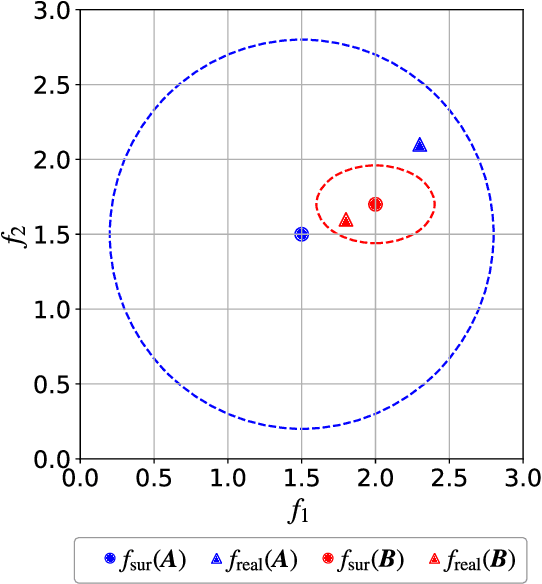

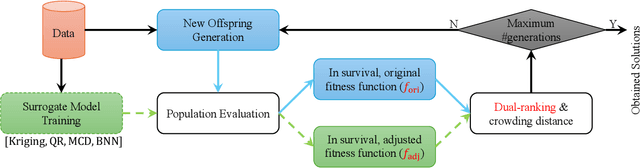
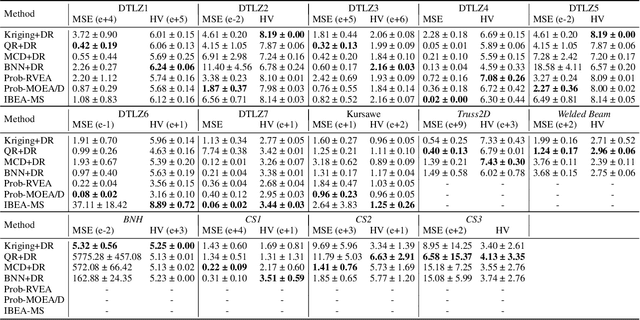
Offline data-driven Multi-Objective Optimization Problems (MOPs) rely on limited data from simulations, experiments, or sensors. This scarcity leads to high epistemic uncertainty in surrogate predictions. Conventional surrogate methods such as Kriging assume Gaussian distributions, which can yield suboptimal results when the assumptions fail. To address these issues, we propose a simple yet novel dual-ranking strategy, working with a basic multi-objective evolutionary algorithm, NSGA-II, where the built-in non-dominated sorting is kept and the second rank is devised for uncertainty estimation. In the latter, we utilize the uncertainty estimates given by several surrogate models, including Quantile Regression (QR), Monte Carlo Dropout (MCD), and Bayesian Neural Networks (BNNs). Concretely, with this dual-ranking strategy, each solution's final rank is the average of its non-dominated sorting rank and a rank derived from the uncertainty-adjusted fitness function, thus reducing the risk of misguided optimization under data constraints. We evaluate our approach on benchmark and real-world MOPs, comparing it to state-of-the-art methods. The results show that our dual-ranking strategy significantly improves the performance of NSGA-II in offline settings, achieving competitive outcomes compared with traditional surrogate-based methods. This framework advances uncertainty-aware multi-objective evolutionary algorithms, offering a robust solution for data-limited, real-world applications.