 Add to Chrome
 Add to Firefox
 Add to Edge
Uncertainty-Aware Dual-Ranking Strategy for Offline Data-Driven Multi-Objective Optimization
Nov 09, 2025
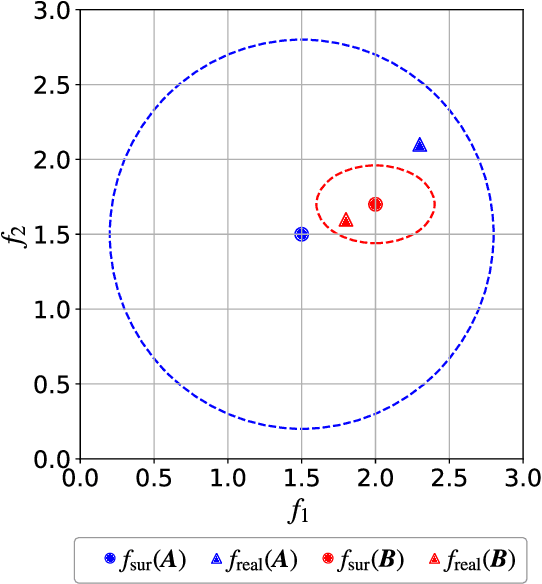

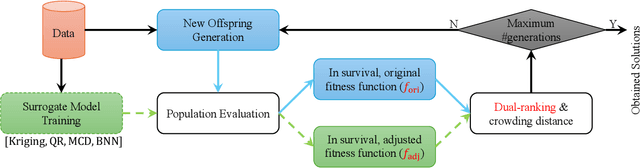
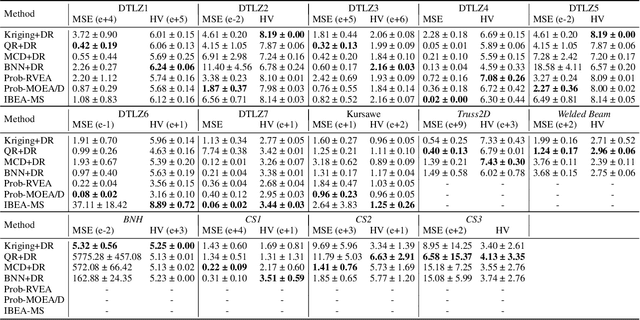
Offline data-driven Multi-Objective Optimization Problems (MOPs) rely on limited data from simulations, experiments, or sensors. This scarcity leads to high epistemic uncertainty in surrogate predictions. Conventional surrogate methods such as Kriging assume Gaussian distributions, which can yield suboptimal results when the assumptions fail. To address these issues, we propose a simple yet novel dual-ranking strategy, working with a basic multi-objective evolutionary algorithm, NSGA-II, where the built-in non-dominated sorting is kept and the second rank is devised for uncertainty estimation. In the latter, we utilize the uncertainty estimates given by several surrogate models, including Quantile Regression (QR), Monte Carlo Dropout (MCD), and Bayesian Neural Networks (BNNs). Concretely, with this dual-ranking strategy, each solution's final rank is the average of its non-dominated sorting rank and a rank derived from the uncertainty-adjusted fitness function, thus reducing the risk of misguided optimization under data constraints. We evaluate our approach on benchmark and real-world MOPs, comparing it to state-of-the-art methods. The results show that our dual-ranking strategy significantly improves the performance of NSGA-II in offline settings, achieving competitive outcomes compared with traditional surrogate-based methods. This framework advances uncertainty-aware multi-objective evolutionary algorithms, offering a robust solution for data-limited, real-world applications.

iTARGET: Interpretable Tailored Age Regression for Grouped Epigenetic Traits
Jan 04, 2025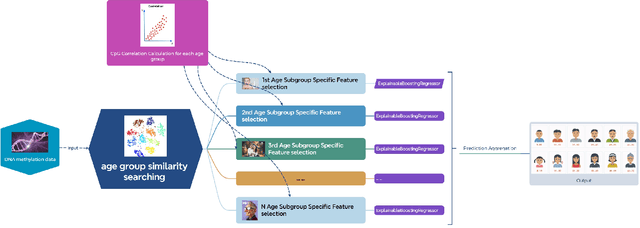
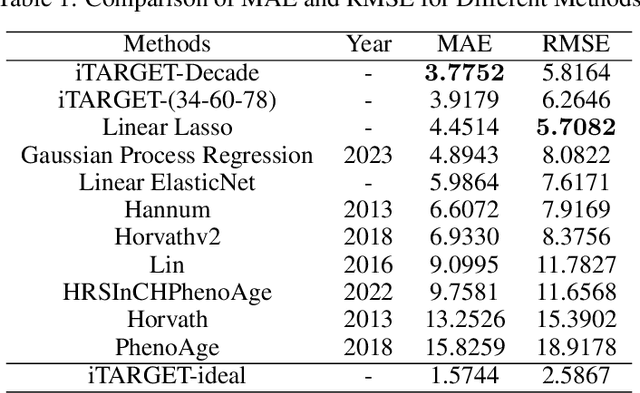
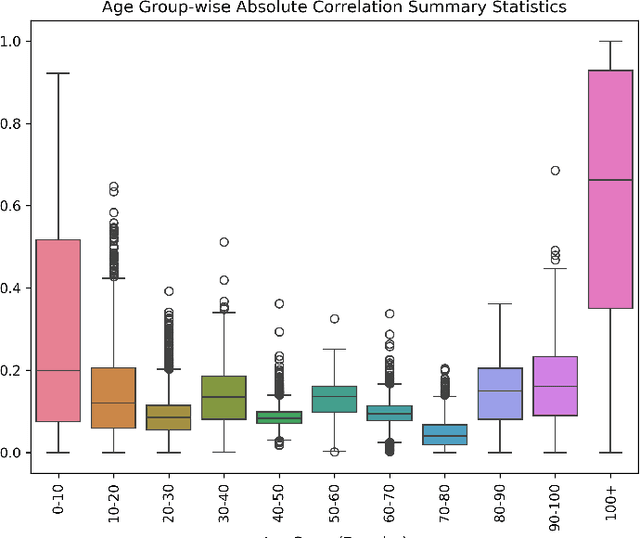
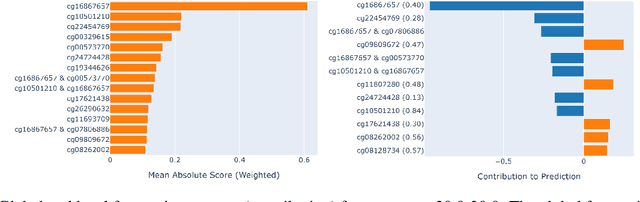
Accurately predicting chronological age from DNA methylation patterns is crucial for advancing biological age estimation. However, this task is made challenging by Epigenetic Correlation Drift (ECD) and Heterogeneity Among CpGs (HAC), which reflect the dynamic relationship between methylation and age across different life stages. To address these issues, we propose a novel two-phase algorithm. The first phase employs similarity searching to cluster methylation profiles by age group, while the second phase uses Explainable Boosting Machines (EBM) for precise, group-specific prediction. Our method not only improves prediction accuracy but also reveals key age-related CpG sites, detects age-specific changes in aging rates, and identifies pairwise interactions between CpG sites. Experimental results show that our approach outperforms traditional epigenetic clocks and machine learning models, offering a more accurate and interpretable solution for biological age estimation with significant implications for aging research.