 Add to Chrome
 Add to Firefox
 Add to Edge
Off-Policy Evaluation for Missingness-Aware Policies in MDPs with Rewards Missing Not at Random
Jun 18, 2026
In offline Reinforcement Learning, immediate rewards in logged batch data are often unobserved due to sparse or irregular record-keeping, or censored beyond certain reward values. This issue arises in practical settings, including health care and marketing. We investigate off-policy evaluation (OPE) in finite-horizon Markov decision processes when rewards are missing not at random (MNAR), which breaks ignorability and induces selection bias even after conditioning on states and actions. To address this, we formalize a reward-dependent propensity model and use future states as shadow variables to identify the full-data conditional mean reward. We further introduce a bridge function that recovers the conditional mean reward without explicitly modeling the MNAR mechanism, and estimate it via a min-max procedure to avoid double sampling. Building upon these identification results, we propose an Fitted-Q-Evaluation-style estimator that propagates the recovered rewards while allowing target policies to depend on past missingness indicators. Finally, we establish consistency and finite-sample error bounds for our OPE estimator, and show through experiments the strong performance of our method compared to existing methods on simulated and MIMIC-III Sepsis data.

SEA: A Scalable Entity Alignment System
Apr 14, 2023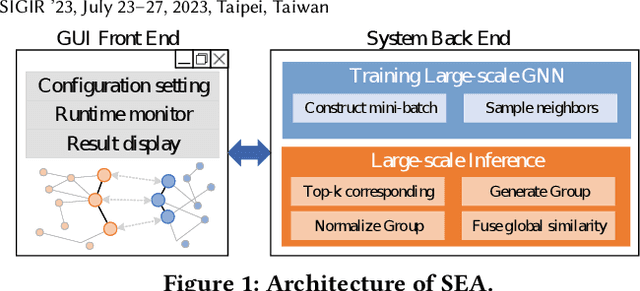
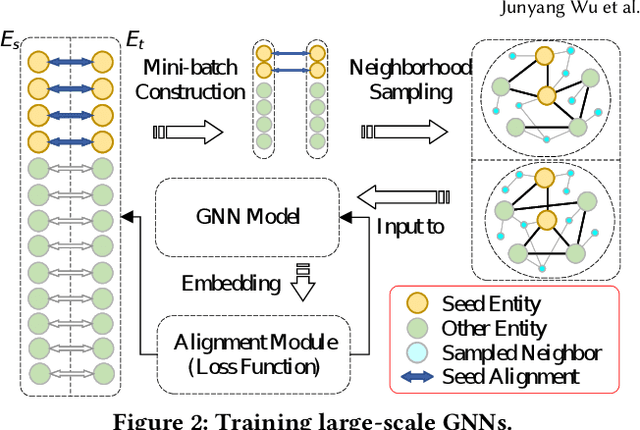
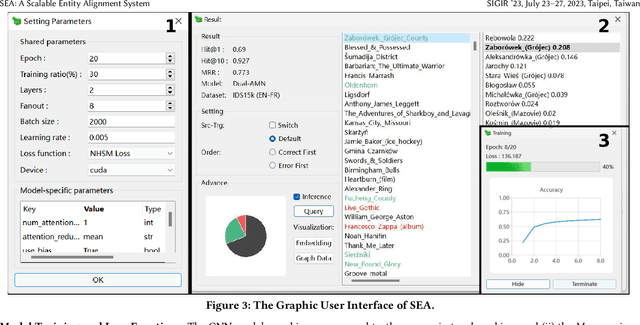
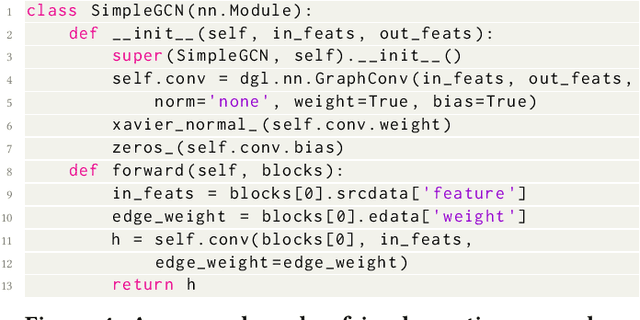
Entity alignment (EA) aims to find equivalent entities in different knowledge graphs (KGs). State-of-the-art EA approaches generally use Graph Neural Networks (GNNs) to encode entities. However, most of them train the models and evaluate the results in a fullbatch fashion, which prohibits EA from being scalable on largescale datasets. To enhance the usability of GNN-based EA models in real-world applications, we present SEA, a scalable entity alignment system that enables to (i) train large-scale GNNs for EA, (ii) speed up the normalization and the evaluation process, and (iii) report clear results for users to estimate different models and parameter settings. SEA can be run on a computer with merely one graphic card. Moreover, SEA encompasses six state-of-the-art EA models and provides access for users to quickly establish and evaluate their own models. Thus, SEA allows users to perform EA without being involved in tedious implementations, such as negative sampling and GPU-accelerated evaluation. With SEA, users can gain a clear view of the model performance. In the demonstration, we show that SEA is user-friendly and is of high scalability even on computers with limited computational resources.