 Add to Chrome
 Add to Firefox
 Add to Edge
SPECTRE: Spectral Pre-training Embeddings with Cylindrical Temporal Rotary Position Encoding for Fine-Grained sEMG-Based Movement Decoding
Dec 27, 2025
Decoding fine-grained movement from non-invasive surface Electromyography (sEMG) is a challenge for prosthetic control due to signal non-stationarity and low signal-to-noise ratios. Generic self-supervised learning (SSL) frameworks often yield suboptimal results on sEMG as they attempt to reconstruct noisy raw signals and lack the inductive bias to model the cylindrical topology of electrode arrays. To overcome these limitations, we introduce SPECTRE, a domain-specific SSL framework. SPECTRE features two primary contributions: a physiologically-grounded pre-training task and a novel positional encoding. The pre-training involves masked prediction of discrete pseudo-labels from clustered Short-Time Fourier Transform (STFT) representations, compelling the model to learn robust, physiologically relevant frequency patterns. Additionally, our Cylindrical Rotary Position Embedding (CyRoPE) factorizes embeddings along linear temporal and annular spatial dimensions, explicitly modeling the forearm sensor topology to capture muscle synergies. Evaluations on multiple datasets, including challenging data from individuals with amputation, demonstrate that SPECTRE establishes a new state-of-the-art for movement decoding, significantly outperforming both supervised baselines and generic SSL approaches. Ablation studies validate the critical roles of both spectral pre-training and CyRoPE. SPECTRE provides a robust foundation for practical myoelectric interfaces capable of handling real-world sEMG complexities.

Caption This, Reason That: VLMs Caught in the Middle
May 24, 2025
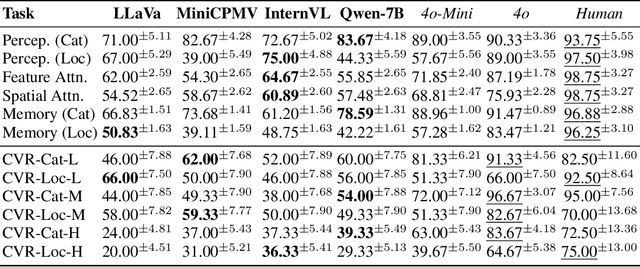
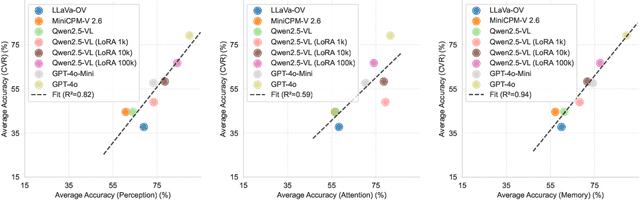
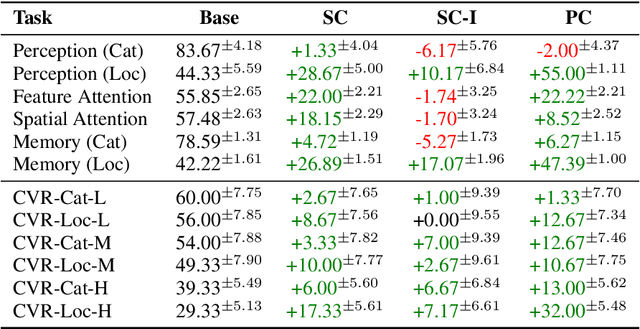
Vision-Language Models (VLMs) have shown remarkable progress in visual understanding in recent years. Yet, they still lag behind human capabilities in specific visual tasks such as counting or relational reasoning. To understand the underlying limitations, we adopt methodologies from cognitive science, analyzing VLM performance along core cognitive axes: Perception, Attention, and Memory. Using a suite of tasks targeting these abilities, we evaluate state-of-the-art VLMs, including GPT-4o. Our analysis reveals distinct cognitive profiles: while advanced models approach ceiling performance on some tasks (e.g. category identification), a significant gap persists, particularly in tasks requiring spatial understanding or selective attention. Investigating the source of these failures and potential methods for improvement, we employ a vision-text decoupling analysis, finding that models struggling with direct visual reasoning show marked improvement when reasoning over their own generated text captions. These experiments reveal a strong need for improved VLM Chain-of-Thought (CoT) abilities, even in models that consistently exceed human performance. Furthermore, we demonstrate the potential of targeted fine-tuning on composite visual reasoning tasks and show that fine-tuning smaller VLMs substantially improves core cognitive abilities. While this improvement does not translate to large enhancements on challenging, out-of-distribution benchmarks, we show broadly that VLM performance on our datasets strongly correlates with performance on these other benchmarks. Our work provides a detailed analysis of VLM cognitive strengths and weaknesses and identifies key bottlenecks in simultaneous perception and reasoning while also providing an effective and simple solution.