 Add to Chrome
 Add to Firefox
 Add to Edge
MENASpeechBank: A Reference Voice Bank with Persona-Conditioned Multi-Turn Conversations for AudioLLMs
Feb 03, 2026
Audio large language models (AudioLLMs) enable instruction-following over speech and general audio, but progress is increasingly limited by the lack of diverse, conversational, instruction-aligned speech-text data. This bottleneck is especially acute for persona-grounded interactions and dialectal coverage, where collecting and releasing real multi-speaker recordings is costly and slow. We introduce MENASpeechBank, a reference speech bank comprising about 18K high-quality utterances from 124 speakers spanning multiple MENA countries, covering English, Modern Standard Arabic (MSA), and regional Arabic varieties. Building on this resource, we develop a controllable synthetic data pipeline that: (i) constructs persona profiles enriched with World Values Survey-inspired attributes, (ii) defines a taxonomy of about 5K conversational scenarios, (iii) matches personas to scenarios via semantic similarity, (iv) generates about 417K role-play conversations with an LLM where the user speaks as the persona and the assistant behaves as a helpful agent, and (v) synthesizes the user turns by conditioning on reference speaker audio to preserve speaker identity and diversity. We evaluate both synthetic and human-recorded conversations and provide detailed analysis. We will release MENASpeechBank and the generated conversations publicly for the community.

Overview of the CLEF--2021 CheckThat! Lab on Detecting Check-Worthy Claims, Previously Fact-Checked Claims, and Fake News
Sep 23, 2021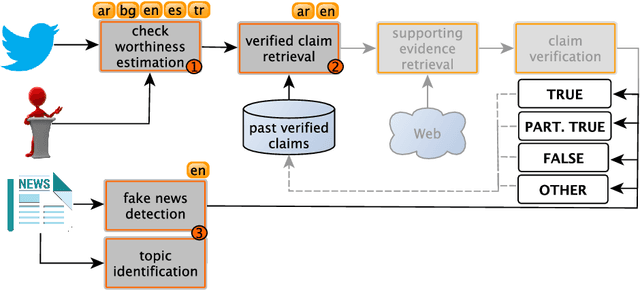
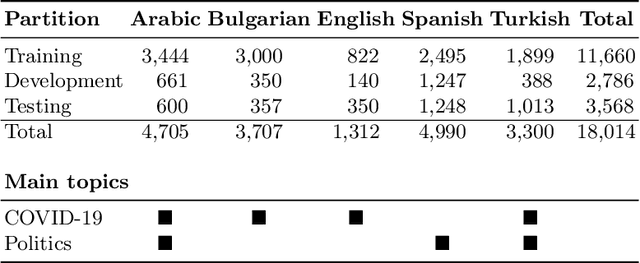
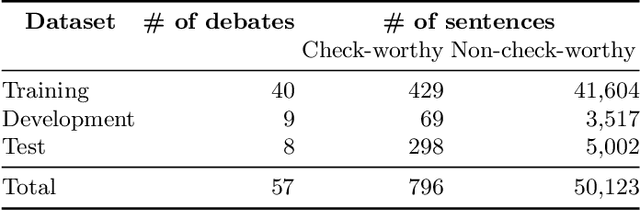
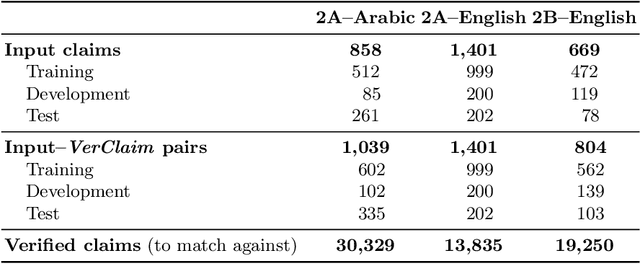
We describe the fourth edition of the CheckThat! Lab, part of the 2021 Conference and Labs of the Evaluation Forum (CLEF). The lab evaluates technology supporting tasks related to factuality, and covers Arabic, Bulgarian, English, Spanish, and Turkish. Task 1 asks to predict which posts in a Twitter stream are worth fact-checking, focusing on COVID-19 and politics (in all five languages). Task 2 asks to determine whether a claim in a tweet can be verified using a set of previously fact-checked claims (in Arabic and English). Task 3 asks to predict the veracity of a news article and its topical domain (in English). The evaluation is based on mean average precision or precision at rank k for the ranking tasks, and macro-F1 for the classification tasks. This was the most popular CLEF-2021 lab in terms of team registrations: 132 teams. Nearly one-third of them participated: 15, 5, and 25 teams submitted official runs for tasks 1, 2, and 3, respectively.
* Check-Worthiness Estimation, Fact-Checking, Veracity, Evidence-based Verification, Detecting Previously Fact-Checked Claims, Social Media Verification, Computational Journalism, COVID-19
Overview of CheckThat! 2020: Automatic Identification and Verification of Claims in Social Media
Jul 15, 2020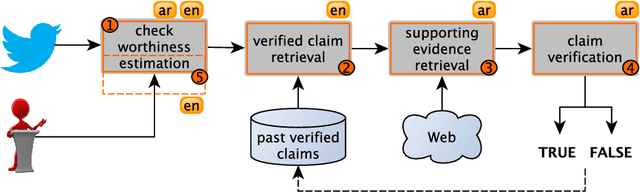
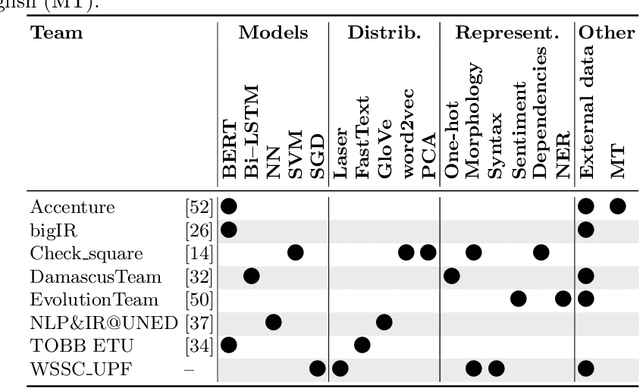
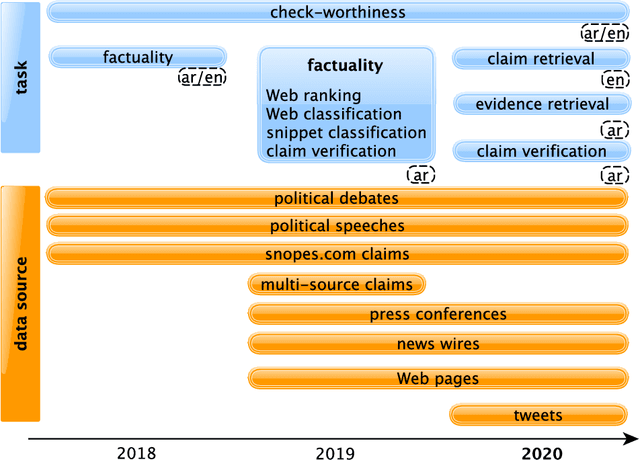
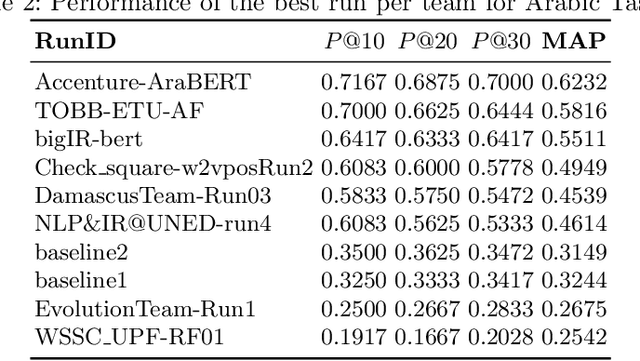
We present an overview of the third edition of the CheckThat! Lab at CLEF 2020. The lab featured five tasks in two different languages: English and Arabic. The first four tasks compose the full pipeline of claim verification in social media: Task 1 on check-worthiness estimation, Task 2 on retrieving previously fact-checked claims, Task 3 on evidence retrieval, and Task 4 on claim verification. The lab is completed with Task 5 on check-worthiness estimation in political debates and speeches. A total of 67 teams registered to participate in the lab (up from 47 at CLEF 2019), and 23 of them actually submitted runs (compared to 14 at CLEF 2019). Most teams used deep neural networks based on BERT, LSTMs, or CNNs, and achieved sizable improvements over the baselines on all tasks. Here we describe the tasks setup, the evaluation results, and a summary of the approaches used by the participants, and we discuss some lessons learned. Last but not least, we release to the research community all datasets from the lab as well as the evaluation scripts, which should enable further research in the important tasks of check-worthiness estimation and automatic claim verification.
* Check-Worthiness Estimation, Fact-Checking, Veracity, Evidence-based Verification, Detecting Previously Fact-Checked Claims, Social Media Verification, Computational Journalism, COVID-19