 Add to Chrome
 Add to Firefox
 Add to Edge
A Foundational EDM2-Based Generative Model for High-Resolution Synthetic Fetal Ultrasound Imaging from Open Datasets
Aug 05, 2026
Prenatal ultrasound imaging is key for assessing fetal health, but AI progress is limited by scarce, privacy-restricted, and hard-to-annotate datasets. We propose a high-resolution fetal ultrasound synthesis framework based on the EDM2 diffusion architecture, trained on multiple public datasets to generate 512x512 images across six anatomical classes. Our method achieved improved image quality with lower FID scores and enhanced downstream fetal plane classification, reaching 93.36% ensemble accuracy after fine-tuning, surpassing real-data-only training. Clinical evaluation by an experienced fetal ultrasound specialist (10+ years) on 100 images yielded a mean realism score of 2.67/5, with real images rated higher than synthetic. Artefacts included smoothing, speckle irregularities, and anatomical inconsistencies. Code, data, models and other resources to reproduce this work are available at https://github.com/xfetus/fetal-ultrasound-edm2.

eKalibr: Dynamic Intrinsic Calibration for Event Cameras From First Principles of Events
Jan 10, 2025
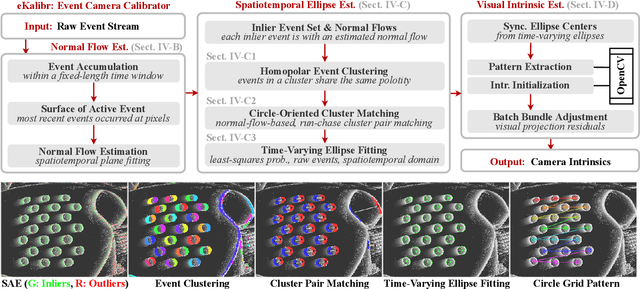

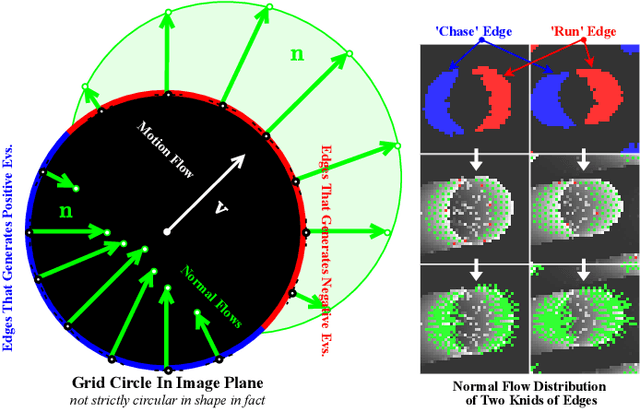
The bio-inspired event camera has garnered extensive research attention in recent years, owing to its significant potential derived from its high dynamic range and low latency characteristics. Similar to the standard camera, the event camera requires precise intrinsic calibration to facilitate further high-level visual applications, such as pose estimation and mapping. While several calibration methods for event cameras have been proposed, most of them are either (i) engineering-driven, heavily relying on conventional image-based calibration pipelines, or (ii) inconvenient, requiring complex instrumentation. To this end, we propose an accurate and convenient intrinsic calibration method for event cameras, named eKalibr, which builds upon a carefully designed event-based circle grid pattern recognition algorithm. To extract target patterns from events, we perform event-based normal flow estimation to identify potential events generated by circle edges, and cluster them spatially. Subsequently, event clusters associated with the same grid circles are matched and grouped using normal flows, for subsequent time-varying ellipse estimation. Fitted ellipse centers are time-synchronized, for final grid pattern recognition. We conducted extensive experiments to evaluate the performance of eKalibr in terms of pattern extraction and intrinsic calibration. The implementation of eKalibr is open-sourced at (https://github.com/Unsigned-Long/eKalibr) to benefit the research community.
URS-NeRF: Unordered Rolling Shutter Bundle Adjustment for Neural Radiance Fields
Mar 25, 2024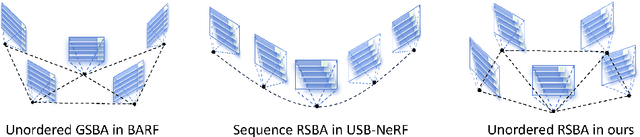
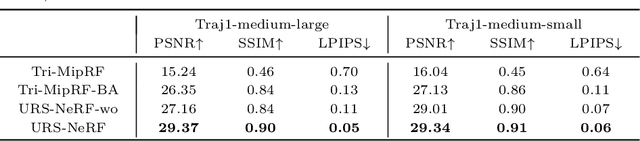
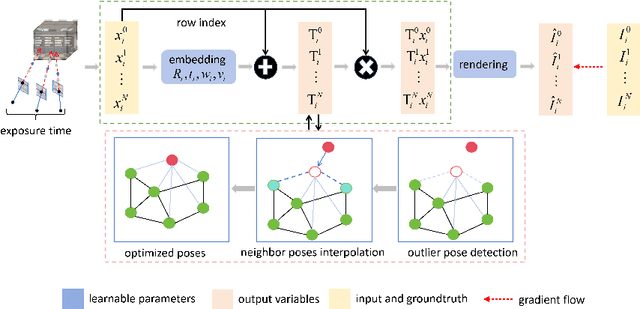
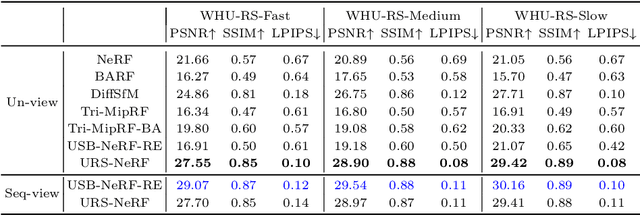
We propose a novel rolling shutter bundle adjustment method for neural radiance fields (NeRF), which utilizes the unordered rolling shutter (RS) images to obtain the implicit 3D representation. Existing NeRF methods suffer from low-quality images and inaccurate initial camera poses due to the RS effect in the image, whereas, the previous method that incorporates the RS into NeRF requires strict sequential data input, limiting its widespread applicability. In constant, our method recovers the physical formation of RS images by estimating camera poses and velocities, thereby removing the input constraints on sequential data. Moreover, we adopt a coarse-to-fine training strategy, in which the RS epipolar constraints of the pairwise frames in the scene graph are used to detect the camera poses that fall into local minima. The poses detected as outliers are corrected by the interpolation method with neighboring poses. The experimental results validate the effectiveness of our method over state-of-the-art works and demonstrate that the reconstruction of 3D representations is not constrained by the requirement of video sequence input.