 Add to Chrome
 Add to Firefox
 Add to Edge
DTBench: A Synthetic Benchmark for Document-to-Table Extraction
Feb 17, 2026
Document-to-table (Doc2Table) extraction derives structured tables from unstructured documents under a target schema, enabling reliable and verifiable SQL-based data analytics. Although large language models (LLMs) have shown promise in flexible information extraction, their ability to produce precisely structured tables remains insufficiently understood, particularly for indirect extraction that requires complex capabilities such as reasoning and conflict resolution. Existing benchmarks neither explicitly distinguish nor comprehensively cover the diverse capabilities required in Doc2Table extraction. We argue that a capability-aware benchmark is essential for systematic evaluation. However, constructing such benchmarks using human-annotated document-table pairs is costly, difficult to scale, and limited in capability coverage. To address this, we adopt a reverse Table2Doc paradigm and design a multi-agent synthesis workflow to generate documents from ground-truth tables. Based on this approach, we present DTBench, a synthetic benchmark that adopts a proposed two-level taxonomy of Doc2Table capabilities, covering 5 major categories and 13 subcategories. We evaluate several mainstream LLMs on DTBench, and demonstrate substantial performance gaps across models, as well as persistent challenges in reasoning, faithfulness, and conflict resolution. DTBench provides a comprehensive testbed for data generation and evaluation, facilitating future research on Doc2Table extraction. The benchmark is publicly available at https://github.com/ZJU-DAILY/DTBench.

Automatic Spectral Calibration of Hyperspectral Images:Method, Dataset and Benchmark
Dec 19, 2024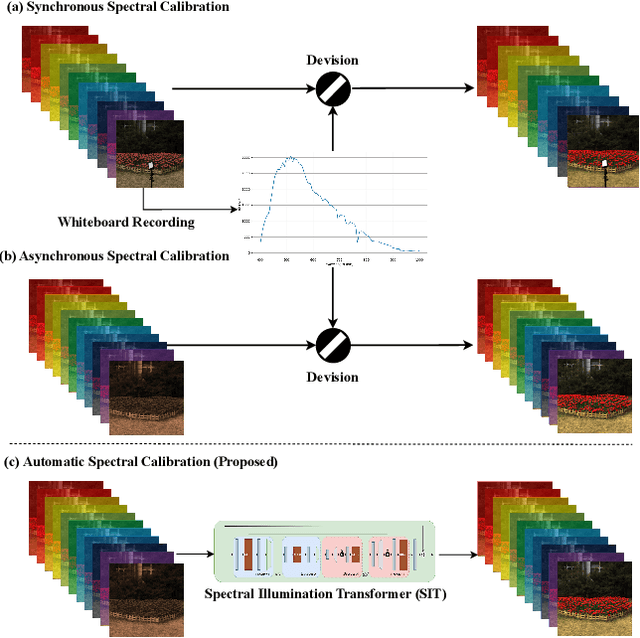


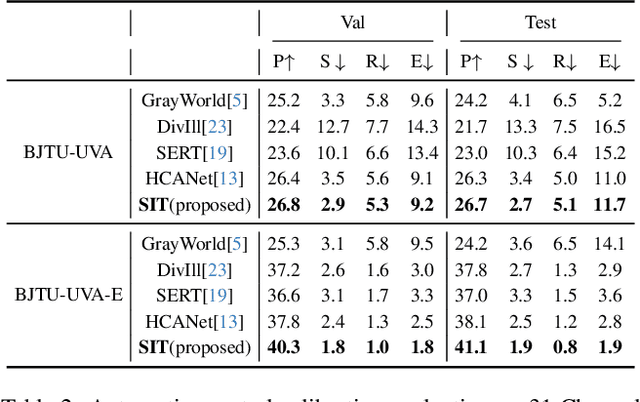
Hyperspectral image (HSI) densely samples the world in both the space and frequency domain and therefore is more distinctive than RGB images. Usually, HSI needs to be calibrated to minimize the impact of various illumination conditions. The traditional way to calibrate HSI utilizes a physical reference, which involves manual operations, occlusions, and/or limits camera mobility. These limitations inspire this paper to automatically calibrate HSIs using a learning-based method. Towards this goal, a large-scale HSI calibration dataset is created, which has 765 high-quality HSI pairs covering diversified natural scenes and illuminations. The dataset is further expanded to 7650 pairs by combining with 10 different physically measured illuminations. A spectral illumination transformer (SIT) together with an illumination attention module is proposed. Extensive benchmarks demonstrate the SoTA performance of the proposed SIT. The benchmarks also indicate that low-light conditions are more challenging than normal conditions. The dataset and codes are available online:https://github.com/duranze/Automatic-spectral-calibration-of-HSI