 Add to Chrome
 Add to Firefox
 Add to Edge
Specification-Driven Generation and Evaluation of Discrete-Event World Models via the DEVS Formalism
Mar 04, 2026
World models are essential for planning and evaluation in agentic systems, yet existing approaches lie at two extremes: hand-engineered simulators that offer consistency and reproducibility but are costly to adapt, and implicit neural models that are flexible but difficult to constrain, verify, and debug over long horizons. We seek a principled middle ground that combines the reliability of explicit simulators with the flexibility of learned models, allowing world models to be adapted during online execution. By targeting a broad class of environments whose dynamics are governed by the ordering, timing, and causality of discrete events, such as queueing and service operations, embodied task planning, and message-mediated multi-agent coordination, we advocate explicit, executable discrete-event world models synthesized directly from natural-language specifications. Our approach adopts the DEVS formalism and introduces a staged LLM-based generation pipeline that separates structural inference of component interactions from component-level event and timing logic. To evaluate generated models without a unique ground truth, simulators emit structured event traces that are validated against specification-derived temporal and semantic constraints, enabling reproducible verification and localized diagnostics. Together, these contributions produce world models that are consistent over long-horizon rollouts, verifiable from observable behavior, and efficient to synthesize on demand during online execution.

Why Don't You Clean Your Glasses? Perception Attacks with Dynamic Optical Perturbations
Jul 27, 2023
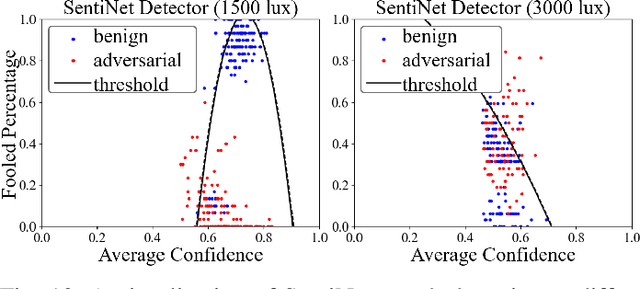
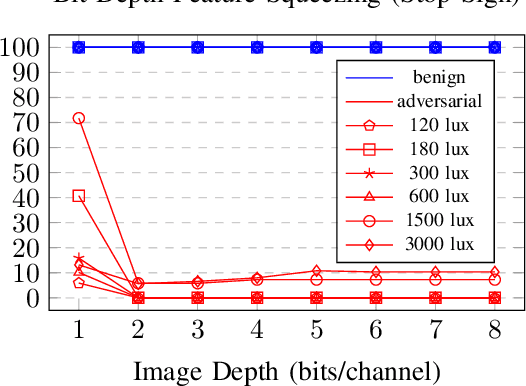

Camera-based autonomous systems that emulate human perception are increasingly being integrated into safety-critical platforms. Consequently, an established body of literature has emerged that explores adversarial attacks targeting the underlying machine learning models. Adapting adversarial attacks to the physical world is desirable for the attacker, as this removes the need to compromise digital systems. However, the real world poses challenges related to the "survivability" of adversarial manipulations given environmental noise in perception pipelines and the dynamicity of autonomous systems. In this paper, we take a sensor-first approach. We present EvilEye, a man-in-the-middle perception attack that leverages transparent displays to generate dynamic physical adversarial examples. EvilEye exploits the camera's optics to induce misclassifications under a variety of illumination conditions. To generate dynamic perturbations, we formalize the projection of a digital attack into the physical domain by modeling the transformation function of the captured image through the optical pipeline. Our extensive experiments show that EvilEye's generated adversarial perturbations are much more robust across varying environmental light conditions relative to existing physical perturbation frameworks, achieving a high attack success rate (ASR) while bypassing state-of-the-art physical adversarial detection frameworks. We demonstrate that the dynamic nature of EvilEye enables attackers to adapt adversarial examples across a variety of objects with a significantly higher ASR compared to state-of-the-art physical world attack frameworks. Finally, we discuss mitigation strategies against the EvilEye attack.