 Add to Chrome
 Add to Firefox
 Add to Edge
RealisticTritonBench: A Benchmark for Triton-Kernel Generation in Real-World AI Frameworks
Aug 12, 2026
In modern AI frameworks, GPU kernels are key to overall system performance. Combining usability, portability, and near-handwritten CUDA performance, Triton is widely adopted for implementing GPU kernels. Recent advances show the potential of large language models (LLMs) to automatically generate Triton kernels, reducing the manual effort required from expert kernel developers. Several benchmarks evaluate LLM-generated Triton kernels. However, they suffer from three key limitations: (1) they restrict tasks to PyTorch-to-Triton translation, failing to reflect the diversity and complexity of real-world Triton tasks; (2) they evaluate only individual-kernel performance rather than end-to-end performance, the core criterion for real-world deployment in AI frameworks; and (3) they rely on manually written evaluation scripts for individual kernels, which may contain flaws that models can exploit to bypass correctness checks and obtain inflated scores. To address these limitations, we introduce RealisticTritonBench, the first benchmark to derive Triton kernel generation tasks from real-world pull requests in popular AI frameworks, enabling realistic, production-like evaluation. RealisticTritonBench systematically extracts PRs that modify Triton kernels from popular open-source AI frameworks and transforms them into generation tasks with concrete engineering contexts. Each task takes a natural language requirement as input and requires a corresponding Triton kernel implementation, with a complete and reproducible evaluation environment. Unlike prior benchmarks focused on isolated kernel performance, RealisticTritonBench integrates generated kernels into their original frameworks and evaluates them using end-to-end tests, enabling a more faithful assessment. We evaluate leading LLMs on RealisticTritonBench and find that they still struggle with real-world Triton kernel generation tasks.

AscendCraft: Automatic Ascend NPU Kernel Generation via DSL-Guided Transcompilation
Jan 30, 2026The performance of deep learning models critically depends on efficient kernel implementations, yet developing high-performance kernels for specialized accelerators remains time-consuming and expertise-intensive. While recent work demonstrates that large language models (LLMs) can generate correct and performant GPU kernels, kernel generation for neural processing units (NPUs) remains largely underexplored due to domain-specific programming models, limited public examples, and sparse documentation. Consequently, directly generating AscendC kernels with LLMs yields extremely low correctness, highlighting a substantial gap between GPU and NPU kernel generation. We present AscendCraft, a DSL-guided approach for automatic AscendC kernel generation. AscendCraft introduces a lightweight DSL that abstracts non-essential complexity while explicitly modeling Ascend-specific execution semantics. Kernels are first generated in the DSL using category-specific expert examples and then transcompiled into AscendC through structured, constraint-driven LLM lowering passes. Evaluated on MultiKernelBench across seven operator categories, AscendCraft achieves 98.1% compilation success and 90.4% functional correctness. Moreover, 46.2% of generated kernels match or exceed PyTorch eager execution performance, demonstrating that DSL-guided transcompilation can enable LLMs to generate both correct and competitive NPU kernels. Beyond benchmarks, AscendCraft further demonstrates its generality by successfully generating two correct kernels for newly proposed mHC architecture, achieving performance that substantially surpasses PyTorch eager execution.
Every Document Owns Its Structure: Inductive Text Classification via Graph Neural Networks
May 12, 2020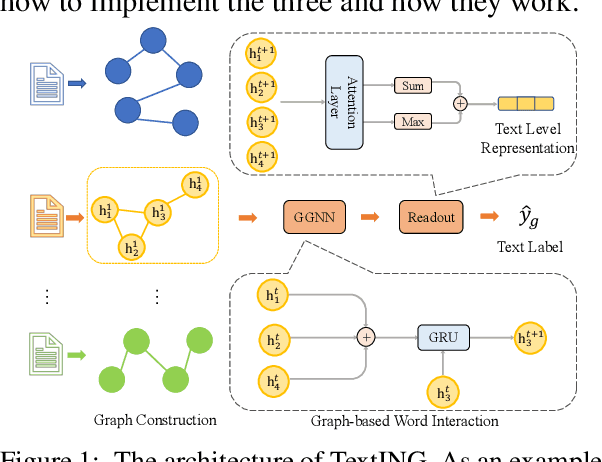
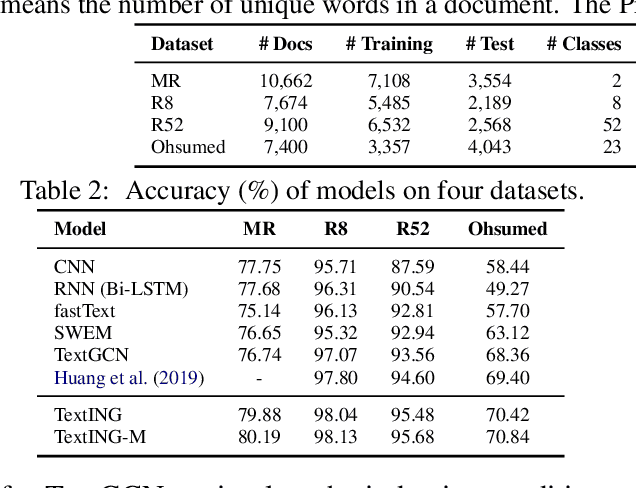
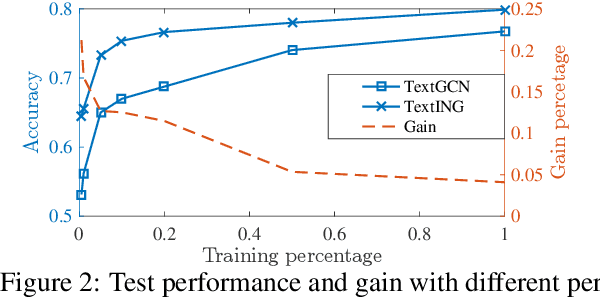
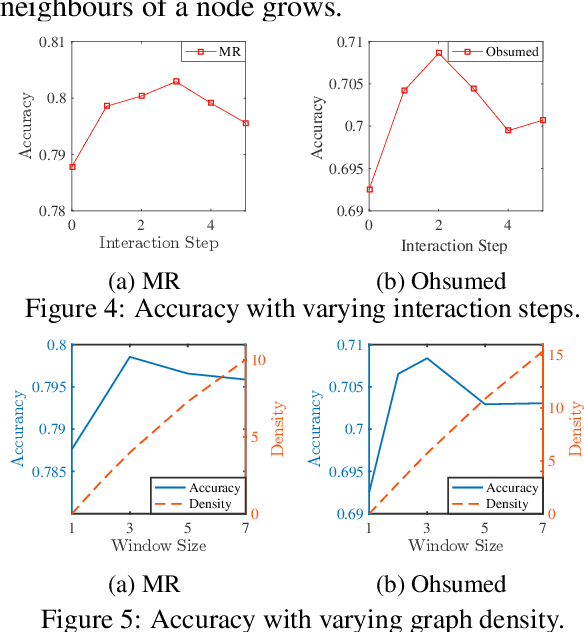
Text classification is fundamental in natural language processing (NLP), and Graph Neural Networks (GNN) are recently applied in this task. However, the existing graph-based works can neither capture the contextual word relationships within each document nor fulfil the inductive learning of new words. In this work, to overcome such problems, we propose TextING for inductive text classification via GNN. We first build individual graphs for each document and then use GNN to learn the fine-grained word representations based on their local structures, which can also effectively produce embeddings for unseen words in the new document. Finally, the word nodes are aggregated as the document embedding. Extensive experiments on four benchmark datasets show that our method outperforms state-of-the-art text classification methods.