 Add to Chrome
 Add to Firefox
 Add to Edge
A Multi-Branch Hierarchy-Aware Framework for Heterogeneous Audio Classification
Jul 02, 2026
This technical report describes our system for Task 1 of the DCASE 2026 Challenge, which aims to classify heterogeneous audio recordings according to the Broad Sound Taxonomy (BST). The task requires both accurate second-level prediction and consistency with the top-level taxonomy. Our system is built on CLAP-based audio-text representations and is improved along three strategies: expanding the training set with a filtered subset of BSD35k, enhancing acoustic modeling with feature-specific branches, and refining predictions using hierarchy-aware classifiers and KNN-based post-processing. Among the acoustic features considered, the log-STFT branch provides the strongest single-model performance. With KNN-based post-processing, our best single system achieves a hierarchical F1 score (Hier. F1) of 80.84% on the BSD10k-v1.2 set under the same evaluation protocol as the baseline. We further construct ensemble systems by combining models with complementary acoustic features and classification heads, achieving Hier. F1 scores of 81.25% and 81.18%, respectively.

Partial AUC optimization based deep speaker embeddings with class-center learning for text-independent speaker verification
Nov 19, 2019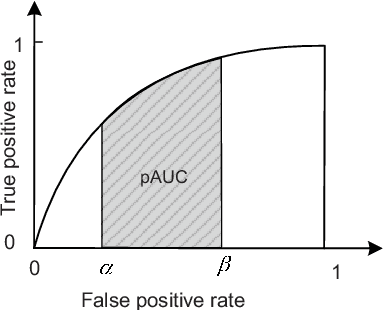
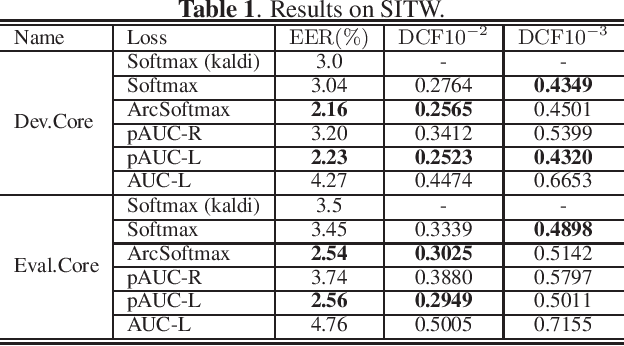
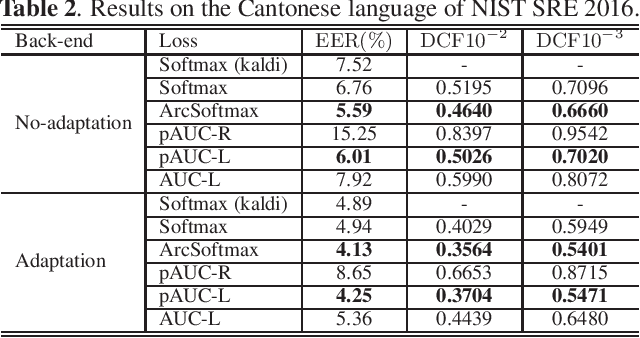
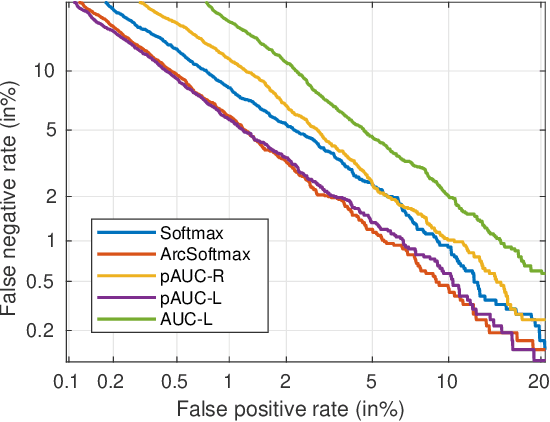
Deep embedding based text-independent speaker verification has demonstrated superior performance to traditional methods in many challenging scenarios. Its loss functions can be generally categorized into two classes, i.e., verification and identification. The verification loss functions match the pipeline of speaker verification, but their implementations are difficult. Thus, most state-of-the-art deep embedding methods use the identification loss functions with softmax output units or their variants. In this paper, we propose a verification loss function, named the maximization of partial area under the Receiver-operating-characteristic (ROC) curve (pAUC), for deep embedding based text-independent speaker verification. We also propose a class-center based training trial construction method to improve the training efficiency, which is critical for the proposed loss function to be comparable to the identification loss in performance. Experiments on the Speaker in the Wild (SITW) and NIST SRE 2016 datasets show that the proposed pAUC loss function is highly competitive with the state-of-the-art identification loss functions.