 Add to Chrome
 Add to Firefox
 Add to Edge
Stellar: Scalable Multimodal Document Retrieval for Natural Language Queries
Jun 18, 2026
Multimodal document retrieval--selecting the most relevant multimodal document from a large corpus to answer a natural language query--plays an essential role in Retrieval-Augmented Generation (RAG) systems. State-of-the-art methods represent each document and query with multiple token-level embeddings and use late interaction to achieve high effectiveness. However, such multi-vector representations incur substantial memory overhead during retrieval, leading to poor scalability and hindering real-world deployment. In this paper, we present Stellar, a scalable multimodal document retrieval framework that stores token-level document embeddings on disk and loads only a small set of candidate embeddings into memory for late interaction. Stellar comprises two key components: (i) Lexical Representation-based Filtering (LRF), which fine-tunes a Multimodal Large Language Model (MLLM) as a sparse encoder to produce high-quality lexical representations, enabling efficient and effective document filtering to significantly reduce the candidate set; (ii) Efficient Disk-backed Late Interaction (DLI), which designs an on-disk token embedding storage layout guided by a balanced clustering algorithm, and dynamically loads only the necessary token embeddings into memory using a simple yet effective cost model. Extensive experiments on four real-world benchmarks and a newly presented large-scale dataset demonstrate that Stellar reduces memory overhead and query latency by 1-2 orders of magnitude compared to existing methods without compromising retrieval effectiveness.

Snoopy: Effective and Efficient Semantic Join Discovery via Proxy Columns
Feb 24, 2025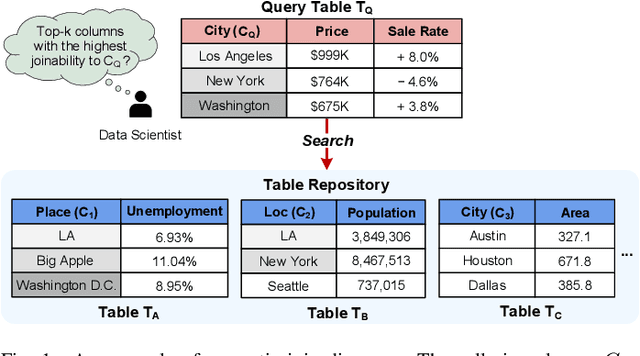
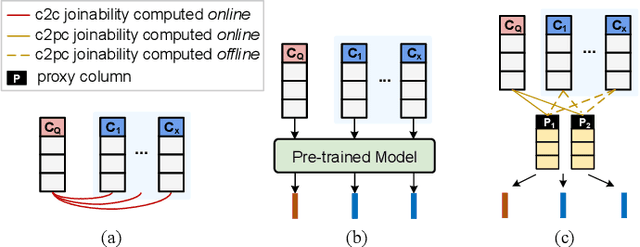
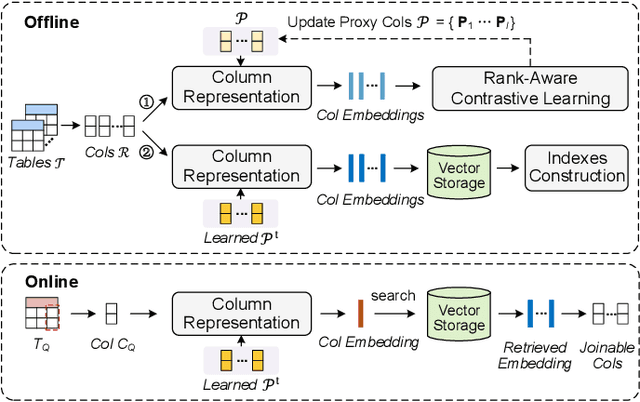
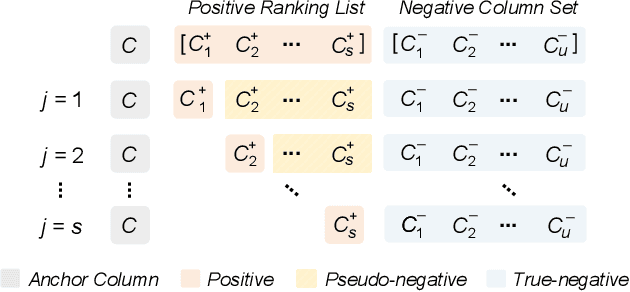
Semantic join discovery, which aims to find columns in a table repository with high semantic joinabilities to a query column, is crucial for dataset discovery. Existing methods can be divided into two categories: cell-level methods and column-level methods. However, neither of them ensures both effectiveness and efficiency simultaneously. Cell-level methods, which compute the joinability by counting cell matches between columns, enjoy ideal effectiveness but suffer poor efficiency. In contrast, column-level methods, which determine joinability only by computing the similarity of column embeddings, enjoy proper efficiency but suffer poor effectiveness due to the issues occurring in their column embeddings: (i) semantics-joinability-gap, (ii) size limit, and (iii) permutation sensitivity. To address these issues, this paper proposes to compute column embeddings via proxy columns; furthermore, a novel column-level semantic join discovery framework, Snoopy, is presented, leveraging proxy-column-based embeddings to bridge effectiveness and efficiency. Specifically, the proposed column embeddings are derived from the implicit column-to-proxy-column relationships, which are captured by the lightweight approximate-graph-matching-based column projection.To acquire good proxy columns for guiding the column projection, we introduce a rank-aware contrastive learning paradigm. Extensive experiments on four real-world datasets demonstrate that Snoopy outperforms SOTA column-level methods by 16% in Recall@25 and 10% in NDCG@25, and achieves superior efficiency--being at least 5 orders of magnitude faster than cell-level solutions, and 3.5x faster than existing column-level methods.