 Add to Chrome
 Add to Firefox
 Add to Edge
FAR-DPO: Feasibility-Aware and Robust Direct Preference Optimization for Cyclic Peptide Design
Aug 20, 2026
Cyclic peptides are emerging as promising molecular scaffolds in drug discovery due to their high binding affinity and structural stability. However, extending generative models from linear to cyclic peptide design remains challenging, as cyclization sharply restricts the feasible design space through coupled geometric and biophysical constraints. Moreover, limited training data has led existing approaches to rely largely on zero-shot generation or post hoc filtering, resulting in low yields of feasible designs and limited control over multi-objective trade-offs. To address these limitations, we propose FAR-DPO (Feasibility-Aware and Robust Direct Preference Optimization), an architecture-agnostic framework that steers generative models toward structurally and biophysically feasible cyclic peptide designs, particularly for challenging targets. FAR-DPO integrates feasibility-aware preference construction with difficulty-aware group-robust optimization. Specifically, it constructs within-target preference pairs through feasibility-gated multi-objective dominance and adaptively reweights predefined difficulty groups according to their current preference losses. On the CPSea LNR benchmark, under a fixed generation budget, FAR-DPO increases overall success rate from 46.89% to 57.79% on PepGLAD and from 47.96% to 49.57% on PepFlow. These gains also extend to the hardest target quartile and are accompanied by more favorable best-per-target binding scores. Together, these results demonstrate FAR-DPO's effectiveness in improving feasibility and target-wise robustness.

A GNN-RNN Approach for Harnessing Geospatial and Temporal Information: Application to Crop Yield Prediction
Nov 17, 2021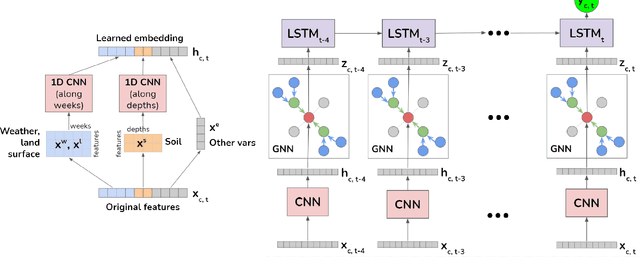
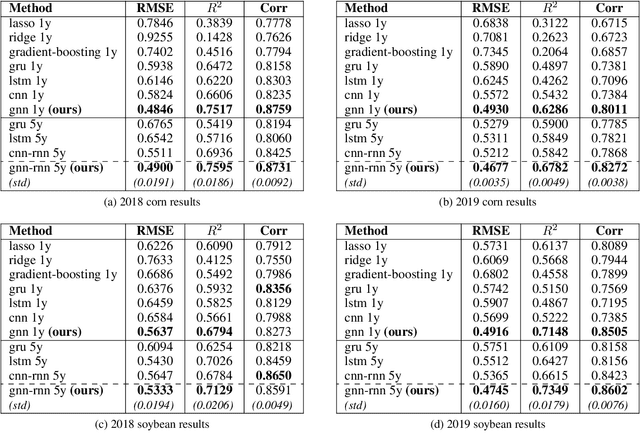
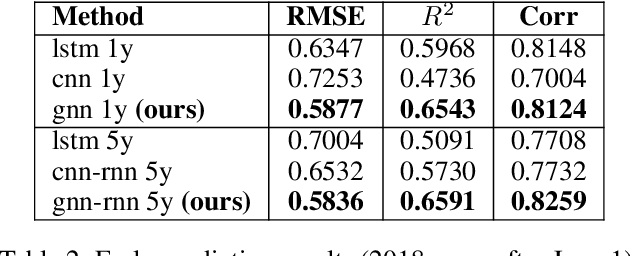
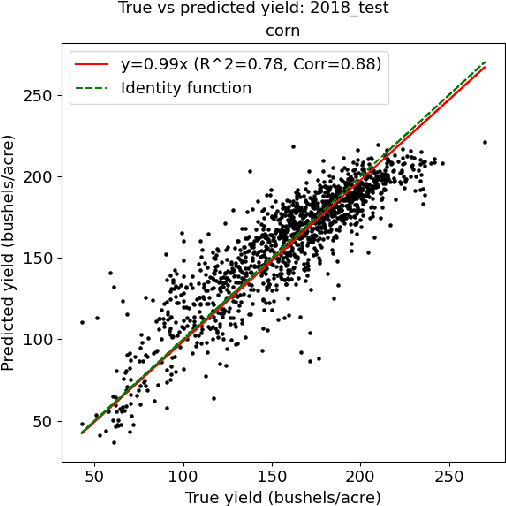
Climate change is posing new challenges to crop-related concerns including food insecurity, supply stability and economic planning. As one of the central challenges, crop yield prediction has become a pressing task in the machine learning field. Despite its importance, the prediction task is exceptionally complicated since crop yields depend on various factors such as weather, land surface, soil quality as well as their interactions. In recent years, machine learning models have been successfully applied in this domain. However, these models either restrict their tasks to a relatively small region, or only study over a single or few years, which makes them hard to generalize spatially and temporally. In this paper, we introduce a novel graph-based recurrent neural network for crop yield prediction, to incorporate both geographical and temporal knowledge in the model, and further boost predictive power. Our method is trained, validated, and tested on over 2000 counties from 41 states in the US mainland, covering years from 1981 to 2019. As far as we know, this is the first machine learning method that embeds geographical knowledge in crop yield prediction and predicts the crop yields at county level nationwide. We also laid a solid foundation for the comparison with other machine learning baselines by applying well-known linear models, tree-based models, deep learning methods and comparing their performance. Experiments show that our proposed method consistently outperforms the existing state-of-the-art methods on various metrics, validating the effectiveness of geospatial and temporal information.