 Add to Chrome
 Add to Firefox
 Add to Edge
Efficient Hierarchical Implicit Flow Q-learning for Offline Goal-conditioned Reinforcement Learning
Apr 10, 2026
Offline goal-conditioned reinforcement learning (GCRL) is a practical reinforcement learning paradigm that aims to learn goal-conditioned policies from reward-free offline data. Despite recent advances in hierarchical architectures such as HIQL, long-horizon control in offline GCRL remains challenging due to the limited expressiveness of Gaussian policies and the inability of high-level policies to generate effective subgoals. To address these limitations, we propose the goal-conditioned mean flow policy, which introduces an average velocity field into hierarchical policy modeling for offline GCRL. Specifically, the mean flow policy captures complex target distributions for both high-level and low-level policies through a learned average velocity field, enabling efficient action generation via one-step sampling. Furthermore, considering the insufficiency of goal representation, we introduce a LeJEPA loss that repels goal representation embeddings during training, thereby encouraging more discriminative representations and improving generalization. Experimental results show that our method achieves strong performance across both state-based and pixel-based tasks in the OGBench benchmark.

Value-Guidance MeanFlow for Offline Multi-Agent Reinforcement Learning
Apr 09, 2026Offline multi-agent reinforcement learning (MARL) aims to learn the optimal joint policy from pre-collected datasets, requiring a trade-off between maximizing global returns and mitigating distribution shift from offline data. Recent studies use diffusion or flow generative models to capture complex joint policy behaviors among agents; however, they typically rely on multi-step iterative sampling, thereby reducing training and inference efficiency. Although further research improves sampling efficiency through methods like distillation, it remains sensitive to the behavior regularization coefficient. To address the above-mentioned issues, we propose Value Guidance Multi-agent MeanFlow Policy (VGM$^2$P), a simple yet effective flow-based policy learning framework that enables efficient action generation with coefficient-insensitive conditional behavior cloning. Specifically, VGM$^2$P uses global advantage values to guide agent collaboration, treating optimal policy learning as conditional behavior cloning. Additionally, to improve policy expressiveness and inference efficiency in multi-agent scenarios, it leverages classifier-free guidance MeanFlow for both policy training and execution. Experiments on tasks with both discrete and continuous action spaces demonstrate that, even when trained solely via conditional behavior cloning, VGM$^2$P efficiently achieves performance comparable to state-of-the-art methods.
Equivariant Efficient Joint Discrete and Continuous MeanFlow for Molecular Graph Generation
Apr 09, 2026Graph-structured data jointly contain discrete topology and continuous geometry, which poses fundamental challenges for generative modeling due to heterogeneous distributions, incompatible noise dynamics, and the need for equivariant inductive biases. Existing flow-matching approaches for graph generation typically decouple structure from geometry, lack synchronized cross-domain dynamics, and rely on iterative sampling, often resulting in physically inconsistent molecular conformations and slow sampling. To address these limitations, we propose Equivariant MeanFlow (EQUIMF), a unified SE(3)-equivariant generative framework that jointly models discrete and continuous components through synchronized MeanFlow dynamics. EQUIMF introduces a unified time bridge and average-velocity updates with mutual conditioning between structure and geometry, enabling efficient few-step generation while preserving physical consistency. Moreover, we develop a novel discrete MeanFlow formulation with a simple yet effective parameterization to support efficient generation over discrete graph structures. Extensive experiments demonstrate that EQUIMF consistently outperforms prior diffusion and flow-matching methods in generation quality, physical validity, and sampling efficiency.
LEAPS: End-to-End One-Step Person Search With Learnable Proposals
Mar 21, 2023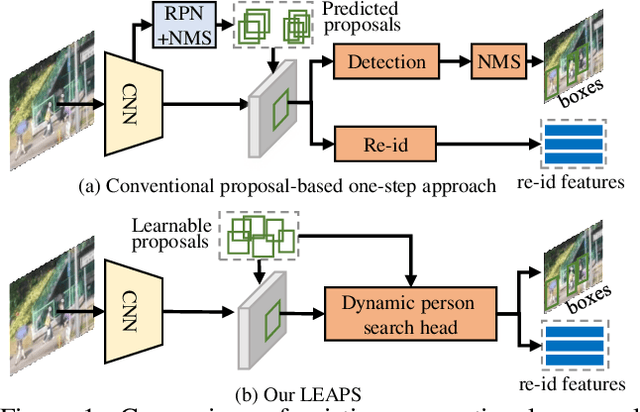
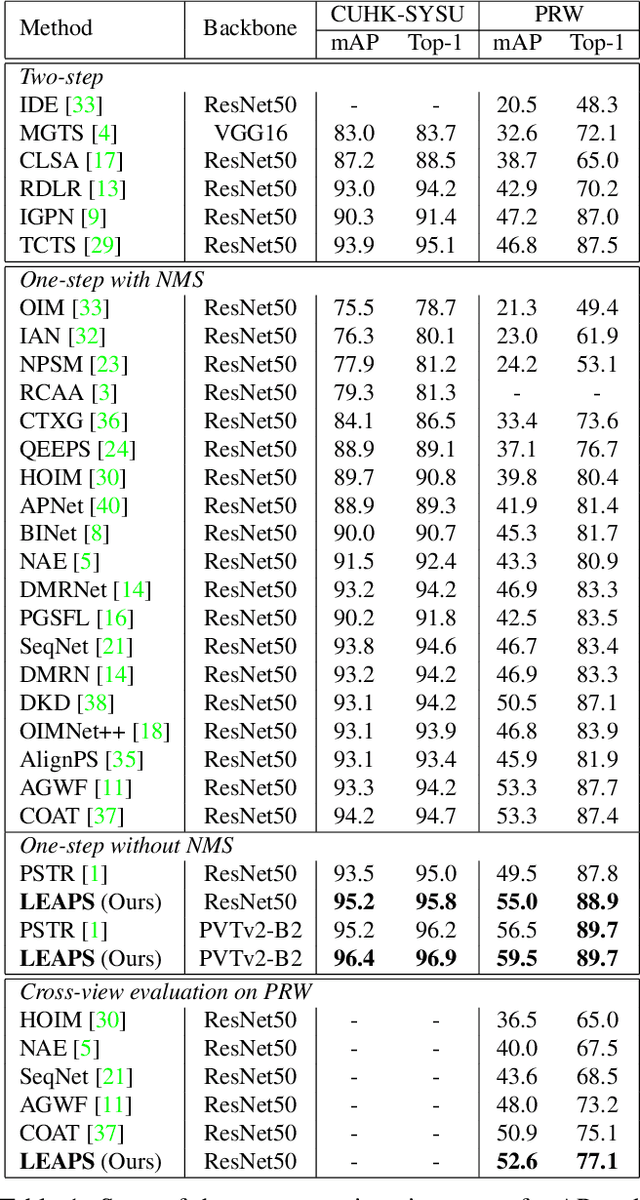
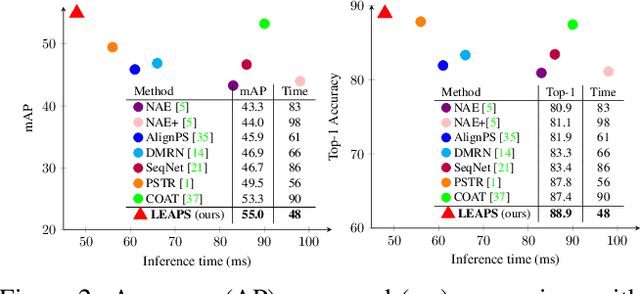

We propose an end-to-end one-step person search approach with learnable proposals, named LEAPS. Given a set of sparse and learnable proposals, LEAPS employs a dynamic person search head to directly perform person detection and corresponding re-id feature generation without non-maximum suppression post-processing. The dynamic person search head comprises a detection head and a novel flexible re-id head. Our flexible re-id head first employs a dynamic region-of-interest (RoI) operation to extract discriminative RoI features of the proposals. Then, it generates re-id features using a plain and a hierarchical interaction re-id module. To better guide discriminative re-id feature learning, we introduce a diverse re-id sample matching strategy, instead of bipartite matching in detection head. Comprehensive experiments reveal the benefit of the proposed LEAPS, achieving a favorable performance on two public person search benchmarks: CUHK-SYSU and PRW. When using the same ResNet50 backbone, our LEAPS obtains a mAP score of 55.0%, outperforming the best reported results in literature by 1.7%, while achieving around a two-fold speedup on the challenging PRW dataset. Our source code and models will be released.