 Add to Chrome
 Add to Firefox
 Add to Edge
Efficient Hierarchical Implicit Flow Q-learning for Offline Goal-conditioned Reinforcement Learning
Apr 10, 2026
Offline goal-conditioned reinforcement learning (GCRL) is a practical reinforcement learning paradigm that aims to learn goal-conditioned policies from reward-free offline data. Despite recent advances in hierarchical architectures such as HIQL, long-horizon control in offline GCRL remains challenging due to the limited expressiveness of Gaussian policies and the inability of high-level policies to generate effective subgoals. To address these limitations, we propose the goal-conditioned mean flow policy, which introduces an average velocity field into hierarchical policy modeling for offline GCRL. Specifically, the mean flow policy captures complex target distributions for both high-level and low-level policies through a learned average velocity field, enabling efficient action generation via one-step sampling. Furthermore, considering the insufficiency of goal representation, we introduce a LeJEPA loss that repels goal representation embeddings during training, thereby encouraging more discriminative representations and improving generalization. Experimental results show that our method achieves strong performance across both state-based and pixel-based tasks in the OGBench benchmark.

Value-Guidance MeanFlow for Offline Multi-Agent Reinforcement Learning
Apr 09, 2026Offline multi-agent reinforcement learning (MARL) aims to learn the optimal joint policy from pre-collected datasets, requiring a trade-off between maximizing global returns and mitigating distribution shift from offline data. Recent studies use diffusion or flow generative models to capture complex joint policy behaviors among agents; however, they typically rely on multi-step iterative sampling, thereby reducing training and inference efficiency. Although further research improves sampling efficiency through methods like distillation, it remains sensitive to the behavior regularization coefficient. To address the above-mentioned issues, we propose Value Guidance Multi-agent MeanFlow Policy (VGM$^2$P), a simple yet effective flow-based policy learning framework that enables efficient action generation with coefficient-insensitive conditional behavior cloning. Specifically, VGM$^2$P uses global advantage values to guide agent collaboration, treating optimal policy learning as conditional behavior cloning. Additionally, to improve policy expressiveness and inference efficiency in multi-agent scenarios, it leverages classifier-free guidance MeanFlow for both policy training and execution. Experiments on tasks with both discrete and continuous action spaces demonstrate that, even when trained solely via conditional behavior cloning, VGM$^2$P efficiently achieves performance comparable to state-of-the-art methods.
Equivariant Efficient Joint Discrete and Continuous MeanFlow for Molecular Graph Generation
Apr 09, 2026Graph-structured data jointly contain discrete topology and continuous geometry, which poses fundamental challenges for generative modeling due to heterogeneous distributions, incompatible noise dynamics, and the need for equivariant inductive biases. Existing flow-matching approaches for graph generation typically decouple structure from geometry, lack synchronized cross-domain dynamics, and rely on iterative sampling, often resulting in physically inconsistent molecular conformations and slow sampling. To address these limitations, we propose Equivariant MeanFlow (EQUIMF), a unified SE(3)-equivariant generative framework that jointly models discrete and continuous components through synchronized MeanFlow dynamics. EQUIMF introduces a unified time bridge and average-velocity updates with mutual conditioning between structure and geometry, enabling efficient few-step generation while preserving physical consistency. Moreover, we develop a novel discrete MeanFlow formulation with a simple yet effective parameterization to support efficient generation over discrete graph structures. Extensive experiments demonstrate that EQUIMF consistently outperforms prior diffusion and flow-matching methods in generation quality, physical validity, and sampling efficiency.
DPR: Diffusion Preference-based Reward for Offline Reinforcement Learning
Mar 03, 2025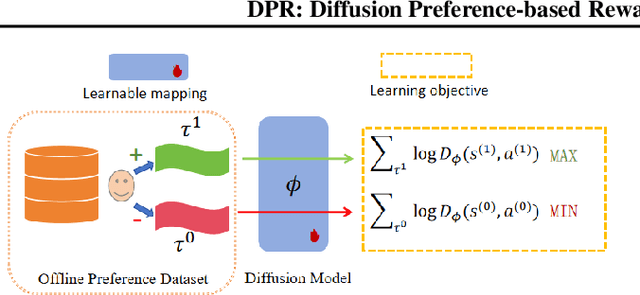
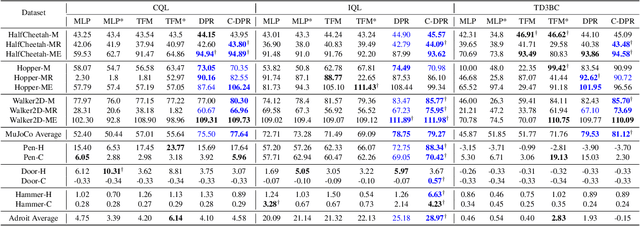
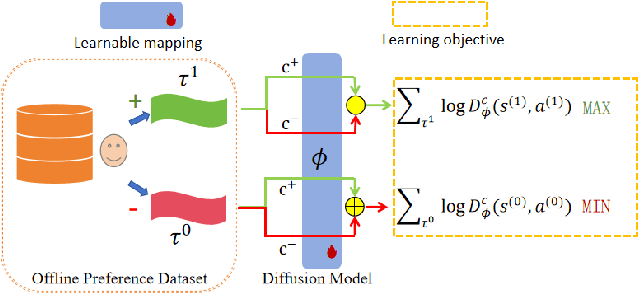
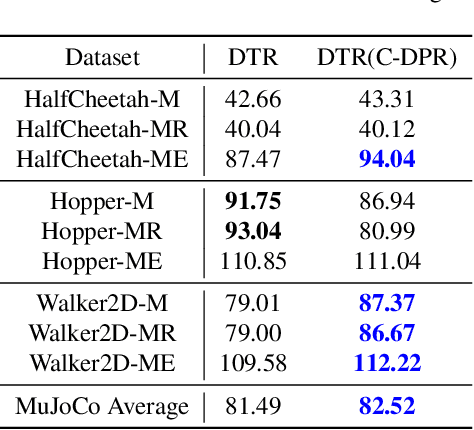
Offline preference-based reinforcement learning (PbRL) mitigates the need for reward definition, aligning with human preferences via preference-driven reward feedback without interacting with the environment. However, the effectiveness of preference-driven reward functions depends on the modeling ability of the learning model, which current MLP-based and Transformer-based methods may fail to adequately provide. To alleviate the failure of the reward function caused by insufficient modeling, we propose a novel preference-based reward acquisition method: Diffusion Preference-based Reward (DPR). Unlike previous methods using Bradley-Terry models for trajectory preferences, we use diffusion models to directly model preference distributions for state-action pairs, allowing rewards to be discriminatively obtained from these distributions. In addition, considering the particularity of preference data that only know the internal relationships of paired trajectories, we further propose Conditional Diffusion Preference-based Reward (C-DPR), which leverages relative preference information to enhance the construction of the diffusion model. We apply the above methods to existing offline reinforcement learning algorithms and a series of experiment results demonstrate that the diffusion-based reward acquisition approach outperforms previous MLP-based and Transformer-based methods.
Towards Macro-AUC oriented Imbalanced Multi-Label Continual Learning
Dec 24, 2024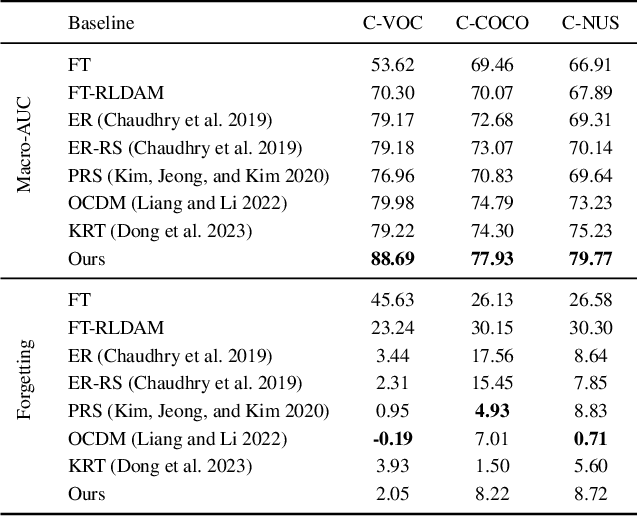
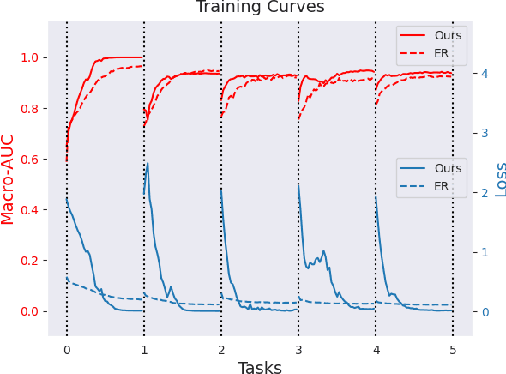

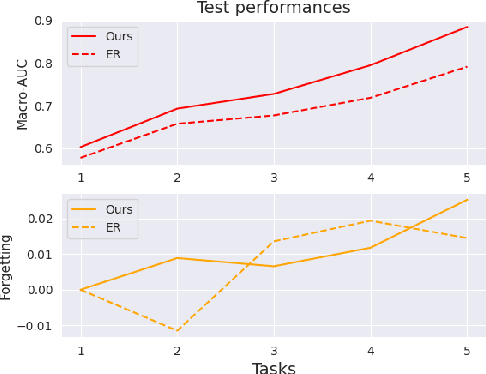
In Continual Learning (CL), while existing work primarily focuses on the multi-class classification task, there has been limited research on Multi-Label Learning (MLL). In practice, MLL datasets are often class-imbalanced, making it inherently challenging, a problem that is even more acute in CL. Due to its sensitivity to imbalance, Macro-AUC is an appropriate and widely used measure in MLL. However, there is no research to optimize Macro-AUC in MLCL specifically. To fill this gap, in this paper, we propose a new memory replay-based method to tackle the imbalance issue for Macro-AUC-oriented MLCL. Specifically, inspired by recent theory work, we propose a new Reweighted Label-Distribution-Aware Margin (RLDAM) loss. Furthermore, to be compatible with the RLDAM loss, a new memory-updating strategy named Weight Retain Updating (WRU) is proposed to maintain the numbers of positive and negative instances of the original dataset in memory. Theoretically, we provide superior generalization analyses of the RLDAM-based algorithm in terms of Macro-AUC, separately in batch MLL and MLCL settings. This is the first work to offer theoretical generalization analyses in MLCL to our knowledge. Finally, a series of experimental results illustrate the effectiveness of our method over several baselines. Our codes are available at https://github.com/ML-Group-SDU/Macro-AUC-CL.
DiffAIL: Diffusion Adversarial Imitation Learning
Dec 12, 2023Imitation learning aims to solve the problem of defining reward functions in real-world decision-making tasks. The current popular approach is the Adversarial Imitation Learning (AIL) framework, which matches expert state-action occupancy measures to obtain a surrogate reward for forward reinforcement learning. However, the traditional discriminator is a simple binary classifier and doesn't learn an accurate distribution, which may result in failing to identify expert-level state-action pairs induced by the policy interacting with the environment. To address this issue, we propose a method named diffusion adversarial imitation learning (DiffAIL), which introduces the diffusion model into the AIL framework. Specifically, DiffAIL models the state-action pairs as unconditional diffusion models and uses diffusion loss as part of the discriminator's learning objective, which enables the discriminator to capture better expert demonstrations and improve generalization. Experimentally, the results show that our method achieves state-of-the-art performance and significantly surpasses expert demonstration on two benchmark tasks, including the standard state-action setting and state-only settings. Our code can be available at the link https://github.com/ML-Group-SDU/DiffAIL.