 Add to Chrome
 Add to Firefox
 Add to Edge
Low-Cost Physical-Layer Security Design for IRS-Assisted mMIMO Systems with One-Bit DACs
Feb 15, 2026
Integrating massive multiple-input multiple-output (mMIMO) systems with intelligent reflecting surfaces (IRS) presents a promising paradigm for enhancing physical-layer security (PLS) in wireless communications. However, deploying high-resolution quantizers in large-scale mMIMO arrays, along with numerous IRS elements, leads to substantial hardware complexity. To address these challenges, this paper proposes a cost-effective PLS design for IRS-assisted mMIMO systems by employing one-bit digital-to-analog converters (DACs). The focus is on jointly optimizing one-bit quantized precoding at the transmitter and constant-modulus phase shifts at the IRS to maximize the secrecy rate. This leads to a highly non-convex fractional secrecy rate maximization (SRM) problem. To efficiently solve this problem, two algorithms are proposed: (1) the WMMSE-PDD algorithm, which reformulates the SRM problem into a sequence of non-fractional programs with auxiliary variables using the weighted minimum mean-square error (WMMSE) method and solves them via the penalty dual decomposition (PDD) approach, achieving superior secrecy performance; and (2) the exact penalty product Riemannian gradient descent (EPPRGD) algorithm, which transforms the SRM problem into an unconstrained optimization over a product Riemannian manifold, eliminating auxiliary variables and enabling faster convergence with a slight trade-off in secrecy performance. Both algorithms provide analytical solutions at each iteration and are proven to converge to Karush-Kuhn-Tucker (KKT) points. Simulation results confirm the effectiveness of the proposed methods and highlight their respective advantages.

Joint Analog Beamforming and Antenna Position Design for Secure Communication systems With Movable Antennas
Nov 19, 2025Movable antennas (MA) are a novel technology that allows for the flexible adjustment of antenna positions within a specified region, thereby enhancing the performance of wireless communication systems. In this paper, we explore the use of MA to improve physical layer security in an analog beamforming (AB) communication system. Our goal is to maximize the secrecy rate by jointly optimizing the transmit AB and MA position, subject to constant modulus (CM) constraints on the AB and position constraints for the MA. The resulting problem is non-convex, and we propose a penalty product manifold (PPM) method to solve it efficiently. Specifically, we convert the inequality constraints related to MA position into a penalty function using smoothing techniques, thereby reformulating the problem as an unconstrained optimization on the product manifold space (PMS). We then derive a parallel conjugate gradient descent (PCGD) algorithm to update both the AB and MA position on the PMS. This method is efficient, providing an analytical solution at each step and ensuring convergence to a KKT point. Simulation results show that the MA system achieves a higher secrecy rate than systems with fixed-position antennas.
Constant-Modulus Secure Analog Beamforming for an IRS-Assisted Communication System with Large-Scale Antenna Array
Nov 19, 2025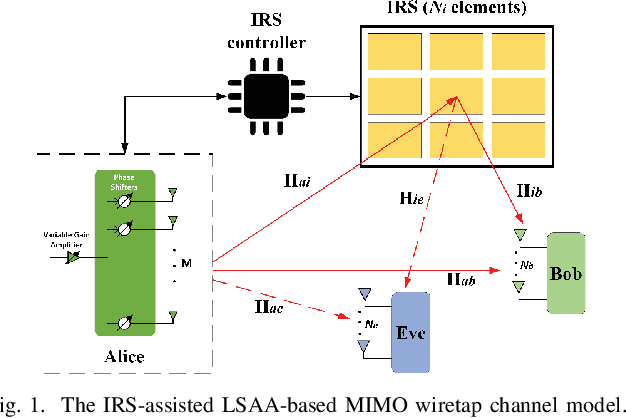
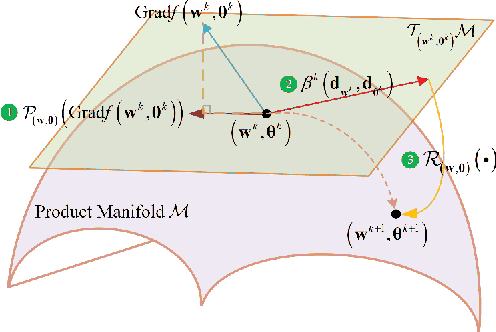
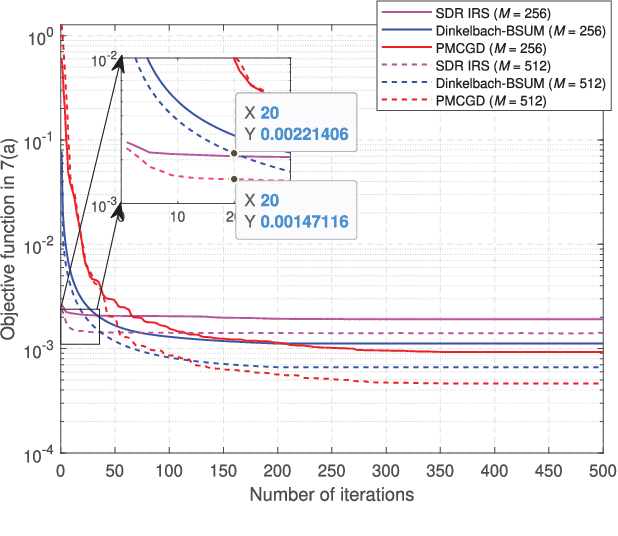
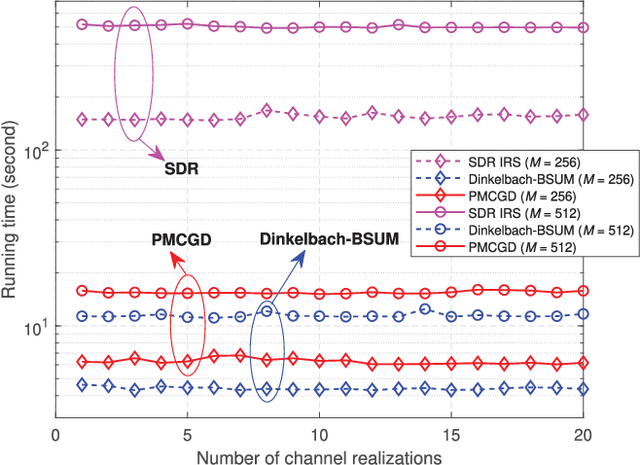
Physical layer security (PLS) is an important technology in wireless communication systems to safeguard communication privacy and security between transmitters and legitimate users. The integration of large-scale antenna arrays (LSAA) and intelligent reflecting surfaces (IRS) has emerged as a promising approach to enhance PLS. However, LSAA requires a dedicated radio frequency (RF) chain for each antenna element, and IRS comprises hundreds of reflecting micro-antennas, leading to increased hardware costs and power consumption. To address this, cost-effective solutions like constant modulus analog beamforming (CMAB) have gained attention. This paper investigates PLS in IRS-assisted communication systems with a focus on jointly designing the CMAB at the transmitter and phase shifts at the IRS to maximize the secrecy rate. The resulting secrecy rate maximization (SRM) problem is non-convex. To solve the problem efficiently, we propose two algorithms: (1) the time-efficient Dinkelbach-BSUM algorithm, which reformulates the fractional problem into a series of quadratic programs using the Dinkelbach method and solves them via block successive upper-bound minimization (BSUM), and (2) the product manifold conjugate gradient descent (PMCGD) algorithm, which provides a better solution at the cost of slightly higher computational time by transforming the problem into an unconstrained optimization on a Riemannian product manifold and solving it using the conjugate gradient descent (CGD) algorithm. Simulation results validate the effectiveness of the proposed algorithms and highlight their distinct advantages.