 Add to Chrome
 Add to Firefox
 Add to Edge
IRAF: Interference-Resilient Adaptive Fusion for Noise-Robust End-to-End Full-Duplex Spoken Dialogue Systems
Jun 04, 2026
Full-duplex spoken dialogue models allow voice agents to listen and speak concurrently, enabling natural interaction with real-time overlap. However, end-to-end dual-channel models that jointly encode user and agent streams may degrade in realistic acoustic environments: interfering speakers leaking into the user microphone can be encoded as part of the user query, corrupting the LLM's conditioning and causing unstable turn-taking and reduced response quality. We propose Interference-Resilient Adaptive Fusion (IRAF), a lightweight, streaming-compatible module that modulates the contribution of user audio to the LLM frame by frame. IRAF predicts a scalar reliability gate from target-speaker and user audio embeddings and rescales user representations before fusion with agent embeddings. Experiments on MS-MARCO and InstructS2S-200K show consistent gains in response quality and full-duplex interaction under interfering-speaker conditions.

MBTFNet: Multi-Band Temporal-Frequency Neural Network For Singing Voice Enhancement
Oct 06, 2023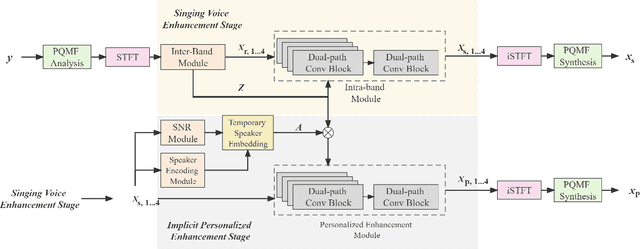
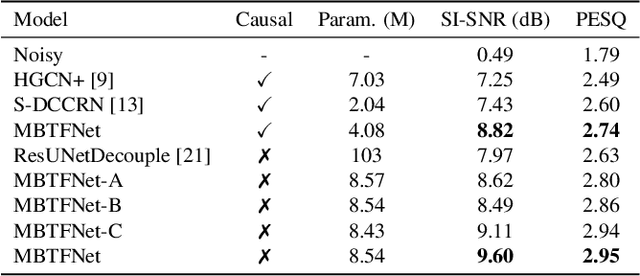
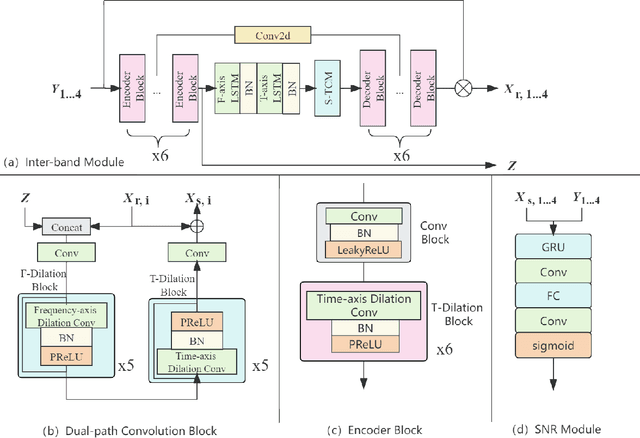
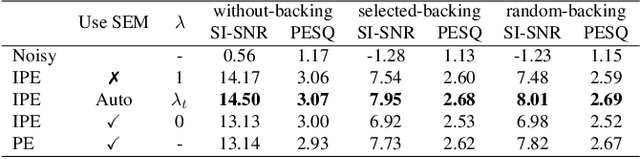
A typical neural speech enhancement (SE) approach mainly handles speech and noise mixtures, which is not optimal for singing voice enhancement scenarios. Music source separation (MSS) models treat vocals and various accompaniment components equally, which may reduce performance compared to the model that only considers vocal enhancement. In this paper, we propose a novel multi-band temporal-frequency neural network (MBTFNet) for singing voice enhancement, which particularly removes background music, noise and even backing vocals from singing recordings. MBTFNet combines inter and intra-band modeling for better processing of full-band signals. Dual-path modeling are introduced to expand the receptive field of the model. We propose an implicit personalized enhancement (IPE) stage based on signal-to-noise ratio (SNR) estimation, which further improves the performance of MBTFNet. Experiments show that our proposed model significantly outperforms several state-of-the-art SE and MSS models.