 Add to Chrome
 Add to Firefox
 Add to Edge
Tacmap: Bridging the Tactile Sim-to-Real Gap via Geometry-Consistent Penetration Depth Map
Feb 25, 2026
Vision-Based Tactile Sensors (VBTS) are essential for achieving dexterous robotic manipulation, yet the tactile sim-to-real gap remains a fundamental bottleneck. Current tactile simulations suffer from a persistent dilemma: simplified geometric projections lack physical authenticity, while high-fidelity Finite Element Methods (FEM) are too computationally prohibitive for large-scale reinforcement learning. In this work, we present Tacmap, a high-fidelity, computationally efficient tactile simulation framework anchored in volumetric penetration depth. Our key insight is to bridge the tactile sim-to-real gap by unifying both domains through a shared deform map representation. Specifically, we compute 3D intersection volumes as depth maps in simulation, while in the real world, we employ an automated data-collection rig to learn a robust mapping from raw tactile images to ground-truth depth maps. By aligning simulation and real-world in this unified geometric space, Tacmap minimizes domain shift while maintaining physical consistency. Quantitative evaluations across diverse contact scenarios demonstrate that Tacmap's deform maps closely mirror real-world measurements. Moreover, we validate the utility of Tacmap through an in-hand rotation task, where a policy trained exclusively in simulation achieves zero-shot transfer to a physical robot.

CompdVision: Combining Near-Field 3D Visual and Tactile Sensing Using a Compact Compound-Eye Imaging System
Dec 12, 2023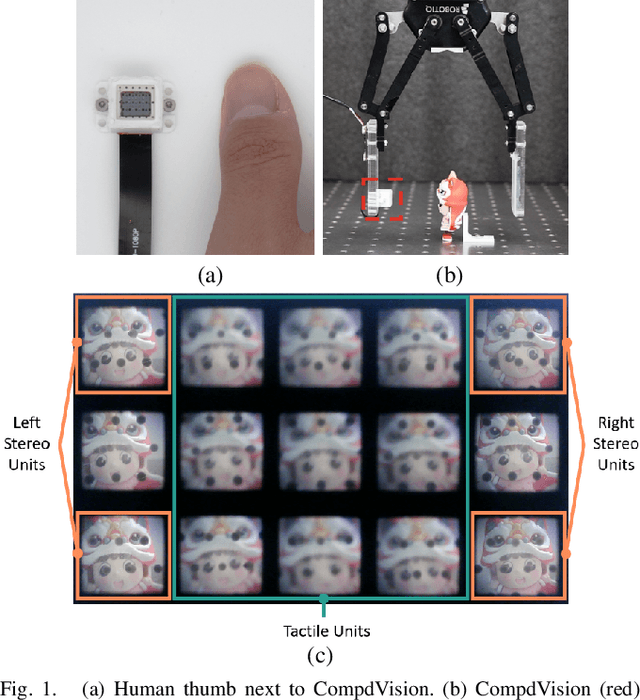
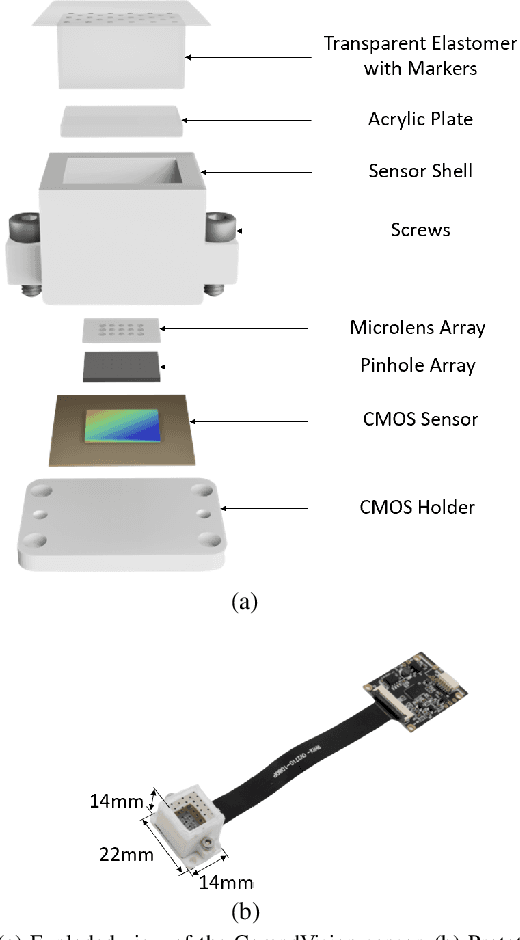
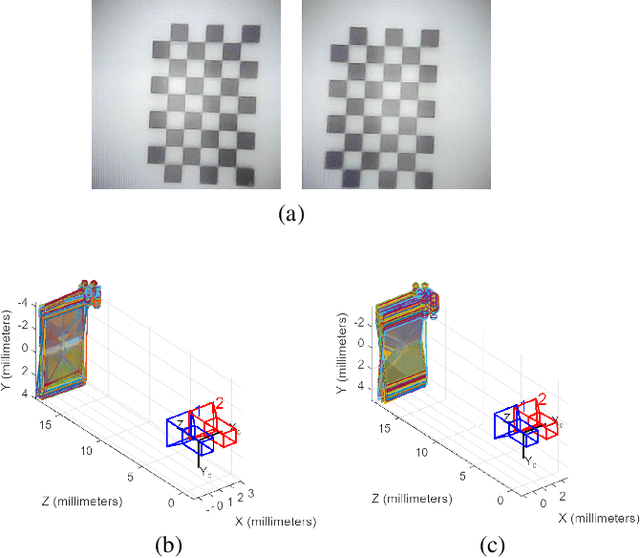

As automation technologies advance, the need for compact and multi-modal sensors in robotic applications is growing. To address this demand, we introduce CompdVision, a novel sensor that combines near-field 3D visual and tactile sensing. This sensor, with dimensions of 22$\times$14$\times$14 mm, leverages the compound eye imaging system to achieve a compact form factor without compromising its dual modalities. CompdVision utilizes two types of vision units to meet diverse sensing requirements. Stereo units with far-focus lenses can see through the transparent elastomer, facilitating depth estimation beyond the contact surface, while tactile units with near-focus lenses track the movement of markers embedded in the elastomer to obtain contact deformation. Experimental results validate the sensor's superior performance in 3D visual and tactile sensing. The sensor demonstrates effective depth estimation within a 70mm range from its surface. Additionally, it registers high accuracy in tangential and normal force measurements. The dual modalities and compact design make the sensor a versatile tool for complex robotic tasks.