 Add to Chrome
 Add to Firefox
 Add to Edge
YouZhi: Towards High-Concurrency Financial LLMs via Adaptive GQA-to-MLA Transition
Jun 04, 2026
Large language models (LLMs) drive significant financial innovations, yet their high-concurrency deployment is severely bottlenecked by KV cache memory overhead, which inflates infrastructure costs and throttles scalability. To address this, we propose YouZhi-LLM, a highly efficient financial LLM empowered by a comprehensive structural transition and training pipeline natively built on the Huawei Ascend ecosystem. At its algorithmic core, YouZhi-LLM features a layer-adaptive GQA-to-MLA transition framework that dynamically assigns per-layer FreqFold sizes, maximizing KV-cache compression while minimizing perplexity degradation. To recover representation capacity and inject domain expertise, the Ascend-based training pipeline seamlessly integrates generalized knowledge distillation with financial-specific supervised fine-tuning. Evaluations demonstrate the superiority of this systematic approach, with the adaptive transition reducing perplexity degradation by up to 35% over uniform baselines. Crucially, when evaluated on Ascend NPUs via vLLM-Ascend, the massive KV-cache reduction translates directly into deployment efficiency. Compared to their respective base models, YouZhi-7B yields a 12.3% improvement in average financial benchmark score alongside a 2.69$\times$ increase in maximum concurrency; similarly, YouZhi-14B achieves a 7.0% accuracy gain and a 2.43$\times$ concurrency boost, establishing a new paradigm for cost-effective, high-throughput financial inference.

INViT: A Generalizable Routing Problem Solver with Invariant Nested View Transformer
Feb 12, 2024Recently, deep reinforcement learning has shown promising results for learning fast heuristics to solve routing problems. Meanwhile, most of the solvers suffer from generalizing to an unseen distribution or distributions with different scales. To address this issue, we propose a novel architecture, called Invariant Nested View Transformer (INViT), which is designed to enforce a nested design together with invariant views inside the encoders to promote the generalizability of the learned solver. It applies a modified policy gradient algorithm enhanced with data augmentations. We demonstrate that the proposed INViT achieves a dominant generalization performance on both TSP and CVRP problems with various distributions and different problem scales.
Learning to Reduce Information Bottleneck for Object Detection in Aerial Images
Apr 05, 2022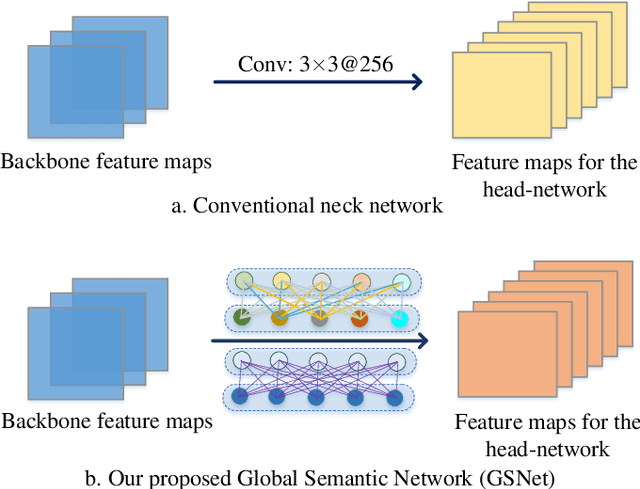
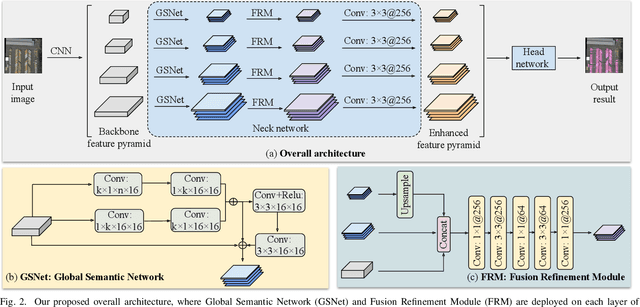
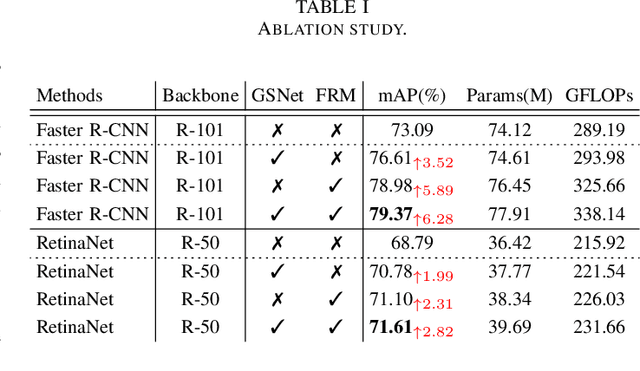
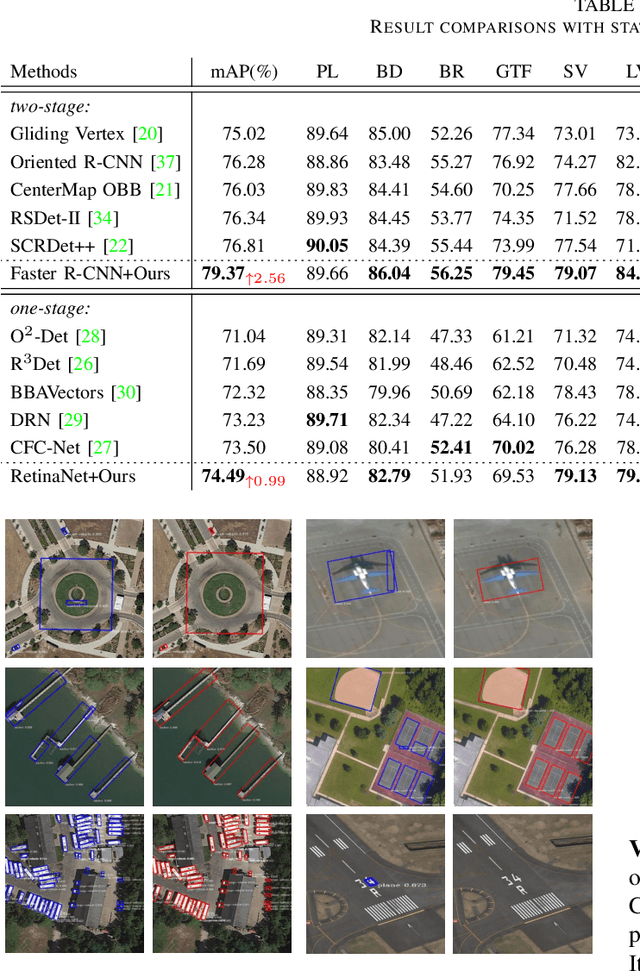
Object detection in aerial images is a fundamental research topic in the domain of geoscience and remote sensing. However, advanced progresses on this topic are mainly focused on the designment of backbone networks or header networks, but surprisingly ignored the neck ones. In this letter, we first analyse the importance of the neck network in object detection frameworks from the theory of information bottleneck. Then, to alleviate the information loss problem in the current neck network, we propose a global semantic network, which acts as a bridge from the backbone to the head network in a bidirectional global convolution manner. Compared to the existing neck networks, our method has advantages of capturing rich detailed information and less computational costs. Moreover, we further propose a fusion refinement module, which is used for feature fusion with rich details from different scales. To demonstrate the effectiveness and efficiency of our method, experiments are carried out on two challenging datasets (i.e., DOTA and HRSC2016). Results in terms of accuracy and computational complexity both can verify the superiority of our method.