 Add to Chrome
 Add to Firefox
 Add to Edge
High-dimensional online learning via asynchronous decomposition: Non-divergent results, dynamic regularization, and beyond
Mar 21, 2026
Existing high-dimensional online learning methods often face the challenge that their error bounds, or per-batch sample sizes, diverge as the number of data batches increases. To address this issue, we propose an asynchronous decomposition framework that leverages summary statistics to construct a surrogate score function for current-batch learning. This framework is implemented via a dynamic-regularized iterative hard thresholding algorithm, providing a computationally and memory-efficient solution for sparse online optimization. We provide a unified theoretical analysis that accounts for both the streaming computational error and statistical accuracy, establishing that our estimator maintains non-divergent error bounds and $\ell_0$ sparsity across all batches. Furthermore, the proposed estimator adaptively achieves additional gains as batches accumulate, attaining the oracle accuracy as if the entire historical dataset were accessible and the true support were known. These theoretical properties are further illustrated through an example of the generalized linear model.

The Optimality of Kernel Classifiers in Sobolev Space
Feb 02, 2024

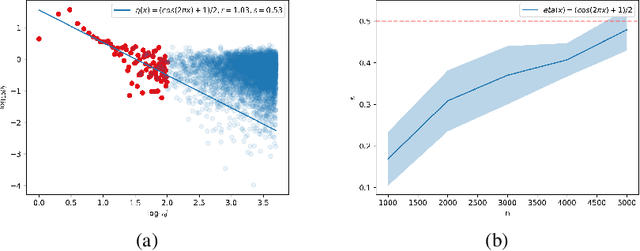
Kernel methods are widely used in machine learning, especially for classification problems. However, the theoretical analysis of kernel classification is still limited. This paper investigates the statistical performances of kernel classifiers. With some mild assumptions on the conditional probability $\eta(x)=\mathbb{P}(Y=1\mid X=x)$, we derive an upper bound on the classification excess risk of a kernel classifier using recent advances in the theory of kernel regression. We also obtain a minimax lower bound for Sobolev spaces, which shows the optimality of the proposed classifier. Our theoretical results can be extended to the generalization error of overparameterized neural network classifiers. To make our theoretical results more applicable in realistic settings, we also propose a simple method to estimate the interpolation smoothness of $2\eta(x)-1$ and apply the method to real datasets.