 Add to Chrome
 Add to Firefox
 Add to Edge
Adversarial Contamination Meets Hard Thresholding: An Iterative Algorithm with Signal Adaptivity and Minimax Optimality
Jun 26, 2026
Pervasive data contamination -- stemming from measurement errors, outliers, or adversarial corruption -- has motivated the development of robust statistical methods. In this context, we propose a two-stage Adversarial Contamination-resistant Iterative Hard Thresholding (AC-IHT) algorithm for high-dimensional regression with contamination. Our nonconvex algorithm achieves minimax near-optimal (up to logarithmic terms) estimation by iteratively updating the coefficient vector and the contamination vector with different thresholding scales. We further demonstrate that our AC-IHT estimator is signal-adaptive: under proper signal conditions, it adaptively attains a sharper estimation rate and more accurate support recovery. Moreover, it enjoys the strong oracle property, laying a theoretical foundation for asymptotic inference. Numerical experiments confirm its superior finite-sample performance. Finally, we discuss theoretical extensions of the proposed procedure to generalized linear models and to heavy-tailed noise settings.

High-dimensional online learning via asynchronous decomposition: Non-divergent results, dynamic regularization, and beyond
Mar 21, 2026Existing high-dimensional online learning methods often face the challenge that their error bounds, or per-batch sample sizes, diverge as the number of data batches increases. To address this issue, we propose an asynchronous decomposition framework that leverages summary statistics to construct a surrogate score function for current-batch learning. This framework is implemented via a dynamic-regularized iterative hard thresholding algorithm, providing a computationally and memory-efficient solution for sparse online optimization. We provide a unified theoretical analysis that accounts for both the streaming computational error and statistical accuracy, establishing that our estimator maintains non-divergent error bounds and $\ell_0$ sparsity across all batches. Furthermore, the proposed estimator adaptively achieves additional gains as batches accumulate, attaining the oracle accuracy as if the entire historical dataset were accessible and the true support were known. These theoretical properties are further illustrated through an example of the generalized linear model.
Pre-training and in-context learning IS Bayesian inference a la De Finetti
Aug 06, 2024


Accurately gauging uncertainty on the underlying environment is a longstanding goal of intelligent systems. We characterize which latent concepts pre-trained sequence models are naturally able to reason with. We go back to De Finetti's predictive view of Bayesian reasoning: instead of modeling latent parameters through priors and likelihoods like topic models do, De Finetti has long advocated for modeling exchangeable (permutation invariant) sequences of observables. According to this view, pre-training autoregressive models formulates informed beliefs based on prior observations ("empirical Bayes"), and forward generation is a simulated instantiation of an environment ("posterior inference"). This connection allows extending in-context learning (ICL) beyond predictive settings, highlighting sequence models' ability to perform explicit statistical inference. In particular, we show the sequence prediction loss over exchangeable documents controls performance on downstream tasks where uncertainty quantification is key. Empirically, we propose and demonstrate several approaches for encoding exchangeability in sequence model architectures: data augmentation, regularization, and causal masking.
Variational Pseudo Marginal Methods for Jet Reconstruction in Particle Physics
Jun 05, 2024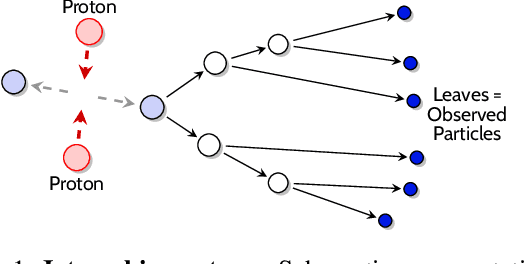

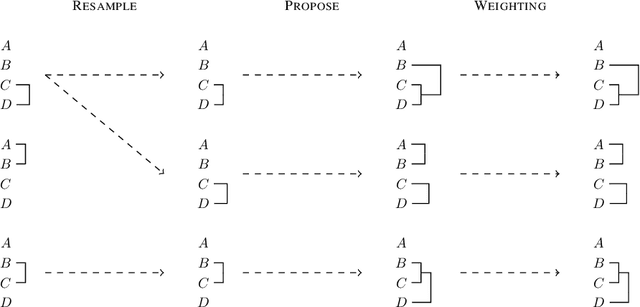
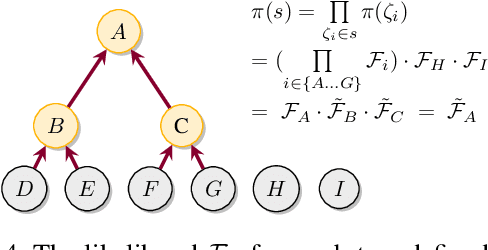
Reconstructing jets, which provide vital insights into the properties and histories of subatomic particles produced in high-energy collisions, is a main problem in data analyses in collider physics. This intricate task deals with estimating the latent structure of a jet (binary tree) and involves parameters such as particle energy, momentum, and types. While Bayesian methods offer a natural approach for handling uncertainty and leveraging prior knowledge, they face significant challenges due to the super-exponential growth of potential jet topologies as the number of observed particles increases. To address this, we introduce a Combinatorial Sequential Monte Carlo approach for inferring jet latent structures. As a second contribution, we leverage the resulting estimator to develop a variational inference algorithm for parameter learning. Building on this, we introduce a variational family using a pseudo-marginal framework for a fully Bayesian treatment of all variables, unifying the generative model with the inference process. We illustrate our method's effectiveness through experiments using data generated with a collider physics generative model, highlighting superior speed and accuracy across a range of tasks.