 Add to Chrome
 Add to Firefox
 Add to Edge
Learning Curves and Benign Overfitting of Spectral Algorithms in Large Dimensions
Apr 25, 2026
Existing large-dimensional theory for spectral algorithms resolves either the optimally tuned point or the interpolation limit, but leaves the under-regularized regime unexplored. We study the learning curve and benign overfitting of spectral algorithms in the large-dimensional setting where the sample size and dimension are of comparable order, i.e., $n \asymp d^γ$ for some $γ>0$. We first consider inner-product kernels on the sphere $\mathbb{S}^{d-1}$ and establish a sharp asymptotic characterization of the excess risk across the full regularization path under various source conditions $s \geq 0$, where $s$ measures the relative smoothness of the regression function. Our results reveal that the learning curve is not simply U-shaped but instead consists of three distinct regimes: over-regularized, under-regularized, and interpolation regimes. This characterization allows us to fully capture the benign overfitting phenomenon, demonstrating that benign overfitting arises consistently across both the under-regularized and interpolation regimes whenever $s$ is positive but no larger than a critical threshold. We further show that, in the sufficiently regularized regime, the kernel learning curve is recovered by an associated sequence model. Finally, we extend the learning-curve analysis to large-dimensional KRR for a class of kernels on general domains in $\mathbb{R}^d$ whose low-degree eigenspaces satisfy spectral-scaling and hyper-contractivity conditions.

The Optimality of Kernel Classifiers in Sobolev Space
Feb 02, 2024

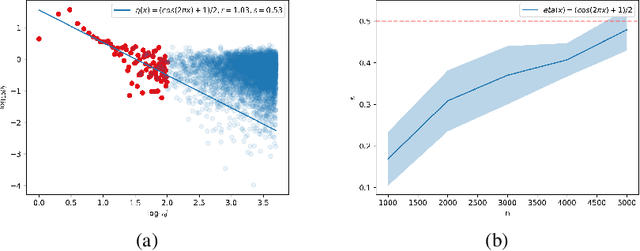
Kernel methods are widely used in machine learning, especially for classification problems. However, the theoretical analysis of kernel classification is still limited. This paper investigates the statistical performances of kernel classifiers. With some mild assumptions on the conditional probability $\eta(x)=\mathbb{P}(Y=1\mid X=x)$, we derive an upper bound on the classification excess risk of a kernel classifier using recent advances in the theory of kernel regression. We also obtain a minimax lower bound for Sobolev spaces, which shows the optimality of the proposed classifier. Our theoretical results can be extended to the generalization error of overparameterized neural network classifiers. To make our theoretical results more applicable in realistic settings, we also propose a simple method to estimate the interpolation smoothness of $2\eta(x)-1$ and apply the method to real datasets.