 Add to Chrome
 Add to Firefox
 Add to Edge
R$^2$Energy: A Large-Scale Benchmark for Robust Renewable Energy Forecasting under Diverse and Extreme Conditions
Feb 17, 2026
The rapid expansion of renewable energy, particularly wind and solar power, has made reliable forecasting critical for power system operations. While recent deep learning models have achieved strong average accuracy, the increasing frequency and intensity of climate-driven extreme weather events pose severe threats to grid stability and operational security. Consequently, developing robust forecasting models that can withstand volatile conditions has become a paramount challenge. In this paper, we present R$^2$Energy, a large-scale benchmark for NWP-assisted renewable energy forecasting. It comprises over 10.7 million high-fidelity hourly records from 902 wind and solar stations across four provinces in China, providing the diverse meteorological conditions necessary to capture the wide-ranging variability of renewable generation. We further establish a standardized, leakage-free forecasting paradigm that grants all models identical access to future Numerical Weather Prediction (NWP) signals, enabling fair and reproducible comparison across state-of-the-art representative forecasting architectures. Beyond aggregate accuracy, we incorporate regime-wise evaluation with expert-aligned extreme weather annotations, uncovering a critical ``robustness gap'' typically obscured by average metrics. This gap reveals a stark robustness-complexity trade-off: under extreme conditions, a model's reliability is driven by its meteorological integration strategy rather than its architectural complexity. R$^2$Energy provides a principled foundation for evaluating and developing forecasting models for safety-critical power system applications.

Unveiling the Power of Noise Priors: Enhancing Diffusion Models for Mobile Traffic Prediction
Jan 23, 2025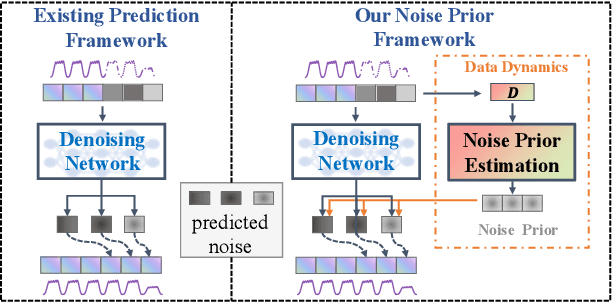

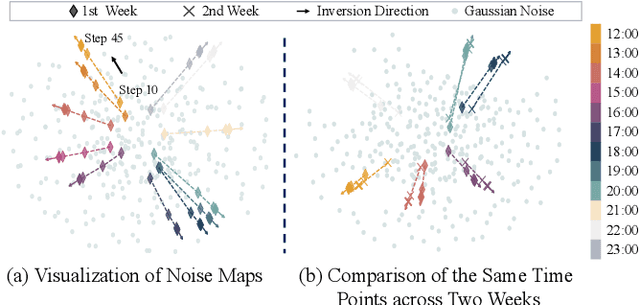
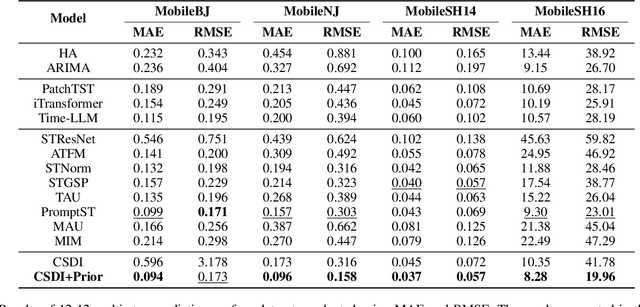
Accurate prediction of mobile traffic, \textit{i.e.,} network traffic from cellular base stations, is crucial for optimizing network performance and supporting urban development. However, the non-stationary nature of mobile traffic, driven by human activity and environmental changes, leads to both regular patterns and abrupt variations. Diffusion models excel in capturing such complex temporal dynamics due to their ability to capture the inherent uncertainties. Most existing approaches prioritize designing novel denoising networks but often neglect the critical role of noise itself, potentially leading to sub-optimal performance. In this paper, we introduce a novel perspective by emphasizing the role of noise in the denoising process. Our analysis reveals that noise fundamentally shapes mobile traffic predictions, exhibiting distinct and consistent patterns. We propose NPDiff, a framework that decomposes noise into \textit{prior} and \textit{residual} components, with the \textit{prior} derived from data dynamics, enhancing the model's ability to capture both regular and abrupt variations. NPDiff can seamlessly integrate with various diffusion-based prediction models, delivering predictions that are effective, efficient, and robust. Extensive experiments demonstrate that it achieves superior performance with an improvement over 30\%, offering a new perspective on leveraging diffusion models in this domain.