 Add to Chrome
 Add to Firefox
 Add to Edge
Target-Aware Linear Regression Under Distribution Shift
Jun 23, 2026
Distribution shift between training and deployment is a pervasive challenge for modern AI systems. In many cases, the target marginals of covariates and response are known or specified through population-level observations, boundary conditions, properties of simulator configurations, or alignment-time distributional constraints. Such knowledge may provide valuable side information for regression estimation. We study this problem in the multivariate linear regression setting with a stable conditional mean $E[Y\mid X]$ across source and target, and identify the hybrid-loss estimator, which jointly incorporates both target marginals, as a benchmark target-aware estimator. Its direct computation, however, requires solving a coupled nonlinear optimization that is expensive at scale. Our main contribution is to develop and evaluate two computationally tractable alternatives: a constrained moment-matching estimator and a two-stage estimator that augments ordinary least squares with a calibration step. For all three estimators, we derive and compare closed-form asymptotic mean squared errors, yielding conditions under which the tractable alternatives match or closely approximate the hybrid benchmark, and regimes in which they do not. Monte Carlo experiments across three controlled shift regimes validate the theoretical results, investigate the accuracy-runtime tradeoffs among the three estimators, and translate into guidance on estimator choice. In particular, the two-stage estimator nearly matches the hybrid benchmark in the high signal-to-noise regime at essentially no additional cost, providing theoretical grounding for empirical observations in nonlinear settings.

Bagged Deep Image Prior for Recovering Images in the Presence of Speckle Noise
Feb 23, 2024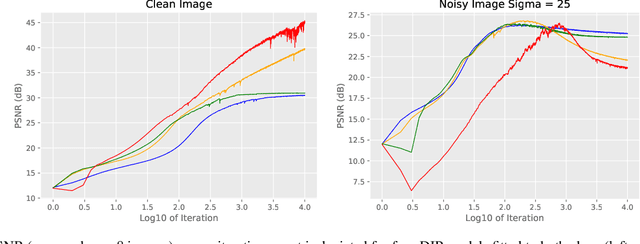
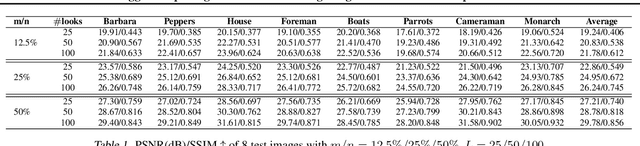
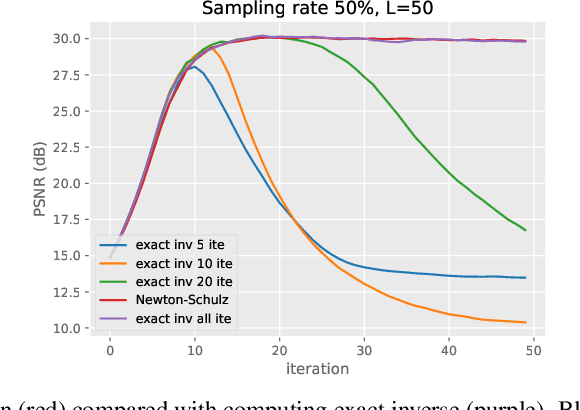
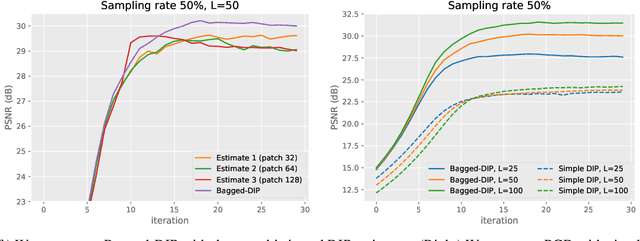
We investigate both the theoretical and algorithmic aspects of likelihood-based methods for recovering a complex-valued signal from multiple sets of measurements, referred to as looks, affected by speckle (multiplicative) noise. Our theoretical contributions include establishing the first existing theoretical upper bound on the Mean Squared Error (MSE) of the maximum likelihood estimator under the deep image prior hypothesis. Our theoretical results capture the dependence of MSE upon the number of parameters in the deep image prior, the number of looks, the signal dimension, and the number of measurements per look. On the algorithmic side, we introduce the concept of bagged Deep Image Priors (Bagged-DIP) and integrate them with projected gradient descent. Furthermore, we show how employing Newton-Schulz algorithm for calculating matrix inverses within the iterations of PGD reduces the computational complexity of the algorithm. We will show that this method achieves the state-of-the-art performance.