 Add to Chrome
 Add to Firefox
 Add to Edge
Learning Early-to-Final Solution Consistency for MILP Acceleration
Aug 20, 2026
Mixed-Integer Linear Programming (MILP) is a fundamental problem class in operations research and combinatorial optimization, with broad applications to industrial decision-making. Owing to their NP-hardness, however, modern solvers may struggle to find high-quality solutions for challenging MILP instances within practical time limits. Recent learning-based approaches seek to accelerate MILP solving by directly predicting high-quality solutions from static instance-level features, such as variable-constraint bipartite graphs. Yet accurate solution prediction from instance features alone is difficult, and these methods largely overlook the information revealed during the solver's search process. In this paper, we find that solutions produced at the early search stage of MILP solvers, which are computationally cheap to obtain, are often structurally close to the solutions found after full-budget search. Motivated by this observation, we propose a new solver-informed paradigm that shifts the learning target from variable assignment to early-to-final consistency: for each variable, we predict whether its early-stage assignment should persist in full-budget solutions. The predicted consistency naturally guides downstream search, for instance by fixing the assignments deemed consistent. At inference time, we further ensemble consistency predictions across multiple early-stage solutions to improve robustness. Experiments across four MILP benchmarks show our method improves prediction-guided search across diverse downstream pipelines. With Gurobi, our proposed method reduces the primal gap by 56.9% on average and closes it completely on combinatorial auction instances. Besides, we transferred the Gurobi-trained model zero-shot to SCIP without adaptation, achieving a 36.4% average gap reduction across benchmarks.

Str-L Pose: Integrating Point and Structured Line for Relative Pose Estimation in Dual-Graph
Aug 28, 2024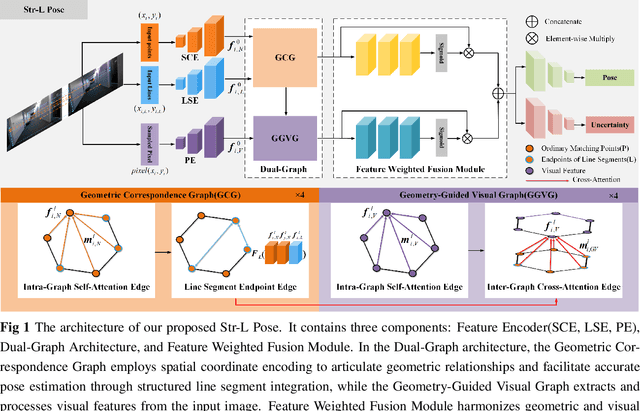
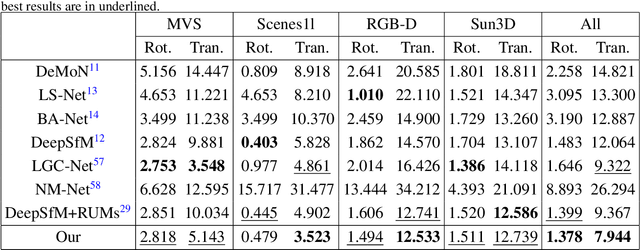
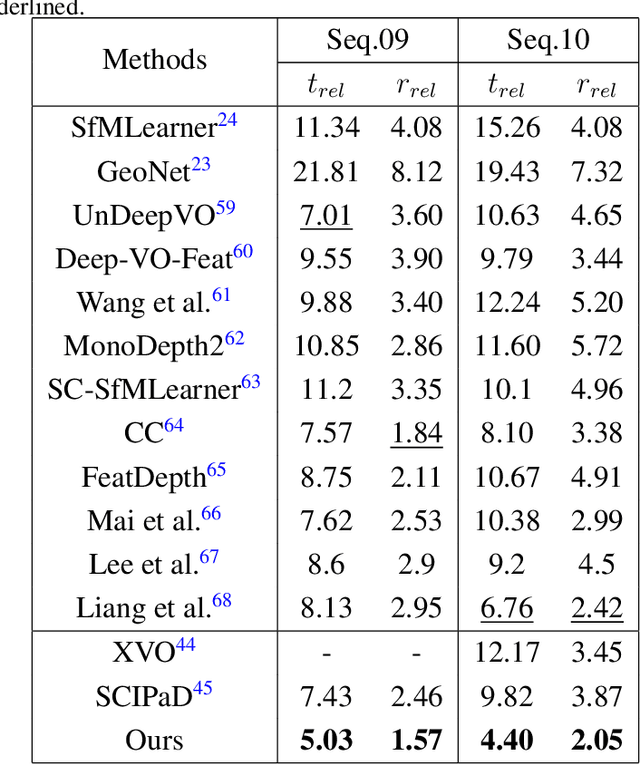
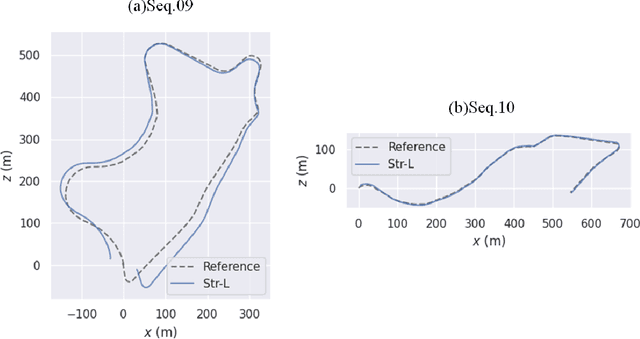
Relative pose estimation is crucial for various computer vision applications, including Robotic and Autonomous Driving. Current methods primarily depend on selecting and matching feature points prone to incorrect matches, leading to poor performance. Consequently, relying solely on point-matching relationships for pose estimation is a huge challenge. To overcome these limitations, we propose a Geometric Correspondence Graph neural network that integrates point features with extra structured line segments. This integration of matched points and line segments further exploits the geometry constraints and enhances model performance across different environments. We employ the Dual-Graph module and Feature Weighted Fusion Module to aggregate geometric and visual features effectively, facilitating complex scene understanding. We demonstrate our approach through extensive experiments on the DeMoN and KITTI Odometry datasets. The results show that our method is competitive with state-of-the-art techniques.