 Add to Chrome
 Add to Firefox
 Add to Edge
DynTrace: Tracking Dynamic Object Evidence for 4D Spatio-Temporal Reasoning in MLLMs
Jul 14, 2026
4D spatio-temporal reasoning, jointly modeling 3D spatial structure and temporal evolution, is essential for understanding dynamic worlds and enabling embodied interaction. While current Multimodal Large Language Models (MLLMs) show strong capabilities in static scene understanding and coarse-grained 4D tasks, they still have notable limitations in continuous dynamic scene perception, especially in tracking dynamic object evidence for coherent 4D spatio-temporal reasoning. This shortcoming stems mainly from relying on sparse frame-level observations, fragmenting continuous dynamic cues and leaving models unable to disentangle genuine object dynamics from camera-induced apparent motion. Inspired by humans tracking dynamic cues while compensating for viewpoint changes, we propose DynTrace, a training-free framework for 4D spatio-temporal reasoning with two complementary components. Dynamic Trajectory Visualization (DTV) reprojects world-coordinate trajectories onto the image plane, providing geometry-informed visual priors that disentangle genuine object dynamics from camera-induced apparent motion. Meanwhile, the Dynamic Trace Token (DT-Token), organized into a Dynamic Trace Graph (DTG), tracks object-level dynamic cues, trace evolution, and key moments, maintaining continuous dynamic object evidence for coherent 4D reasoning. Together, these two components equip MLLMs with continuously tracked dynamic object evidence, grounded in geometry-informed visual priors and structured spatio-temporal traces. DynTrace consistently improves open-source MLLMs, achieving state-of-the-art results on Dyn-Bench, VLM4D, and DSI-Bench, validating the importance of tracking dynamic object evidence for robust 4D spatio-temporal reasoning.

Valid Explanations for Learning to Rank Models
May 17, 2020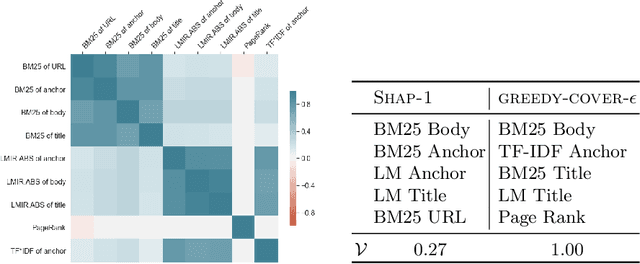
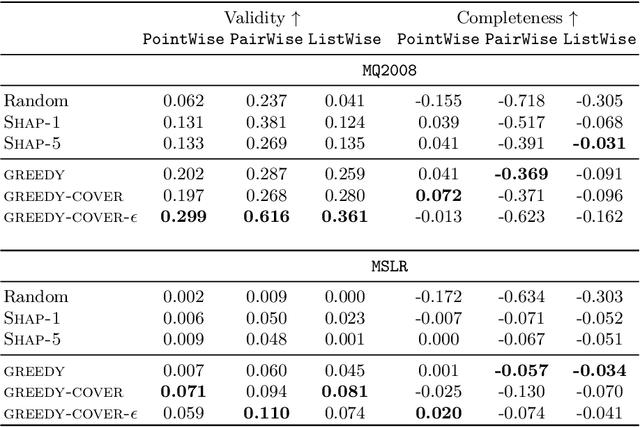
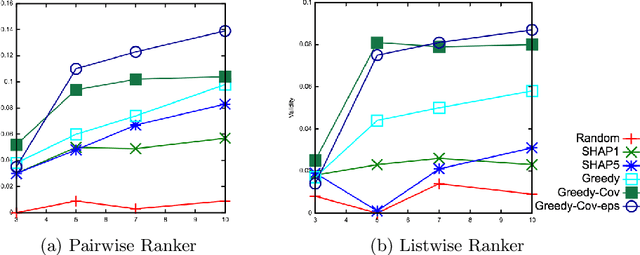
Learning-to-rank (LTR) is a class of supervised learning techniques that apply to ranking problems dealing with a large number of features. The popularity and widespread application of LTR models in prioritizing information in a variety of domains makes their scrutability vital in today's landscape of fair and transparent learning systems. However, limited work exists that deals with interpreting the decisions of learning systems that output rankings. In this paper we propose a model agnostic local explanation method that seeks to identify a small subset of input features as explanation to a ranking decision. We introduce new notions of validity and completeness of explanations specifically for rankings, based on the presence or absence of selected features, as a way of measuring goodness. We devise a novel optimization problem to maximize validity directly and propose greedy algorithms as solutions. In extensive quantitative experiments we show that our approach outperforms other model agnostic explanation approaches across pointwise, pairwise and listwise LTR models in validity while not compromising on completeness.