 Add to Chrome
 Add to Firefox
 Add to Edge
Geometry Reinforced Efficient Attention Tuning Equipped with Normals for Robust Stereo Matching
Apr 10, 2026
Despite remarkable advances in image-driven stereo matching over the past decade, Synthetic-to-Realistic Zero-Shot (Syn-to-Real) generalization remains an open challenge. This suboptimal generalization performance mainly stems from cross-domain shifts and ill-posed ambiguities inherent in image textures, particularly in occluded, textureless, repetitive, and non-Lambertian (specular/transparent) regions. To improve Syn-to-Real generalization, we propose GREATEN, a framework that incorporates surface normals as domain-invariant, object-intrinsic, and discriminative geometric cues to compensate for the limitations of image textures. The proposed framework consists of three key components. First, a Gated Contextual-Geometric Fusion (GCGF) module adaptively suppresses unreliable contextual cues in image features and fuses the filtered image features with normal-driven geometric features to construct domain-invariant and discriminative contextual-geometric representations. Second, a Specular-Transparent Augmentation (STA) strategy improves the robustness of GCGF against misleading visual cues in non-Lambertian regions. Third, sparse attention designs preserve the fine-grained global feature extraction capability of GREAT-Stereo for handling occlusion and texture-related ambiguities while substantially reducing computational overhead, including Sparse Spatial (SSA), Sparse Dual-Matching (SDMA), and Simple Volume (SVA) attentions. Trained exclusively on synthetic data such as SceneFlow, GREATEN-IGEV achieves outstanding Syn-to-Real performance. Specifically, it reduces errors by 30% on ETH3D, 8.5% on the non-Lambertian Booster, and 14.1% on KITTI-2015, compared to FoundationStereo, Monster-Stereo, and DEFOM-Stereo, respectively. In addition, GREATEN-IGEV runs 19.2% faster than GREAT-IGEV and supports high-resolution (3K) inference on Middlebury with disparity ranges up to 768.

Global Regulation and Excitation via Attention Tuning for Stereo Matching
Sep 19, 2025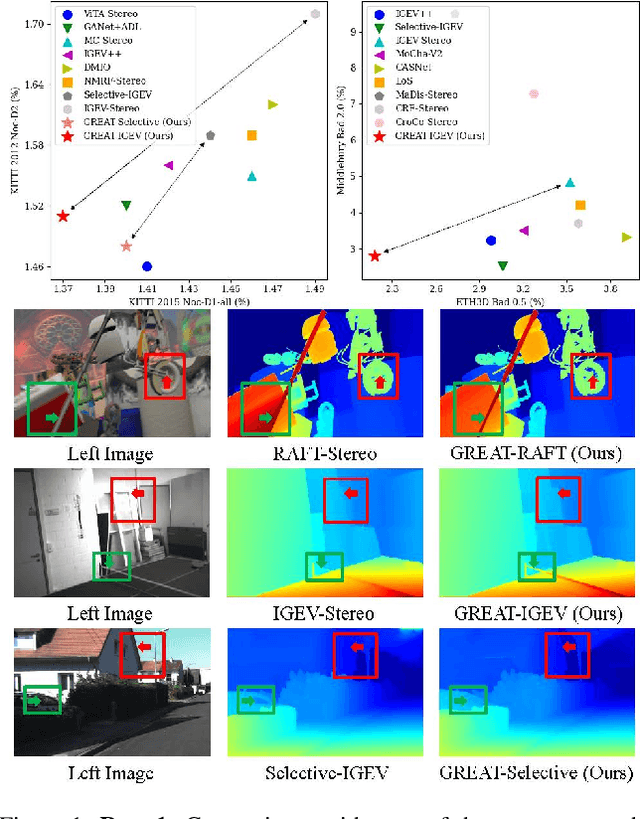
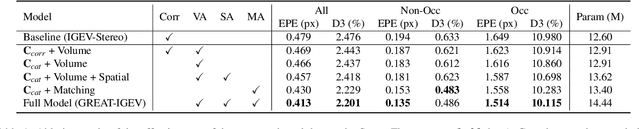
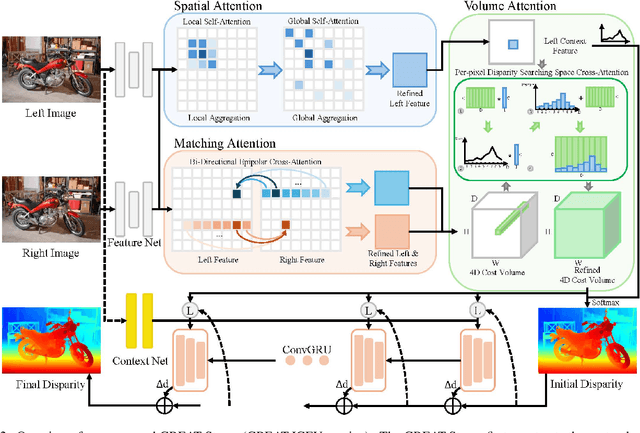
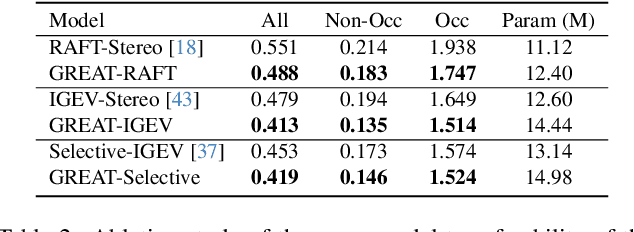
Stereo matching achieves significant progress with iterative algorithms like RAFT-Stereo and IGEV-Stereo. However, these methods struggle in ill-posed regions with occlusions, textureless, or repetitive patterns, due to a lack of global context and geometric information for effective iterative refinement. To enable the existing iterative approaches to incorporate global context, we propose the Global Regulation and Excitation via Attention Tuning (GREAT) framework which encompasses three attention modules. Specifically, Spatial Attention (SA) captures the global context within the spatial dimension, Matching Attention (MA) extracts global context along epipolar lines, and Volume Attention (VA) works in conjunction with SA and MA to construct a more robust cost-volume excited by global context and geometric details. To verify the universality and effectiveness of this framework, we integrate it into several representative iterative stereo-matching methods and validate it through extensive experiments, collectively denoted as GREAT-Stereo. This framework demonstrates superior performance in challenging ill-posed regions. Applied to IGEV-Stereo, among all published methods, our GREAT-IGEV ranks first on the Scene Flow test set, KITTI 2015, and ETH3D leaderboards, and achieves second on the Middlebury benchmark. Code is available at https://github.com/JarvisLee0423/GREAT-Stereo.