 Add to Chrome
 Add to Firefox
 Add to Edge
Rethinking Depth Pruning for Vision Transformers: A Heterogeneity-Aware Perspective
Jul 04, 2026
While prior studies have successfully compressed vision Transformers (ViTs) through various pruning techniques, most have concentrated on width pruning to achieve significant reductions in model size. Depth pruning, which removes entire layers from a ViT, is notoriously difficult for accuracy recovery despite its potential to deliver higher speedups, limiting the acceleration achieved by existing joint width-and-depth pruning methods. In this work, we reveal that the failure of existing depth pruning methods lies in their neglect of heterogeneity between different layers, and we introduce HetDPT, a heterogeneity-aware depth pruning method that avoids dimension mismatch. Comprehensive experiments on ImageNet-1K, CIFAR-100, COCO, and ADE20K validate our method: HetDPT achieves a 1.58$\times$ speedup for DeiT-B while maintaining accuracy and a 1.39$\times$ speedup for DeiT-S with nearly no accuracy degradation. Furthermore, when combined with width pruning, HetDPT+ sets a new state-of-the-art record in extreme ViT pruning, enhancing the acceleration ratio from 4.24$\times$ to 5.19$\times$ for the Isomorphic-Pruning-2.6G configuration while maintaining near-lossless accuracy; our code is available at https://github.com/Efficient-AI-for-All/HetDPT.

Beyond 2:4: exploring V:N:M sparsity for efficient transformer inference on GPUs
Oct 21, 2024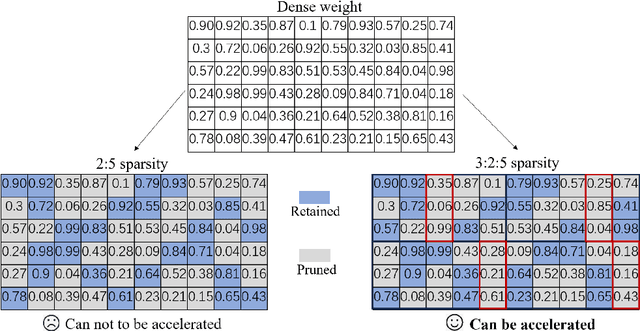
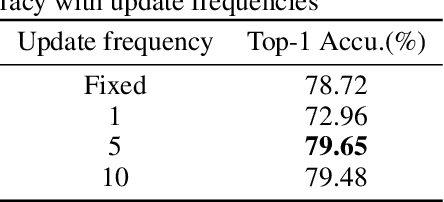
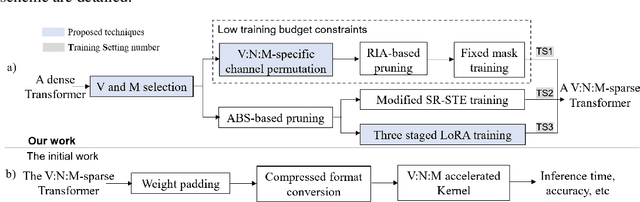
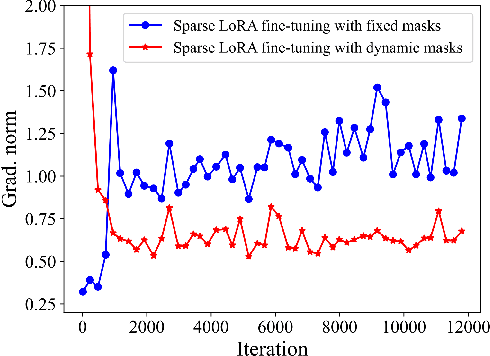
To date, 2:4 sparsity has stood as the only sparse pattern that can be accelerated using sparse tensor cores on GPUs. In practice, 2:4 sparsity often possesses low actual speedups ($\leq 1.3$) and requires fixed sparse ratios, meaning that other ratios, such as 4:8, 8:16, or those exceeding 50% sparsity, do not incur any speedups on GPUs. Recent studies suggest that V:N:M sparsity is promising in addressing these limitations of 2:4 sparsity. However, regarding accuracy, the effects of V:N:M sparsity on broader Transformer models, such as vision Transformers and large language models (LLMs), are largely unexamined. Moreover, Some specific issues related to V:N:M sparsity, such as how to select appropriate V and M values, remain unresolved. In this study, we thoroughly investigate the application of V:N:M sparsity in vision models and LLMs across multiple tasks, from pertaining to downstream tasks. We propose three key approaches to enhance the applicability and accuracy of V:N:M-sparse Transformers, including heuristic V and M selection, V:N:M-specific channel permutation, and three-staged LoRA training techniques. Experimental results show that, with our methods, the DeiT-small achieves lossless accuracy at 64:2:5 sparsity, while the DeiT-base maintains accuracy even at 64:2:8 sparsity. In addition, the fine-tuned LLama2-7B at 64:2:5 sparsity performs comparably or better than training-free 2:4 sparse alternatives on downstream tasks. More importantly, V:N:M-sparse Transformers offer a wider range of speedup-accuracy trade-offs compared to 2:4 sparsity. Overall, our exploration largely facilitates the V:N:M sparsity to act as a truly effective acceleration solution for Transformers in cost-sensitive inference scenarios.