 Add to Chrome
 Add to Firefox
 Add to Edge
Beyond Similarity: Grounded Agentic Extraction and Expert-Adjudicated Evaluation of Intertextuality in Classical Chinese Histories
Jul 30, 2026
Computational approaches to intertextuality have advanced from string matching to neural retrieval, yet their outputs, similarity scores and parallel-passage lists, identify where texts reuse one another without characterizing how or why. We recast fine-grained intertextuality extraction as an agentic task in which a large language model (LLM) reads two text units in full and, through a constrained tool interface, must ground each proposed reuse in exact character spans on both sides and label it under a five-dimension typology of reuse (form, aspect, source-marking, function, stance). We validate the approach on an exhaustive comparison of the Analects with the Book of Han, where three domain experts adjudicate a pooled multi-model candidate set into a benchmark of 2,533 intertextual pairs. Against this standard we study twelve LLMs, reporting precision (56%-93%), a 51$\times$ cost spread at comparable quality, and how well their confidence is calibrated. Expert agreement traces a reliability gradient: dimensions legible on the textual surface are annotated consistently, while those requiring inference of intent are contested, delimiting the claims such annotation supports. Scaling the validated extractor to the full Twenty-Four Histories (65,380 comparisons, 5,766 pairs) recovers corpus-level structure a similarity score cannot express. The interpretive composition of citation shows no systematic change across eighteen centuries, yet the same passage is quoted less and less literally. Stability in the aggregate with drift in the individual case is what a cultural-attraction account expects. We release the extraction protocol and the expert-adjudicated benchmark.

Kimi K3: Open Frontier Intelligence
Jul 27, 2026We introduce Kimi K3, a 2.8T parameter Mixture-of-Experts model with 104 billion activated parameters, native vision capabilities, and a 1-million-token context window. Kimi K3 is built on Kimi Delta Attention and Attention Residuals, which improve information flow across sequence length and model depth. Together with Stable LatentMoE, which effectively activates 16 of 896 routed experts per token, and refined training and data recipes, these advances yield an approximately 2.5x improvement in overall scaling efficiency over Kimi K2. Post-training highlights reinforcement learning across general, agentic, and coding domains and multiple reasoning-effort levels, enabling compositional generalization and robust long-horizon execution. At 2.8T scale, Kimi K3 is supported by infrastructure advances in multiple areas: algorithm-system co-design for KDA, perfectly balanced expert-parallel training with efficient memory management, million-token agentic RL with persistent rollout and sandbox states, and deployment innovations. Extensive evaluations show that Kimi K3 achieves frontier-level performance across long-horizon coding, agentic, knowledge, reasoning, and vision tasks. While its overall performance still trails the most powerful proprietary models, namely Claude Fable 5 and GPT-5.6 Sol, Kimi K3 consistently outperforms other open and proprietary models evaluated in our suite. We release the full Kimi K3 model weights to facilitate future research and accelerate the broader deployment and adoption of frontier intelligence.
Confidence-Aware Automated Assessment of Student-Drawn Scientific Models
Jun 18, 2026Student-generated drawings are widely used in science education to assess learners' conceptual understanding in modeling-based tasks aligned with the Next Generation Science Standards (NGSS). However, scoring such drawings requires expert human judgment to interpret complex visual representations, making large-scale assessment costly to implement and sustain in classroom settings. In this work, we study automated scoring of student-generated scientific drawings using a vision-based model. We evaluate a Vision Transformer (ViT) with parameter-efficient adaptation and propose a confidence-aware scoring framework that derives response-level confidence from test-time predictive distributions. This confidence signal enables selective automation by scoring high-confidence responses automatically while deferring uncertain cases for human review. Experiments on six NGSS-aligned middle school assessment items show that the proposed approach improves scoring reliability while supporting a practical trade-off between automated coverage and scoring risk, highlighting the value of confidence-aware methods for trustworthy educational assessment.
ArguAgent: AI-Supported Real-Time Grouping for Productive Argumentation in STEM Classrooms
Apr 25, 2026Argumentation is a core practice in STEM education, but its productivity depends on who participates and how they interact. Higher-achieving students often dominate the talk and decision-making, while lower-achieving peers may disengage, defer, or comply without contributing substantive reasoning. Forming groups strategically based on students' stances and argumentation skills could help foster inclusive, evidence-based discourse. In practice, however, teachers are constrained in implementing this grouping strategy because it requires real-time insight into students' positions and the quality of their argumentation, information that is difficult to assess reliably and at scale during instruction. We present a generative AI-powered system, ArguAgent, that creates groups optimizing for stance heterogeneity while constraining argumentation quality differences to +/-1 level on a validated learning progression. ArguAgent uses a two-component assessment pipeline: first scoring student arguments on a 0-4 rubric, then clustering positions via semantic analysis. We validated the scoring component against human expert consensus (Krippendorff's ααα = 0.817) using 200 expert-generated scores. Testing three OpenAI models (GPT-4o-mini, GPT-5.1, GPT-5.2) with identical calibrated prompts, we found that systematic prompt engineering informed by human disagreement analysis contributed 89% of scoring improvement (QWK: 0.531 to 0.686), while model upgrades contributed an additional 11% (QWK: 0.686 to 0.708). Simulation testing across 100 classes demonstrated that the grouping algorithm achieves 95.4% of groups that meet both design criteria, a 3.2x improvement over random assignment. These results suggest ArguAgent can enable real-time, theoretically grounded grouping that promotes productive STEM argumentation in classrooms.
* Full paper accepted to the 27th International Conference on AI in Education (AIED 2026). AIED Proceedings to be released Summer 2026
Kimi K2.5: Visual Agentic Intelligence
Feb 02, 2026We introduce Kimi K2.5, an open-source multimodal agentic model designed to advance general agentic intelligence. K2.5 emphasizes the joint optimization of text and vision so that two modalities enhance each other. This includes a series of techniques such as joint text-vision pre-training, zero-vision SFT, and joint text-vision reinforcement learning. Building on this multimodal foundation, K2.5 introduces Agent Swarm, a self-directed parallel agent orchestration framework that dynamically decomposes complex tasks into heterogeneous sub-problems and executes them concurrently. Extensive evaluations show that Kimi K2.5 achieves state-of-the-art results across various domains including coding, vision, reasoning, and agentic tasks. Agent Swarm also reduces latency by up to $4.5\times$ over single-agent baselines. We release the post-trained Kimi K2.5 model checkpoint to facilitate future research and real-world applications of agentic intelligence.
Kimi K2: Open Agentic Intelligence
Jul 28, 2025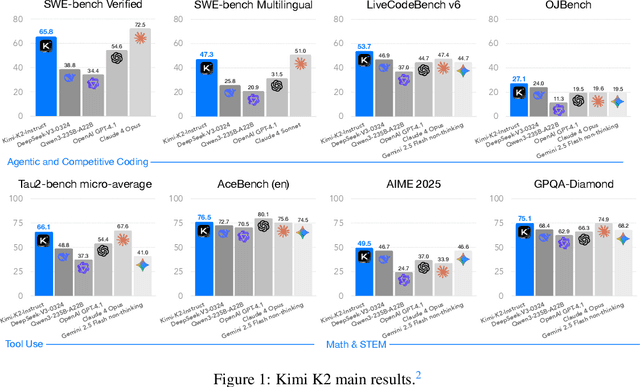
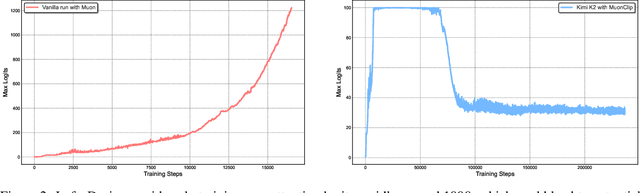
We introduce Kimi K2, a Mixture-of-Experts (MoE) large language model with 32 billion activated parameters and 1 trillion total parameters. We propose the MuonClip optimizer, which improves upon Muon with a novel QK-clip technique to address training instability while enjoying the advanced token efficiency of Muon. Based on MuonClip, K2 was pre-trained on 15.5 trillion tokens with zero loss spike. During post-training, K2 undergoes a multi-stage post-training process, highlighted by a large-scale agentic data synthesis pipeline and a joint reinforcement learning (RL) stage, where the model improves its capabilities through interactions with real and synthetic environments. Kimi K2 achieves state-of-the-art performance among open-source non-thinking models, with strengths in agentic capabilities. Notably, K2 obtains 66.1 on Tau2-Bench, 76.5 on ACEBench (En), 65.8 on SWE-Bench Verified, and 47.3 on SWE-Bench Multilingual -- surpassing most open and closed-sourced baselines in non-thinking settings. It also exhibits strong capabilities in coding, mathematics, and reasoning tasks, with a score of 53.7 on LiveCodeBench v6, 49.5 on AIME 2025, 75.1 on GPQA-Diamond, and 27.1 on OJBench, all without extended thinking. These results position Kimi K2 as one of the most capable open-source large language models to date, particularly in software engineering and agentic tasks. We release our base and post-trained model checkpoints to facilitate future research and applications of agentic intelligence.