 Add to Chrome
 Add to Firefox
 Add to Edge
Video2Sim2Real: Full-Stack Autonomous Dexterous Skill Acquisition from a Single Human Video
Jun 07, 2026
Human manipulation videos are a convenient and intuitive source for robot learning. However, directly transferring human dexterity to robots remains challenging due to perception errors and embodiment gap. To address this, we introduce Video2Sim2Real, a full-stack framework for autonomous skill acquisition from a single human manipulation video. Our framework first uses off-the-shelf foundation models to reconstruct a simulator-ready digital twin and extract robot and object motion priors. Rather than treating the extracted robot motion as a reliable reference throughout execution, our key idea is to recover and leverage the most fundamental sources of supervision from the demonstrated skill: We identify object-centric keyframes to optimize the corresponding robot configurations using object information from the simulator, and use these configurations as anchors that refine the robot motion such that it ultimately has the desired impact on the environment. To bridge the remaining sim-to-real gap, we introduce a sim-to-real strategy that decouples robustness to noisy and incomplete perception from variations in hand-object interaction dynamics. Specifically, we learn to recalibrate robot configurations from noisy real-world point clouds via IL, and leverage residual RL to perform local finger-level adaptations to ensure for robust and effective interactions. Finally, a collision-aware motion planning module enables spatial generalization to novel object configurations. Across several everyday manipulation tasks, Video2Sim2Real improves simulated task success, safety, and trajectory coherence over numerous baselines, and achieves better sim-to-real transfer than existing techniques. These results demonstrate a promising path toward autonomous dexterous skill acquisition from human videos.

Going with the Flow: Koopman Behavioral Models as Implicit Planners for Visuo-Motor Dexterity
Feb 07, 2026There has been rapid and dramatic progress in robots' ability to learn complex visuo-motor manipulation skills from demonstrations, thanks in part to expressive policy classes that employ diffusion- and transformer-based backbones. However, these design choices require significant data and computational resources and remain far from reliable, particularly within the context of multi-fingered dexterous manipulation. Fundamentally, they model skills as reactive mappings and rely on fixed-horizon action chunking to mitigate jitter, creating a rigid trade-off between temporal coherence and reactivity. In this work, we introduce Unified Behavioral Models (UBMs), a framework that learns to represent dexterous skills as coupled dynamical systems that capture how visual features of the environment (visual flow) and proprioceptive states of the robot (action flow) co-evolve. By capturing such behavioral dynamics, UBMs can ensure temporal coherence by construction rather than by heuristic averaging. To operationalize these models, we propose Koopman-UBM, a first instantiation of UBMs that leverages Koopman Operator theory to effectively learn a unified representation in which the joint flow of latent visual and proprioceptive features is governed by a structured linear system. We demonstrate that Koopman-UBM can be viewed as an implicit planner: given an initial condition, it analytically computes the desired robot behavior while simultaneously ''imagining'' the resulting flow of visual features over the entire skill horizon. To enable reactivity and adaptation, we introduce an online replanning strategy in which the model acts as its own runtime monitor that automatically triggers replanning when predicted and observed visual flow diverge beyond a threshold. Across seven simulated tasks and two real-world tasks, we demonstrate that K-UBM matches or exceeds the performance of state-of-the-art baselines, while offering considerably faster inference, smooth execution, robustness to occlusions, and flexible replanning.
AsymDex: Leveraging Asymmetry and Relative Motion in Learning Bimanual Dexterity
Nov 20, 2024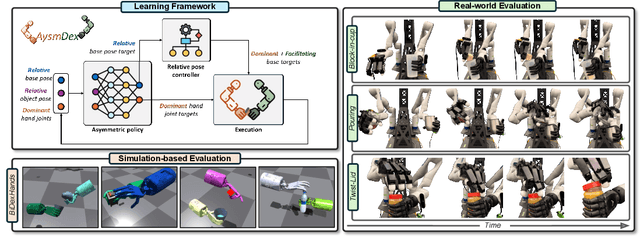

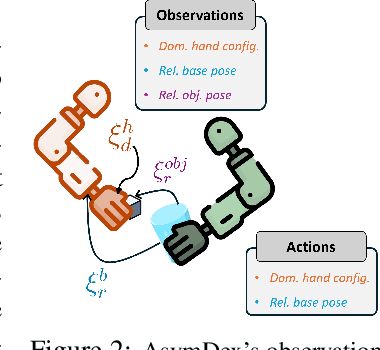
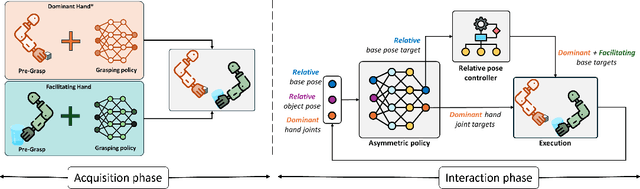
We present Asymmetric Dexterity (AsymDex), a novel reinforcement learning (RL) framework that can efficiently learn asymmetric bimanual skills for multi-fingered hands without relying on demonstrations, which can be cumbersome to collect. Two crucial ingredients enable AsymDex to reduce the observation and action space dimensions and improve sample efficiency. First, AsymDex leverages the natural asymmetry found in human bimanual manipulation and assigns specific and interdependent roles to each hand: a facilitating hand that moves and reorients the object, and a dominant hand that performs complex manipulations on said object. Second, AsymDex defines and operates over relative observation and action spaces, facilitating responsive coordination between the two hands. Further, AsymDex can be easily integrated with recent advances in grasp learning to handle both the object acquisition phase and the interaction phase of bimanual dexterity. Unlike existing RL-based methods for bimanual dexterity, which are tailored to a specific task, AsymDex can be used to learn a wide variety of bimanual tasks that exhibit asymmetry. Detailed experiments on four simulated asymmetric bimanual dexterous manipulation tasks reveal that AsymDex consistently outperforms strong baselines that challenge its design choices, in terms of success rate and sample efficiency. The project website is at https://sites.google.com/view/asymdex-2024/.
Deep Image Style Transfer from Freeform Text
Dec 13, 2022
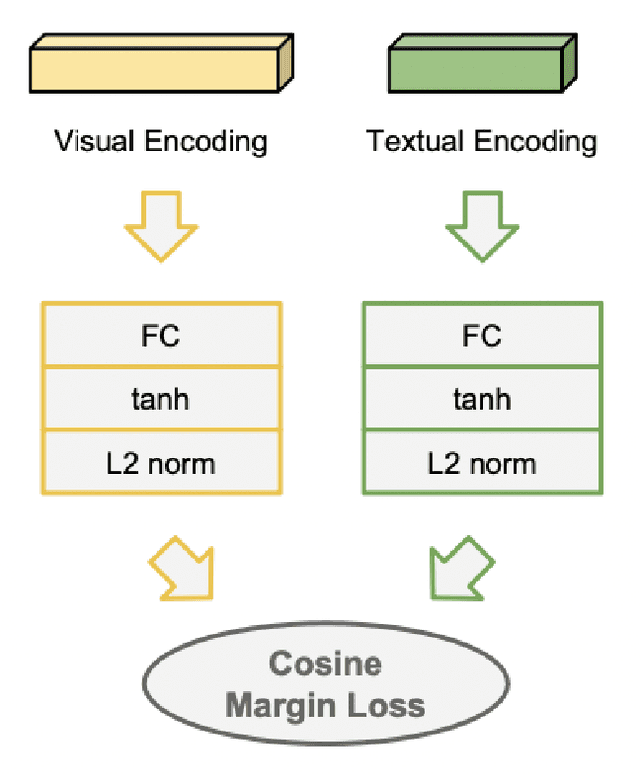

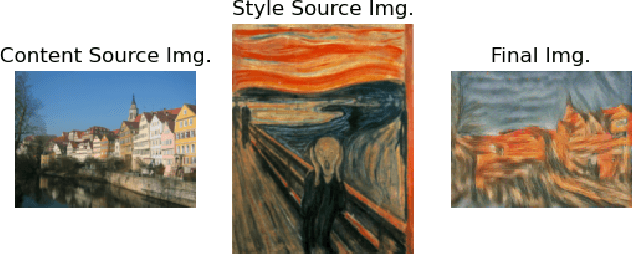
This paper creates a novel method of deep neural style transfer by generating style images from freeform user text input. The language model and style transfer model form a seamless pipeline that can create output images with similar losses and improved quality when compared to baseline style transfer methods. The language model returns a closely matching image given a style text and description input, which is then passed to the style transfer model with an input content image to create a final output. A proof-of-concept tool is also developed to integrate the models and demonstrate the effectiveness of deep image style transfer from freeform text.